Morning Coloring Before School: A 5-Minute Transition Ritual for Tense Mornings
Can 3 to 5 minutes of quiet coloring reduce the friction, rushing, and resistance that often build right before a child has to leave the house? This article is about that specific question — and that specific window.
Why school mornings overload kids faster than adults expect
Picture a typical school morning. The child is still warm from sleep. In the next 30 to 45 minutes, they have to eat, dress, find their bag, manage sensory inputs — bright lights, loud voices, a scratchy tag — and mentally prepare to enter a structured environment where they will be observed, corrected, and asked to perform for hours. That is a significant self-regulation demand. And it all starts before they leave the kitchen.
Many children who seem calm at other times struggle specifically in this window. The issue is rarely defiance. It is the weight of simultaneous transitions: from sleep to alertness, from home rules to school rules, from safe and familiar to public and unpredictable. Adults who are already dressed and caffeinated tend to underestimate how much that costs.
More talking. More instructions. More checking. When a child is already at the edge of their regulation capacity, adding verbal demands — “Did you brush your teeth? Where is your lunchbox? Why are you still in pajamas?” — can push them past it. The child is not ignoring the adult. They may simply have nothing left to respond with.
Guidance on child stress and school readiness consistently treats transition moments — not just big life changes, but daily micro-transitions — as some of the highest-friction points in a child’s day. The school entry transition is particularly loaded because it combines time pressure on the adult side with sensory and emotional preparation demands on the child’s side. Both people are operating under stress, in opposite directions.
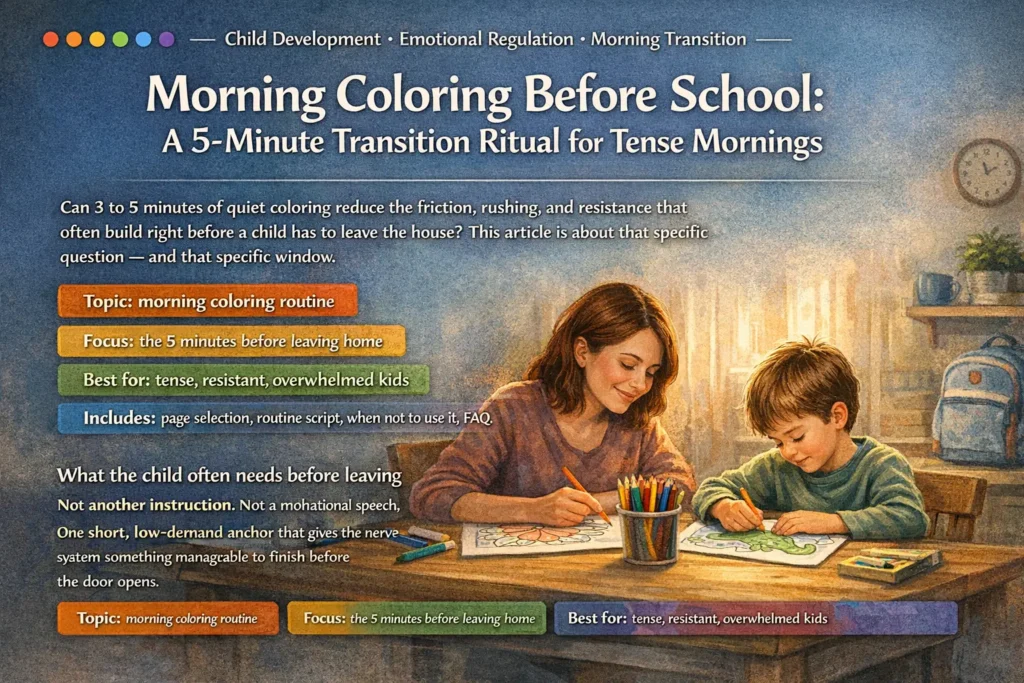
Not another instruction. Not a motivational speech. One short, low-demand anchor that gives the nervous system something manageable to finish before the door opens.
Why a tiny ritual can work better than one more talk
Parents often try to resolve morning tension the way they would resolve a conversation: by explaining, reassuring, negotiating, or motivating. For some children in some moments, that works. But when a child’s nervous system is already overloaded, adding language can make things harder, not easier. Words require processing. Processing requires attention. Attention is already low.
A short, repeatable physical activity works differently. It does not ask the child to explain how they feel or respond to how the adult feels. It gives the hands something to do, the eyes a clear task with an obvious boundary, and the body a brief window of relative stillness. That is not magic. It is just a lower-demand input at a high-demand moment.
Coloring fits this window because it has a clear visual structure, a natural stopping point, no social performance requirement, and no outcome expectation. The child does not have to finish. They do not have to create something good. They only have to begin. That low bar is exactly what makes it usable on hard mornings.
What a short coloring moment does not ask of the child
- No verbal response to an adult question
- No explanation of mood or readiness
- No negotiation about what comes next
- No performance or evaluation
- No finished product
That absence of demand is not a weakness of the activity. It is the point.
Best page types for tense mornings
Not every coloring page works equally well before school. A page that works well at bedtime — soft, detailed, complex — is often wrong in the morning. Morning pages need to match the short window and the child’s state: not fully settled, not fully alert, already moving toward the door.
| Page type | Why it works in the morning | What to avoid |
|---|---|---|
| Single large shape — one animal, one vehicle, one character | Clear boundary, easy to start, easy to stop. No search for “what to color next.” | Avoid multi-scene pages — too many decisions at once |
| Familiar theme — something the child already loves | Reduces novelty load. The child can engage without having to orient first. | Avoid pages that feel like schoolwork or require careful precision |
| Low-detail, open space — clear outlines, room to fill quickly | The child can make visible progress in 2–3 minutes. Progress feels calming. | Avoid intricate patterns or tiny sections — they create frustration, not calm |
| Pre-chosen by the child the night before | Eliminates one decision on the morning itself. The page is already there. | Avoid letting the child search for a page in the morning — it adds time and conflict |
Pages that often backfire in the morning
- Complex mandalas or mosaic patterns — require focus the child does not yet have
- Multi-character group scenes — too many choices about where to start
- Pages tied to a current emotional conflict — e.g., a page about school itself on a day the child is already resistant
- Pages the child has not seen before — novelty requires orientation, which takes time
A 5-minute before-school coloring routine
Most families do not need a complicated plan. They need a sequence short enough to fit into a real morning, predictable enough that the child knows what to expect, and low-stakes enough that skipping one day does not break it. The simpler the sequence, the more likely it will survive an actual Tuesday in November.
Predictable language reduces the child’s processing load at both ends of the activity. If the child hears the same start phrase every morning, they stop having to interpret what is being asked. The phrase becomes a signal, not a sentence. The same applies at the close. “Coloring is done. Shoes next.” is not terse — it is structurally kind. It tells the child exactly what is happening without requiring a response.
What this does NOT mean
It is worth being direct about what a 5-minute morning coloring ritual is not, because overstating its purpose makes it harder to use.
If a child is experiencing consistent school refusal, panic before school, or significant daily distress, a coloring activity is not the right primary response. Those patterns need professional attention, not a new morning habit.
A 5-minute coloring slot works best inside a morning that is already reasonably structured — consistent wake time, predictable breakfast, a clear sequence. It is one element, not the whole system.
Some children do not find any seated activity calming in the morning. Some need movement, some need quiet, some need extra time getting dressed. If coloring consistently creates more friction than it reduces, it is not the right tool for that child.
The goal is to lower the stress of a hard transition — for the child and for the adult. If it is being used as a behavior management tool or a reward-and-consequence mechanism, it will stop working as a transition buffer.
When not to use coloring before school
Coloring is useful only when it fits the child’s state and the morning’s constraints. Some mornings it is the wrong first move — and pushing it anyway usually makes things worse, not better.
| What you notice | Better first move | Why this works better | When to bring in coloring |
|---|---|---|---|
| Child is hungry, pale, or instantly overwhelmed | Food, water, no questions | Basic physical needs are still driving the behavior | After eating, once the sharpest edge comes down |
| Child is full of motor energy and cannot sit | Short movement burst — hallway laps, jumping, heavy work | Some children must discharge motion before seated regulation is possible | After 3–5 minutes, when breathing slows |
| Child looks sensory overloaded — covers ears, avoids light | Silence, dim lights, reduce clutter and talking | The nervous system needs less input before it can manage any task | Once the space feels quieter and visually simpler |
| You are already 10 minutes late | Skip coloring entirely this morning | Adding a calm activity inside a time crisis usually backfires | Tomorrow — with the page set up the night before |
| Child is having a genuine crisis — crying, shutting down | Quiet presence, lowered expectations, one gentle phrase | This state often needs co-regulation, not a task | If and when the child settles enough to engage with anything |
What progress actually looks like over time
Parents who try this often expect a visible improvement within a few days. That sometimes happens. More often, the first two weeks look inconsistent — some mornings it helps, some mornings it does not, some mornings the child refuses entirely. That is normal, and it does not mean the ritual is not working.
What to look for is not “my child is now happy every morning.” What to look for is smaller: the transition takes slightly less effort. The child sits down with slightly less resistance. The adult needs slightly fewer redirects. Morning exits are slightly less charged. Those small shifts, consistent over two to three weeks, are what progress looks like with a routine this small.
Instead: How much adult effort did the transition take? Fewer instructions, fewer redirects, a shorter gap between “time to go” and actually leaving — these are more reliable signals than the child’s visible mood.
Signs the ritual is helping
- The child sits down without being asked after 1–2 weeks of the routine
- Morning exits are slightly less combative most days
- The child asks about the page the night before, or sets it up themselves
- The transition phrase lands without a power struggle more often than it used to
Signs it is time to adjust or stop
- Coloring itself has become a source of conflict almost every morning
- The child is using it to delay — coloring far longer than 5 minutes and resisting the close
- The overall morning is not getting easier after 3–4 weeks
- A different activity — movement, quiet listening, something else — consistently works better
Routines need time to become recognizable. Most children need at least 10–14 consistent repetitions before a new sequence starts to feel predictable. If the first week is bumpy, that is the cost of establishing the pattern, not evidence that the pattern will not work.
FAQ
What if my child refuses to color in the morning?
Do not push it. Leave the page and tools out anyway. Some children will engage once the setup exists and the adult stops asking. Others will not. If refusal is consistent after two weeks, this particular ritual may not be the right fit for this child. Try a different short anchor — a simple puzzle, a quiet book, a familiar toy. The specific activity matters less than the predictability.
How early should I start this routine?
The coloring window works best about 10–15 minutes before you need to leave. Starting too early gives the child time to disengage or get absorbed. Starting too close to the door creates its own time pressure. Build the 5 minutes into the sequence — after breakfast, before shoes — so it sits in a natural gap rather than forcing its own gap.
Should I sit with my child while they color?
It depends on the child. Some children need a quiet adult nearby to feel safe enough to settle. Others do better when the adult moves away and reduces the social input. Start with low-key proximity — in the same room, doing something quiet — and reduce presence if the child is self-directing. Avoid face-to-face sitting, which can increase the pressure to talk or explain.
Can I use this with a child who is in kindergarten? Older kids?
The general approach works across a wide age range, but the page type changes. Young children (3–6) usually do best with very large shapes and simple outlines. Older children (7–11) may prefer slightly more detail but still benefit from familiar themes and an obvious stopping point. Teenagers rarely find this useful in the same form — for older kids, the same logic applies but the activity might be something else entirely: a short playlist, a brief journal, or a wordless routine they control.
What if we are always running late?
If time is the consistent problem, a 5-minute coloring slot will not survive. Before adding this, look at what is eating the time: wake-up, breakfast, lost items, clothing decisions. The ritual only works inside a morning with a small margin. Building in 8–10 minutes of buffer time earlier in the sequence is often what makes the coloring window actually available.
Is this the same as the bedtime coloring routine?
Related in format, different in purpose. Bedtime coloring is typically longer, uses softer and more detailed pages, and aims at winding the nervous system down toward sleep. Morning coloring is shorter, uses simpler pages, and aims at giving the child a brief anchor before a high-demand transition. The logic overlaps, but the implementation is different enough that the two routines do not substitute for each other.
Can coloring in the morning replace professional support?
No. A morning ritual is a practical tool for everyday tension. It is not treatment, and it is not designed to address persistent anxiety, school refusal, or emotional dysregulation that is consistent and significant. If a child’s distress before school is frequent and intense, that pattern deserves direct professional attention.
Sources (primary references)
Licensed Psychologist’s Comment: What I Actually See in Families Who Try Morning Rituals — and Where They Break Down
The conversation trap — and why parents keep falling into it
When I work with families around school transitions, one of the most common patterns I see is this: the parent senses tension in the child and responds by trying to talk it through. “What’s wrong? Are you nervous? Did something happen?” That impulse is caring and completely natural. But for many children — especially in the 5–9 age range — being asked to explain their inner state when they are already dysregulated makes things measurably worse. They do not have the words. More importantly, they do not have the bandwidth to form the words. What comes out instead is irritability, shutdown, or an argument about something unrelated — the shirt being itchy, the wrong spoon.
I often describe it to parents this way: asking a flooded nervous system to produce verbal self-reflection is like asking someone to narrate a car accident while it is happening. The capacity is not there. This is not a character flaw in the child. It is a neurological sequence.
What actually tends to work — and the age difference matters here
Short, hands-on anchors work in this window because they do not ask the child to perform. For children around 4–6, the specific anchor often matters less than the setup: the adult is calm, the materials are already there, and the child is not being questioned. A page with a big animal and three crayons is genuinely enough. For children 7–10, I find that the child having chosen the page the evening before makes a significant difference. That small act of ownership — “I picked this one, I know what I’m doing tomorrow” — seems to reduce the background anticipatory tension in ways that are hard to explain but consistent enough that I pay attention to it in sessions.
The moment where I see rituals break down most often is not in the first week — it is in weeks three and four, when parents relax the predictability. They start changing the phrase, adding commentary, asking if the child enjoyed it. The child starts using coloring to avoid the transition rather than move through it. This is worth watching for: if the child is still coloring after eight minutes, the ritual has shifted function. It is no longer a buffer — it has become an escape hatch.
What I look for when a ritual is not enough
There is a real difference between a child who is grumpy and slow most mornings — common, human, and not necessarily a clinical sign — and a child who shows physical symptoms before school several times a week. Stomachaches that clear up on weekends. Headaches that arrive on Sunday evenings. Sleep that starts breaking around Thursday. When these patterns are consistent over four to six weeks, I do not think the question is “what ritual should we try next.” The question is what specifically about school feels unsafe or unmanageable to this child, and that takes a proper conversation with a professional, not a better coloring page.
That said, I want to be direct: a well-structured morning anchor, used consistently and without pressure, can genuinely soften the hardest 10 minutes of the day for many families. Not because it solves anything deeper, but because it gives both the child and the adult something to do with the tension other than direct it at each other.