Why Adults Turn to Coloring When They Want Creativity Without an Audience
For many adults, the desire to make something has nothing to do with sharing it. It is about having a creative act that belongs entirely to them — no comments, no likes, no one asking to see the result. Coloring fits that need precisely because it asks nothing of an audience and nothing of performance.
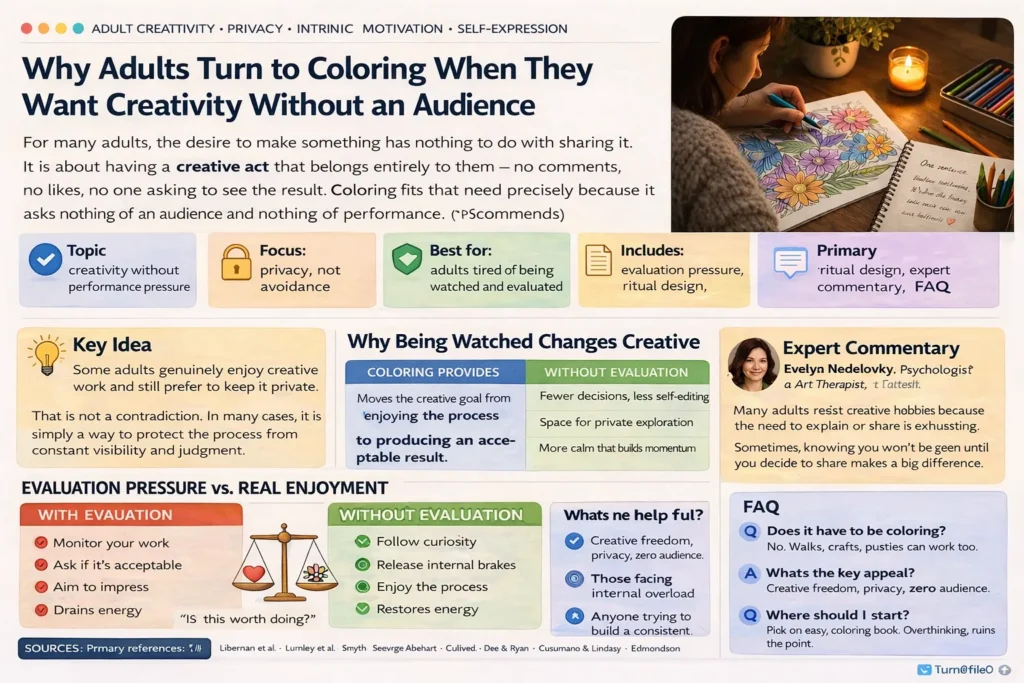
Why being watched changes creative behavior
There is a well-documented phenomenon in social psychology called evaluation apprehension: the awareness that someone is watching or judging changes how a person performs a task. In creative work, this effect is especially pronounced, because creativity already requires a degree of openness to uncertainty. When a person believes their output will be seen and assessed, they begin to self-edit before the creative act has even started.
This does not require a formal audience. A partner glancing over your shoulder. A friend who will inevitably ask, “Can I see?” A social media account that makes sharing feel like the default next step. Even the abstract possibility of being observed is enough to shift the internal experience of making something.
Research on intrinsic motivation shows that external evaluation — even positive feedback — can reduce creative engagement over time. The issue is not that praise is automatically harmful. The problem is that evaluation changes the frame of the activity: once someone is watching, their reaction becomes part of the process whether the creator wants that or not.
For adults who already spend significant parts of their day performing — presenting, replying, being visible on platforms, managing how they appear to colleagues, clients, or followers — the need for a creative act that sits completely outside that loop is not unusual. It is a reasonable response to a life lived under persistent low-level observation.
Evaluation pressure versus real enjoyment
Most adults who say they are “not creative” are not describing an absence of creative ability. They are describing a specific kind of experience: attempting something creative and immediately encountering the internal voice that asks whether it is good enough, original enough, or worth showing. That voice is evaluation pressure, and it tends to arrive early.
The problem is that evaluation pressure and genuine creative enjoyment pull in opposite directions. Enjoyment comes from flow states, from following curiosity, from making a mark and responding to it without knowing in advance where it leads. Evaluation pressure interrupts all of that. It installs a filter between impulse and action that makes the act slower, more anxious, and less satisfying.
The creator monitors their own output as if from the outside. Choices feel reversible only if they would look acceptable. Mistakes feel costly. The goal shifts toward a finished product that could be defended or shared. Energy goes toward managing appearance rather than following genuine interest.
The creator can follow the process without managing its outcome. A color that does not quite work can simply be a color. A line that goes wrong is not a failure — it is just what happened next. The act of making becomes its own reward rather than a means to an end that someone else will approve.
This helps explain why many adults who no longer describe themselves as creative still return to coloring. The task feels safer. The outlines are already there, the choices are limited, and the internal critic often stays quieter than it would in front of a blank page.
The person is not avoiding creativity. They are finding a format of creativity where the evaluative gaze — internal or external — loses most of its leverage.
Why coloring works better than open-ended art when privacy matters
Open-ended creative formats — painting, drawing, writing, or collage — all require the person to generate the starting point themselves. That generating act is where evaluation pressure most often enters. Before the pen touches paper, the question is already there: Is this idea good enough to bother with?
Coloring removes that particular doorway. The structure is already there. The question is not, “What should I make?” but, “What do I want to do within this space?” That is a smaller, less exposable question. And because it is smaller, it is easier to answer honestly rather than strategically.
This is slightly different from the usual coloring-as-self-care explanation. Yes, coloring can be calming because it is repetitive and contained. But for adults who want to make something without being observed, the real appeal is privacy. A coloring page attracts less attention than a canvas or sketchbook, so the act is easier to keep personal and easier to do without explanation.
| Format | Where evaluation pressure typically enters | What private coloring changes |
|---|---|---|
| Blank canvas or paper | At the very first mark — “Is this a good idea to begin with?” | Structure already exists; no origination pressure |
| Free drawing | Every line is a choice that could be judged as wrong | Color choices are contained; errors feel lower-stakes |
| Craft projects | They often imply a finished object others will see or use | No implied audience for the result |
| Digital art / design | Platform sharing is built into many tools | Analog; no share button; no upload prompt |
| Journaling or writing | Content often feels self-exposing even in private | No verbal content; nothing to quote back or misread |
Solitude, privacy, secrecy, and social anxiety are not the same thing
One of the most useful distinctions to make here is between four things that often get collapsed together even though they describe very different states.
If someone prefers to color privately, do not assume they are afraid of people, hiding from the world, or struggling with anxiety. The more likely explanation is simpler: they have found a creative format that belongs to them, and they prefer to keep it that way. That is a complete and sufficient reason.
The finished result is not the only reward — and that matters
Creative work is often discussed in terms of the finished product: the portfolio piece, the post, the thing that can be shown. Over time, that framing teaches people to think that if the result is not shared, the effort was somehow incomplete. For many adults, that is a damaging way to relate to creativity.
Intrinsic motivation research makes a different argument. When people engage in creative work for internal reasons — curiosity, pleasure in the process, or the simple satisfaction of making a mark and responding to it — they tend to sustain the practice longer and report more satisfaction from the activity itself. External rewards and external audiences can both function as motivators, but they often compete with intrinsic motivation rather than strengthening it.
The sensation of color going onto paper. The small decision about which shade to use next. The moment when a section comes together and feels right before anyone else has seen it. These experiences are complete in themselves. They do not need an audience to have occurred.
The assumption behind that question is that creative work needs a destination. But a page that gets colored in and then set in a drawer has still done something. It gave its maker focused attention, sensory engagement, and choice-making that belonged entirely to them. That is not nothing. That is the whole point.
For adults who have spent years in jobs, relationships, or online spaces where their output is constantly assessed, making something that no one will grade can feel strangely unfamiliar. At first it may even seem pointless or indulgent. Usually, that discomfort says more about how deeply evaluation has been internalized than about the value of the activity itself.
Private creativity as recovery, not avoidance by default
Of course, private creative practice can sometimes become avoidance. That happens when a person is so afraid of exposure that they abandon every project before completion or use privacy as a reason never to commit to anything. That pattern is real, and it can become limiting over time.
But that is not what most adults who prefer private coloring are doing. The much more common experience is this: a person who is already socially and professionally visible in many parts of their life wants one creative activity that sits outside all of that. Not because they cannot handle being seen, but because they have enough of being seen already. The private creative act is a recovery space, not an escape hatch.
Recovery looks like this: the person has other areas of life where they engage, share, and connect. The private creative practice is a chosen boundary around one specific activity. It does not spread. It does not prevent other things.
Avoidance looks different: the “private” framing starts applying to more and more contexts. The person becomes more isolated over time, not more restored. The creative practice starts to feel like a hiding place rather than a refuge.
For most adults who color privately, the experience is closer to what athletes describe as active rest — a mode of engagement that restores rather than depletes, precisely because it operates outside the performance register entirely. The nervous system gets to participate in something organized and absorbing without also having to manage how it appears while doing so.
How to build a no-audience ritual without shame
Most adults who want a private creative practice already know it would help. The obstacle is usually not awareness. It is the lingering belief that private creative time is self-indulgent, unproductive, or slightly embarrassing. In practice, the ritual works best when you build around that resistance instead of waiting for it to disappear.
FAQ
Is it normal to not want to show anyone what I color?
Yes. Many people who color or do other private creative activities have no interest in sharing the result. That preference has nothing to do with quality, confidence, or psychological difficulty. It simply reflects a clear sense of what the activity is for — and for many adults, it is not for an audience.
Does coloring privately still count as a creative practice?
Yes. A creative practice is defined by what happens internally — engagement with materials, focused attention, and the making of choices — not by whether the output has a public destination. The absence of an audience does not make the act less real.
I feel guilty for not sharing or displaying what I make. Is that something I should work on?
The guilt often comes from internalized norms about productivity and visible output, not from the coloring itself. If the guilt is mild, it may fade as the ritual becomes more established. If it is tied to broader shame about rest, leisure, or self-expression, that broader issue may be worth exploring separately.
What is the difference between not wanting to share and being afraid to share?
The simplest test is emotional tone. Fear-based non-sharing tends to come with anxiety, avoidance of the topic, and a sense that sharing would be catastrophic. Preference-based non-sharing tends to come with a calm sense that the work belongs to you and does not need an audience.
Should I try open-ended art if I want to grow creatively?
Only if you genuinely want to. Private coloring is not a lesser form of creativity that you are supposed to outgrow. For many adults, it is exactly the right format because the private, low-evaluation structure is what their creative life actually needs.
What if my partner or family keeps asking to see what I’m coloring?
A short and calm explanation is usually enough: “This is something I do for myself, and I don’t show it.” If the questions continue, it is reasonable to say directly that privacy is part of what makes the activity work for you.
Can coloring privately help with burnout from a public-facing job?
For many people, yes. It provides a creative activity that sits entirely outside performance and visibility. It is not a stand-alone solution for serious burnout, but it can be a meaningful restorative practice within a broader recovery routine.
Sources (primary references)
The creative act that belongs only to you is not a lesser version of creativity
Many adults come to private creative routines after years of being evaluated elsewhere. Their work is reviewed, their tone is monitored, their output is measured, and even their hobbies can start to feel visible. By the time they reach for something as simple as coloring, the appeal is not childishness or passivity. It is relief. They finally have an activity where no one needs anything from them.
That matters more than it may appear from the outside. Most people notice performance pressure only in obvious situations such as presentations, exams, or public criticism. What often goes unnoticed is the quieter version that runs in the background all day: the need to phrase things well, look competent, sound informed, and produce something that will hold up under scrutiny. When that pressure becomes chronic, even leisure can start to feel evaluative. At that point, private creativity becomes valuable because it is protected.
Coloring works especially well in this role because it lowers the number of decisions that feel exposed. The page already has a structure. The person does not have to invent a concept, defend a style, or imagine how the finished result will look to others. They can simply enter the page, make choices inside it, and stop when the process has done its job. That is one reason private coloring often feels easier to sustain than open-ended drawing or painting for adults who are already mentally overloaded.
There is also an important distinction between privacy and avoidance. Privacy is a boundary: this activity is mine, and it does not need to become public to be valid. Avoidance is driven by fear and tends to spread, making more and more of life feel off-limits. Most adults who color privately are not shrinking their world. They are creating one protected corner inside it. That is usually a sign of healthy self-regulation, not a sign that something is wrong.
The most useful reframe is simple: a creative act does not become more real because someone else saw it. Its value may lie in concentration, sensory involvement, emotional decompression, or the brief experience of making choices without judgment. Those benefits occur during the process itself. They do not depend on whether the page is framed, posted, or shown to anyone.
For adults who feel guilty about coloring privately, that guilt often comes from cultural habits that equate value with output, display, and proof. But rest, restoration, and unobserved expression also have value. A private coloring practice may look modest from the outside and still be psychologically important. It can help a person restore attention, reduce internal noise, and reclaim a form of creativity that has not been turned into performance. That is not a lesser use of creativity. For many people, it is the form that remains sustainable precisely because it belongs only to them.