Why Coloring Helps Before Stressful Events: Appointments, Exams, Travel, and Hard Conversations
Much of the guidance on calming activities focuses on what happens after a hard experience. This article looks at the narrower window that comes before: the waiting period before a medical appointment, an exam, a flight, or a difficult conversation. That period has different mechanics, and some of the most common responses — too much explanation, repeated reassurance, or high-stimulation screen distraction — are not always the most useful fit.
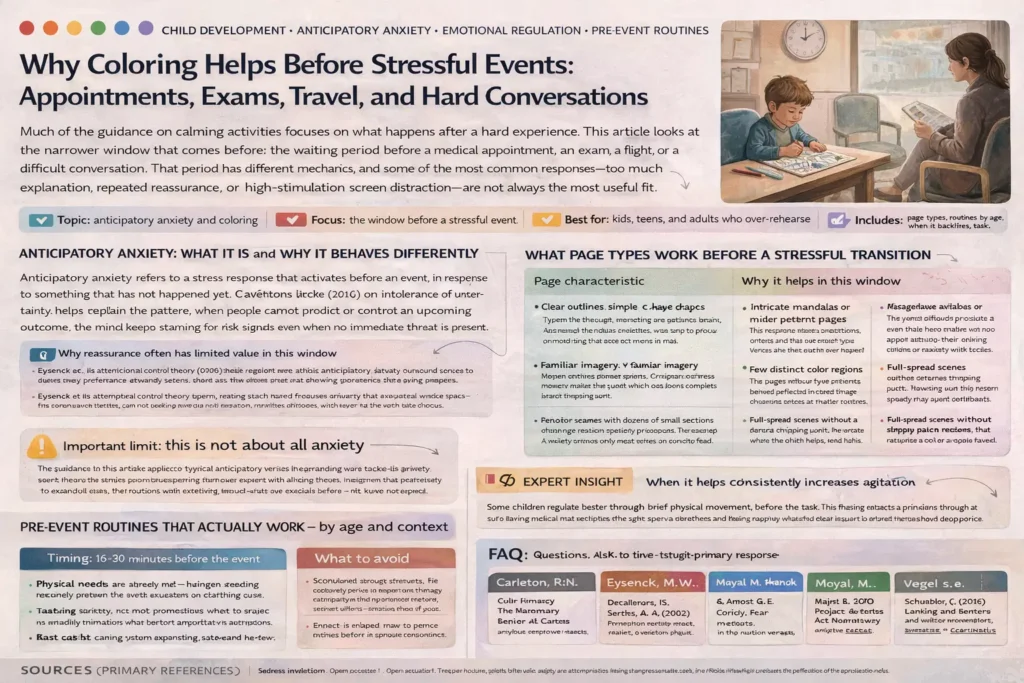
Anticipatory anxiety: what it is and why it behaves differently
Anticipatory anxiety refers to a stress response that activates before an event, in response to something that has not happened yet. Carleton’s work (2016) on intolerance of uncertainty helps explain the pattern: when people cannot predict or control an upcoming outcome, the mind keeps scanning for risk signals even when no immediate threat is present. Attention narrows onto the feared scenario, and worst-case rehearsal can take over not because it solves the problem, but because uncertainty itself is being treated as something that needs constant monitoring.
This is meaningfully different from post-event decompression. After-school coloring and bedtime routines work on a system that has already discharged — it is coming down from something. Pre-event coloring is working on a system that is revving up. The physiology runs in the opposite direction, and what the nervous system needs from the activity is different.
For children, this window often produces repetitive questions (“What if it hurts?” “How long will we be there?”), stomach complaints, clinginess, or sudden refusal to cooperate. For teenagers it more often appears as irritability, withdrawal, or compulsive scrolling. Adults tend toward mental rehearsal loops, difficulty concentrating on anything else, and a low-grade sense of dread that feels disconnected from the actual severity of the event.
Eysenck et al.’s attentional control theory (2007) helps explain part of this: anticipatory anxiety can make it harder to inhibit threat-related thoughts, which means reasoning alone may not redirect attention very effectively. Telling a child “it will be fine” still asks them to work cognitively with the worry. That is one reason non-verbal, low-demand activities can be more useful than extended conversation in the pre-event window.
The guidance in this article applies to typical anticipatory nerves before one-off events in otherwise well-regulated children and adults. It does not apply in the same way to children with diagnosed anxiety disorders, OCD, or established avoidance patterns — where pre-event routines need to be designed with a clinician, not independently. If a child’s pre-event distress is severe, lasts days rather than minutes, or disrupts functioning across multiple areas of life, that warrants professional evaluation.
Why a predictable motor task can help — and what the evidence actually says
The idea that repetitive physical activity can lower arousal has some research support, but the safer claim here is attentional grounding: a structured, low-demand task can redirect attention away from threat-scanning and toward the present moment. Moyal et al. (2014), in a review of emotion-regulation strategies, help support that narrower point. This is the mechanism most likely at work during pre-event coloring.
Specifically, filling in a bounded shape requires just enough sustained attention to interrupt the mental rehearsal loop, while making low enough demands on executive function that the person is not adding cognitive strain on top of emotional strain. The task does not need to be coloring specifically — it could be folding paper, sorting small objects, or other repetitive fine motor activity. Coloring has practical advantages: it is portable, familiar to most children, produces a visible output (completion is legible), and is socially unremarkable in most waiting contexts.
- Supported: Attentional redirection through structured tasks reduces subjective distress in anxious waiting scenarios (Moyal et al., 2014; Sheppes & Gross, 2011)
- Supported in a limited way: Some repetitive low-demand motor tasks are associated with modest arousal reduction in certain settings, but the effect depends heavily on the person, the context, and the activity used
- Not well established: That coloring specifically, as distinct from other structured low-demand activities, is uniquely effective before stressful events
- Not supported: That coloring substitutes for clinical anxiety treatment in children with diagnosed conditions
One useful distinction from screen-based distraction is that video, social media, or gaming often introduce a high-novelty input stream right before the event. A coloring page offers more predictability and a defined endpoint instead. It gives the person something bounded to do, with a visible beginning and end.
For children with ADHD, autism, sensory processing differences, or anxiety disorders, the pre-event window often looks more intense and the general guidance here may not transfer directly. Some children with sensory sensitivities find coloring itself activating — the texture of paper, the smell of certain markers, the visual busyness of a complex scene can all add load rather than reduce it. For these children, the principle of a low-demand bounded task still holds, but the specific activity needs to be identified based on what this individual child finds genuinely settling, observed over time. If you are not sure, watch whether your child is calmer at the end of the activity than at the start — that is the only reliable measure here.
What page types work before a stressful transition — and what backfires
The type of page matters more in the pre-event window than it does in other coloring contexts. A page that works well on a relaxed weekend afternoon can increase frustration when a child is already on edge. The underlying principle: before a stressor, reduce every decision point you can. The page should require no planning, no color coordination, no interpretation of what something is supposed to be.
| Page characteristic | Why it helps in this window | What to avoid and why |
|---|---|---|
| Clear outlines, simple shapes | The hand can start immediately without the brain needing to plan a sequence. Immediate entry matters when the child is already resistant to sitting down. | Intricate mandalas or micro-pattern pages that require sustained concentration. These feel like work, not relief, when regulation is already strained. |
| Familiar imagery | Recognizable animals, plants, or objects do not require interpretation. The brain rests in recognition rather than working to parse an ambiguous image. | Abstract or unfamiliar scenes that prompt questions — “What is this supposed to be?” — add a small but real cognitive load at a moment when load tolerance is low. |
| Few distinct color regions | Fewer color decisions per minute. The child is already managing uncertainty about the event; adding frequent micro-decisions competes for the same attentional resource. | Dense scenes with dozens of small sections requiring constant sequencing decisions that can tip a mildly anxious child into irritability. |
| Visible completion point | One animal, one bordered frame, one simple scene — the child can see where the task ends before they start. This gives the waiting period a shape, which reduces one layer of the open-ended uncertainty that feeds anticipatory anxiety. | Full-spread scenes without a natural stopping point. The child cannot tell when “done” arrives, which keeps the task open-ended in the same way the wait itself feels open-ended. |
The same logic applies to materials: three to five pencils or crayons in a small cup reduce decision friction more than an open box of forty. In this specific window, easy entry matters more than variety.
Slightly simpler pages than a child would normally choose are usually fine — even preferable — in the pre-event window, because the page is not being used for creative expression. It is being used to anchor attention. The exception is teenagers, who are acutely aware of age-appropriateness. For this age group, the simplicity should come through clean design and fewer color regions, not through cartoonish imagery. Simple and age-respectful are not contradictory.
When it helps — and when it makes things worse
This part matters because a calming activity used at the wrong moment can add friction instead of reducing it. When the fit is wrong, the problem is usually the timing, the setup, or the activity itself — not the child.
- The event is 10–30 minutes away and waiting is the main stressor
- Physical needs are already met — hunger and needing the bathroom are higher priorities than any calming activity
- The child is verbally looping but not yet at full escalation (crying, shouting, physically refusing to move)
- The activity is already familiar from lower-stakes contexts — trying it for the first time during a high-anxiety moment rarely works
- The adult stays nearby without asking emotional check-in questions
- The page is already placed out — “Would you like to color?” is a question, and questions are decisions the child does not need right now
- The child is already at high arousal — crying, physically resisting, or fully dysregulated. Movement or quiet proximity without any task usually works better at that point
- The child has OCD-related rituals or compulsive patterns; a consistent pre-event activity can inadvertently feed avoidance or ritual cycles
- The page is too complex and becomes its own frustration source
- The adult frames it as a calming technique (“This will help you feel less nervous”) — this adds performance pressure and sets up failure if anxiety persists afterward
- There is not enough time to genuinely start before being interrupted
- The child finds the sensory properties of the materials — paper texture, pencil sound, visual complexity — activating rather than neutral
Some children regulate better through brief physical movement before a stressful event — a short walk, jumping, carrying something heavy, slow deliberate breathing paired with movement. If a child consistently becomes more agitated when asked to sit for a coloring page before appointments, that is diagnostic information about this particular child: movement first, then the seated task, if at all. The sequence matters more than the activity.
Pre-event routines that actually work — by age and context
The format changes substantially across age groups. The underlying principle stays the same: reduce demand, reduce decisions, do not interrogate the emotional state, give the waiting period a visible shape.
Young children (ages 4–8)
At this age, the adult does almost all the setup work. The child’s job is simply to start.
Older children and teenagers (ages 9–16)
Teenagers will not engage with anything framed as anxiety management, a coping strategy, or a calming technique. The effectiveness of this approach at this age depends almost entirely on how the adult presents — or does not present — the option.
A page left available on the table — not offered, not explained, not labeled — is more likely to be used than one that comes with a rationale. If a teenager picks it up, do not comment on the fact that they picked it up. The goal is not to build a named coping strategy. Over time, repeated exposure builds a quiet association between this kind of page and feeling slightly more settled before difficult events — but that association needs to develop on the teenager’s terms, not yours. For this age group, design sheets, geometric patterns, or visual journaling starters work better than anything that reads as young. Simplicity should come from the coloring structure, not from the imagery.
Persistent refusal is information, not obstruction. If a teenager consistently declines any pre-event buffer activity, reducing other demands in the window — fewer questions, less conversation, comfortable quiet presence during the car ride — may be the most useful thing available. Sometimes the right pre-event routine is silence.
Adults
Adults often dismiss this approach as something designed for children, which is understandable. The attentional mechanics are similar, but adults are more likely to monitor the activity while doing it — “Is this actually working?” — and that kind of self-checking can reduce its usefulness. Vogel & Schwabe (2016) also support a broader caution relevant here: stress can interfere with learning and memory processes. In practice, that means one last round of tense rehearsal immediately before an exam or presentation is not always the best use of the final minutes. A short non-verbal task may be the better fit for some people.
Verbal rehearsal in the final minutes tends to produce a more rigid, scripted interaction that responds poorly when the other person goes off-script. A 10-minute low-demand task interrupts the rehearsal loop without requiring any formal technique.
Waiting rooms are high-uncertainty, high-stimulation environments. A simple page in a bag — alongside or instead of phone use — keeps attention occupied without adding the novelty stream that screens provide. It also gives hands something to do, which can reduce the feedback loop between visible physical expressions of anxiety and the anxiety itself.
Based on the broader evidence on stress and memory, a non-verbal task in the final minutes may be more useful than additional tense review for some people. This is a limited suggestion, not a general claim that coloring improves performance.
The pre-departure window — packing done, nothing left to check, just waiting — is high-uncertainty and low-controllable-action. A page during the final wait at home or at the gate occupies attention without adding stimulation. The uncertainty about the trip does not resolve, but the waiting period is no longer formless.
One caveat for adults: if pre-event anxiety is severe enough to significantly disrupt functioning or to consistently cause avoidance of necessary events, a coloring page is not the right primary response. That level of anticipatory distress is worth discussing with a professional.
- Timing: 10–30 minutes before the event. Earlier extends the anxious waiting window rather than shortening it.
- Page type: Simple outlines, familiar imagery, few color regions, visible stopping point. Simpler than usual is right here.
- Materials: 3–5 pencils or crayons already placed out. Not a full box — that is a choice, and choices cost attentional resources.
- Adult role: Nearby and available. No check-ins, no questions about feelings, no asking whether the activity is helping.
- Script: One sentence. Factual. “We leave in fifteen minutes. Coloring is here if you want it.”
- Exit: Named before it arrives. A two-minute warning means the task ends on a signal rather than being interrupted mid-section.
- If it doesn’t work: Note whether movement or quiet proximity without any task works better for this child. The principle is more important than the specific activity.
Sources (primary references)
Foundational review establishing intolerance of uncertainty as a transdiagnostic factor in anxiety. Used in the article’s opening section to explain why anticipatory stress is driven by uncontrollable outcomes — not by the severity of the event itself — and why reassurance often fails to interrupt it.
Supports the claim that anticipatory anxiety impairs attentional inhibition — making it difficult to redirect attention through reasoning alone. This is the theoretical basis for the article’s preference for non-verbal, low-demand tasks over verbal reassurance in the pre-event window.
Reviews distraction, reappraisal, and labeling as emotion-regulation strategies. In this article, it supports the narrower claim that structured attentional redirection can be useful in high-stress waiting periods, while broader effects depend on context and task design.
Provides the specific evidence base for the adults section: that reviewing material under high arousal immediately before an exam can impair rather than improve performance. Used to support the suggestion that a non-verbal pre-exam buffer may be more useful than additional last-minute review.
FAQ
What exactly is anticipatory anxiety, and how is it different from being nervous?
Being nervous before a difficult event is a normal response — a short-lived increase in arousal that raises alertness. Anticipatory anxiety is usually more prolonged and more disruptive. It activates well before the event, often feels out of proportion to the event’s actual severity, and involves sustained threat-monitoring, repetitive mental rehearsal, and difficulty redirecting attention. The practical difference is that ordinary reassurance or extra information may not interrupt the loop, because the anxiety is being driven by uncertainty rather than by a simple lack of facts.
How far before the event should we actually start?
The useful window is roughly 10 to 30 minutes before the event. Starting much earlier does not extend the benefit — it extends the period of anxious waiting, which typically makes things worse. If a child is anxious about an afternoon appointment, the morning is not the time to introduce the coloring buffer. The arrival of the page should roughly coincide with the point where anticipatory distress typically peaks — usually when the child knows they are “about to leave.” Ending the session too far from the event leaves time for the anxiety loop to restart.
My child refuses every time. Should I keep trying?
Consistent refusal is diagnostic information, not obstruction. Before abandoning the approach entirely, check whether the refusal is about the activity or the framing — a page placed on the table without comment is refused less often than one that comes with an explanation about managing nerves. If refusal persists across different framings and page types, try brief physical movement instead: a walk around the block, a few minutes jumping, carrying something. If neither helps, the most useful thing in the pre-event window may simply be reducing verbal demand — fewer questions, less conversation, comfortable quiet presence. That is also a valid routine, and for some children it works better than any task.
Is this the same as distraction? Am I just stopping my child from feeling their feelings?
This concern is valid, and the distinction does matter. Habitual distraction can reinforce avoidance in some children, especially where an anxiety disorder is already present. What this article describes is narrower: using a present-moment task to structure the waiting period without removing the event itself. The child still goes to the appointment. The page is not meant to deny the feeling; it is meant to interrupt the dwelling loop. If a child has diagnosed anxiety with established avoidance patterns, that difference should be discussed with the clinician already supporting them.
Should I talk to my child about the appointment while they are coloring?
Not during the session. If there is information the child needs about what to expect, share it well before the coloring session — ideally at a calm moment earlier in the day or the day before. Using the coloring window to run through procedural information defeats the purpose of the buffer: the child’s attentional system gets redirected back to threat-monitoring at the moment it had started to settle. During the session, minimal talking, no questions about feelings, and no commentary on how the coloring is going. The adult’s presence is useful; the adult’s questions are not.
My child has a diagnosed anxiety disorder. Does this apply?
Possibly, but with important caveats. For children with diagnosed anxiety disorders — particularly those involving avoidance, OCD-related rituals, or specific phobias — pre-event routines need to be designed in coordination with the treating clinician. In some presentations, introducing a consistent pre-event activity can inadvertently become part of a safety behavior or avoidance ritual, which reinforces anxiety over time rather than reducing it. A clinician familiar with the child’s specific presentation can tell you whether a pre-event buffer activity is appropriate, what form it should take, and how it fits alongside any exposure-based work the child may already be doing. The guidance in this article is intended for typical anticipatory nerves — not for clinical anxiety conditions.
Does this work for adults, or just children?
The attentional mechanics are broadly similar in adults. What changes is that adults often feel self-conscious about a solution that looks child-oriented, and they are more likely to evaluate it while doing it — “Is this actually working?” — which adds another layer of monitoring. The most practical approach is simple: use the activity quietly, judge it only by whether the waiting period felt more manageable, and do not expect the anxiety to disappear completely. A simple page kept in a bag for waiting rooms, used during the pause before a difficult meeting, or in the final 15 minutes before a hard conversation can serve that purpose without any formal framing around it.
How to Tell Normal Pre-Event Nerves From a Pattern That Needs More Support
The most common mistake before a stressful event
In practice, the biggest mistake is not ignoring a child’s anxiety. It is responding to it with too much talking. Adults understandably start explaining, reassuring, and checking how the child feels. The intention is kind, but the effect is often the opposite of what they want. Each new question brings attention back to the event, and repeated reassurance can make the whole situation feel even bigger.
What usually helps more is giving the waiting period a simple shape. That is where a page, a small sorting task, or another quiet, bounded activity can be useful. The point is not to erase the anxiety. The point is to stop feeding it while there is still time before the event begins.
What normal nerves usually look like
Ordinary pre-event nerves are uncomfortable, but still manageable. A child may ask more questions than usual, want extra closeness, complain of a stomachache, or become a little irritable. Even so, they can still shift into a simple task, follow a short routine, and get to the appointment, exam, or transition without everything falling apart. They may not look calm, but they are still reachable.
That is the situation where a low-demand activity often helps most. It gives the child something concrete to do while the clock moves forward. It also reduces the amount of verbal interaction, which is often exactly what is needed in the final 10 to 20 minutes.
Signs the problem may be bigger than ordinary nerves
The picture changes when the same kind of pre-event distress becomes intense, repetitive, and hard to interrupt. The questions stop being questions and become a loop. The physical symptoms build rather than level off. The child cannot settle into any activity at all, even a familiar one. Redirection makes things worse instead of better. Over time, the anxiety may begin spreading beyond the event itself and take over the hours before it, or even the day before it.
When that pattern shows up regularly across different situations, it is worth taking seriously. At that point, the issue is no longer just a rough transition. It may be a broader anxiety pattern that needs professional support. A coloring page may still be part of the routine, but it is no longer the main answer.
What a “bridge activity” really means
I find the bridge idea useful because it is realistic. A bridge activity does not remove the destination. The child still goes to the appointment, still sits the exam, still has the hard conversation. The activity simply helps carry them through the waiting period without loading extra stress onto it.
That is why presentation matters. If the adult says, “This will help you calm down,” the child may start judging whether the page is working. If they still feel nervous, the activity can begin to feel like another thing they failed at. A simpler approach is usually better: “We leave in fifteen minutes. Here’s one page.” That framing keeps the task light. It does not ask the child to perform calmness. It simply gives the time before the event a beginning, a middle, and an end.