Coloring After Conflict: A Quiet Repair Ritual for Parent–Child Reconnection
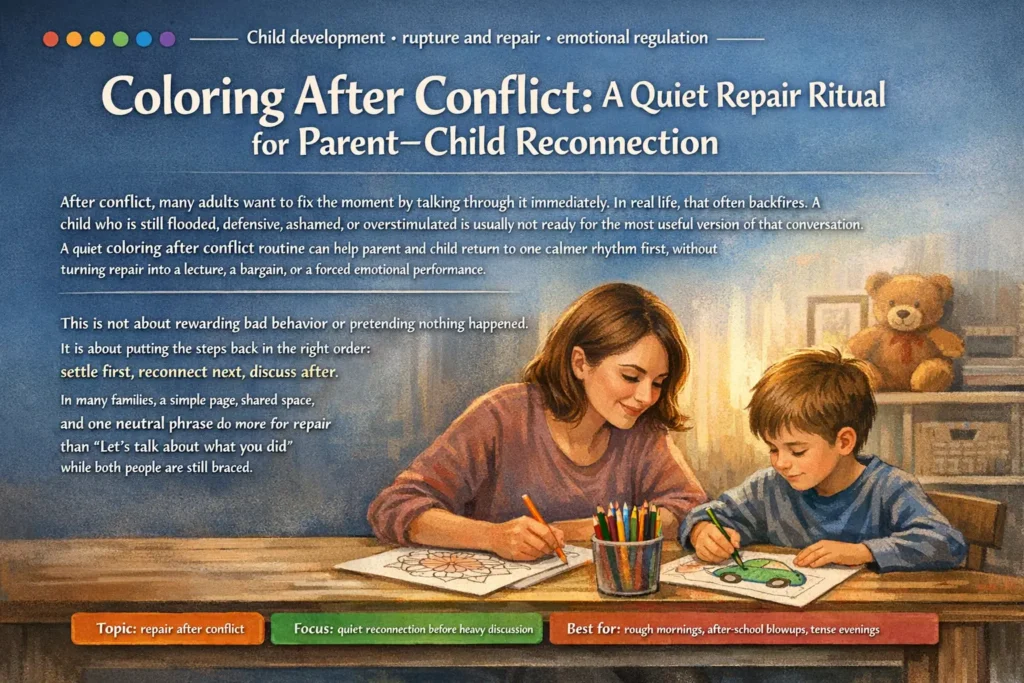
After conflict, many adults want to fix the moment by talking through it immediately. In real life, that often backfires. A child who is still flooded, defensive, ashamed, or overstimulated is usually not ready for the most useful version of that conversation. A quiet coloring after conflict routine can help parent and child return to one calmer rhythm first, without turning repair into a lecture, a bargain, or a forced emotional performance.
This is not about rewarding bad behavior or pretending nothing happened. It is about putting the steps back in the right order: settle first, reconnect next, discuss after. In many families, a simple page, shared space, and one neutral phrase do more for repair than “Let’s talk about what you did” while both people are still braced.
Why repair works better after the nervous system settles
Conflict creates strain in both directions. The child may feel misunderstood, cornered, embarrassed by their own behavior, or frightened by how intense the moment became. The adult may feel disrespected, worried, guilty, or determined to “fix this now.” That combination often creates a second rupture disguised as repair. Too many questions arrive too soon. Tone gets corrected before safety returns. The child hears pressure where the adult intended care.
Repair usually works better after the body has come down a little. That does not mean avoiding the issue or waiting until tomorrow. It means recognizing that meaningful reflection tends to land only once breathing slows, muscle tension drops, and neither person feels immediately judged. In other words, reconnection often needs a calmer body before it can support a better conversation.
This matters because many children are not refusing to talk simply to be difficult. They may still be defending against more input. Even a gentle question can feel like demand when the nervous system is still braced. A quieter shared activity gives both people a way back into contact without the immediate burden of eye contact, full explanation, or instant remorse.
Fewer words, less urgency, one predictable action, and a sense that connection is still available without immediate interrogation.
Coloring as a reconnection ritual, not a reward
Coloring can help in this window because it is quiet, structured, familiar, and low-demand. The page already has boundaries. The activity has a beginning, a middle, and a stopping point. Hands can move before language is ready. Parent and child can share the same space without facing each other in a high-pressure way. That is why coloring can support repair after conflict: not because it is magic, but because it offers a simple shared rhythm when conversation is still too heavy.
The distinction matters. The page is not a prize for having a meltdown, and it is not a trick to erase what happened. Used well, it says something more modest and more useful: “We are not ready for the whole conversation yet, but we can come back into the same space safely.” That is different from bribery, distraction, or avoidance.
In many homes, children respond better to shared quiet than to immediate verbal repair. A parent sitting nearby with another page, or simply putting crayons on the table and staying calm, often communicates more than a long explanation. The child does not have to become suddenly articulate to re-enter connection. The child only has to be allowed to begin.
What a quiet repair moment can look like
Quiet repair is small. It usually does not look dramatic or especially impressive from the outside. It looks like the adult lowering their own intensity, bringing out one easy page, staying close enough to feel available, and using one neutral sentence instead of ten emotional ones. The child may start coloring immediately, cry a little more, refuse at first, or sit silently before touching the pencil. All of those can still be part of repair.
A useful repair ritual is built around low demand. The adult does not force eye contact. The adult does not ask for a full explanation at the table. The child is not required to apologize on command in order to access calm. Instead, both people step into the same environment and let the emotional volume come down first.
Stop the argument. Lower your voice. Do not push for a conclusion while everyone is still activated.
Offer one easy, familiar coloring page with clear outlines. Avoid very detailed pages that feel like another assignment.
Sit nearby. You may color too, or simply stay present. The goal is calm proximity, not analysis.
Try: “We do not have to talk yet. We can just slow down here together.” Or: “We’ll talk after this feels easier.”
When body language and tone soften, you can return to the issue in smaller, more manageable pieces.
Not a perfect apology. Not a life lesson. The first success is that both people come back into safer shared contact without another escalation.
Three common real-life moments where this can help
The child snaps over a tiny request, throws the backpack, and rejects conversation in the car or at the door. A coloring page can become a low-pressure landing step before anyone revisits tone, homework, or the argument itself.
The morning ends with shouting, rushing, and tears. Later that day, coloring can support a calmer re-entry into contact without forcing the child to reopen the whole conflict immediately.
The child yells, slams something, or says hurtful words during a tired transition. Once safety is restored, a quiet page can help everyone step out of the fight mode before consequences or problem-solving are discussed.
The child may still feel wronged, ashamed, or blamed. Shared coloring can reduce the pressure of “Tell me exactly what happened” and make later discussion less combative.
When silence first is the better choice
Sometimes even a gentle repair ritual is too much at the start. If the child is still sobbing hard, physically agitated, glaring, hiding, or unable to tolerate even mild proximity, silence may be the better first move. In those moments, the adult’s task is to stop adding input. That can mean sitting nearby without talking, softening the environment, putting the page within reach, and waiting instead of persuading.
This is especially true after after-school overload, humiliating moments, or intense sibling conflict, when the child may be carrying both emotional heat and shame. Too much adult language can feel like renewed pressure. A quiet minute lets the nervous system register that the argument is no longer actively happening, even if the issue itself will still need attention later.
Silence does not mean emotional distance. It means regulated presence. Many children can feel the difference between being left alone and being calmly given room. Repair becomes easier when the adult stays available without demanding performance.
| What you notice | Better first move | Why this helps | When to bring in coloring |
|---|---|---|---|
| Child is crying hard or breathing fast | Stay close, say less, reduce sensory load | Language often lands as extra pressure | When breathing and body tension begin to slow |
| Child looks angry and cornered | Back off from questions and eye contact | The child needs less social threat before reconnection | When the child can tolerate shared space again |
| Child seems ashamed or withdrawn | Offer calm presence without asking for explanation | Shame usually worsens when pushed into immediate talking | Right away if the invitation stays gentle and optional |
| Adult is still activated too | Regulate yourself first for one or two minutes | Repair offered in a tense tone rarely feels safe | After your own voice, pace, and body come down |
Common parent mistakes after conflict
Most post-conflict mistakes come from urgency. Adults understandably want to clear the air, teach the lesson, and restore peace. But urgency often turns repair into pressure.
“Tell me exactly why you did that” often asks for more insight than the child can access in the moment.
Requiring eye contact, perfect tone, or an apology before reconnection turns repair into a test.
“If you stop acting like this, you can color” moves the ritual away from reconnection and into bargaining.
The page helps because it reduces verbal demand. Over-talking can recreate the same pressure that made the child shut down.
Connection may return before the issue is fully discussed. The issue may still need boundaries, follow-up, or accountability later.
Some children need food, movement, or more distance first. One script will not fit every state or every family.
What repair can support and what it cannot solve
A quiet repair ritual can support reconnection, reduce defensiveness, soften relational distance, and make later conversation more possible. It can help a child feel that conflict did not destroy the relationship. It can help the adult return as a steadier presence rather than as continuing pressure. In that sense, repair matters a great deal.
But repair does not solve everything. It does not replace limits. It does not answer deeper family patterns on its own. It does not make aggressive behavior harmless, and it does not remove the need to revisit what happened. It also does not work the same way in every home or in every type of conflict. Some situations involve trauma, neurodivergence, school strain, chronic stress, or repeated explosive patterns that need more than one low-demand ritual.
- It is not a quick reconciliation trick.
- It does not cancel limits, consequences, or later discussion.
- It is not a way to smooth over a serious conflict and move on as if nothing happened.
- It is not a universal ritual for every child, every adult, or every kind of rupture.
The more realistic promise is smaller and stronger: coloring can sometimes create the first calmer bridge back to contact. That bridge may then support apology, reflection, problem-solving, or boundary-setting. But the bridge is not the whole journey.
A simple repair script parents can actually use
Many adults do better with one short script because it reduces the temptation to over-explain. The tone matters more than the exact words. Slow, neutral, and warm usually work better than emotionally loaded reassurance.
“We do not have to figure it all out right this second. Let’s slow this down first. I’m here. We can sit together with this page, and we can talk later.”
That script works because it does three jobs at once: it lowers demand, protects connection, and leaves room for later accountability. It does not pressure the child to perform calm or insight immediately. It also does not abandon the issue. It simply puts the conversation back in the right order.
Sources (primary references)
Used here for the central framing that responsive relationships, regulation, and stable environments help children recover from stress and return to learning and connection.
Used here for the point that co-regulation, reduced activation, and relational safety often need to come before reflective conversation.
Used here for the practical emphasis on predictable routines, calmer transitions, and parent presence during stressful moments.
Used here for the practical point that children often need adult regulation, pacing, and reduced pressure rather than immediate verbal processing in the heat of the moment.
FAQ
Is coloring after conflict a reward for bad behavior?
Not when it is used as a regulation and reconnection tool rather than as a payoff. The purpose is to reduce emotional heat and return to shared safety, not to trade calm for something pleasant.
Should I talk about the conflict while my child is coloring?
Usually not much at first. A few neutral words may help, but many children do better when conversation becomes optional until their body and tone settle.
What if my child refuses the page?
Refusal does not mean the repair failed. It may mean the child needs more silence, more space, food, water, movement, or simply more time before shared activity feels manageable.
Can this replace consequences or a later discussion?
No. Repair supports relationship and regulation. Limits, reflection, and follow-up may still be needed. The point is that these usually work better after the nervous system has come down.
Is this useful after school arguments or hard mornings?
Yes. Those moments often combine overload, shame, time pressure, and unfinished feelings. A quiet ritual can create a softer re-entry into connection before the issue is revisited.
When is this approach not enough on its own?
It is not enough when there are serious safety concerns, repeated aggressive patterns, trauma-related responses, major family stress, or deeper relational issues that need broader support. In those situations, repair rituals may help, but they are not the full solution.
Expert Commentary: After Conflict, Shared Calm Often Opens the Door to Better Repair Than Immediate Explanation
Why shared calm often comes before useful words
After conflict, both child and adult may still be carrying defensive energy. In that state, conversation can easily turn into a second round of pressure: one person pushes for explanation, the other protects against more exposure. A quiet shared rhythm changes the task. Instead of demanding immediate insight, it lets the relationship become physically calmer first. That shift often makes later words more honest and less reactive.
How to keep the ritual from becoming hidden control
A simple page can support reconnection because it lowers verbal demand and gives both people something steady to orient around. But intention matters. If the adult uses the ritual to secure compliance fast, monitor the child’s emotions, or indirectly force an apology, the child will usually feel that control. Then the page stops being a bridge and becomes another source of pressure. The ritual works best when it protects dignity on both sides and leaves room for real pacing, real silence, and later discussion.
What parents should keep in mind
This is not a five-minute reconciliation method. It is a modest, relationship-protective way to lower activation so repair has a better chance of becoming genuine. The goal is not to skip hard things. The goal is to approach hard things once the child is no longer defending against the moment itself.