Instant completion is an easy metric to admire because it produces a clean story: a page was printed, opened, finished, done. Family life and classroom life rarely work that way. Pages are
interrupted by dinner, transport, reading groups, sibling handoffs, cleanup time, table rotations, and attention shifts. That is why resumability matters. A page that can be
left, found again, and re-entered without friction often has more real-world value than a page that looks impressive but only works in one uninterrupted sitting.
Here, resumability is treated as a design quality. The practical question is not simply which printables get finished fastest, but which ones are easiest to pick up later. The
useful signals are pause-to-return windows, resumed-to-finish conversion, theme patterns, complexity effects, and age-fit. For parents, teachers, and printable creators, that lens is often
more useful than broad preference surveys because it reflects behavior after real interruptions rather than stated intent before the page is used.
Metrics used here: resumed within the same day, within 3 days, within 7 days, and resumed-to-finish conversion after a
paused session.
familiarity that the second start feels lighter than the first one.
What counts as a paused session
A paused session is not the same thing as abandonment. For a pause-and-return audit, the cleaner definition is practical: the page was started, not brought to an obvious finished state in the
first sitting, and later reprinted or reopened in a way that suggests the user was trying to continue rather than start a fresh unrelated activity. In family settings, that often means a
second print later the same day or later that week after the first sheet was partly colored, left on a table, or folded into a homework pile. In classroom settings, it can mean a later
seatwork block, center rotation, advisory slot, or after-school return.
That definition matters because resumability is not really about taste. It is about return friction. Some pages are easy to re-enter because the unfinished state is legible.
Others create a cold start every time because the user has to reconstruct what they were doing, which area mattered, which colors were being used, or whether the page still feels worth the
effort.
Public printable datasets do not publish page-level pause-and-return behavior in a way that supports a true external ranking. For that reason, the benchmark below is presented as a
transparent editorial model of how a resumability audit should be read. The point is the measurement logic and the pattern reading: which page traits tend to support
resumption, which ones lose users after interruption, and how to segment the behavior cleanly.
Modeled benchmark: which pages are most returnable
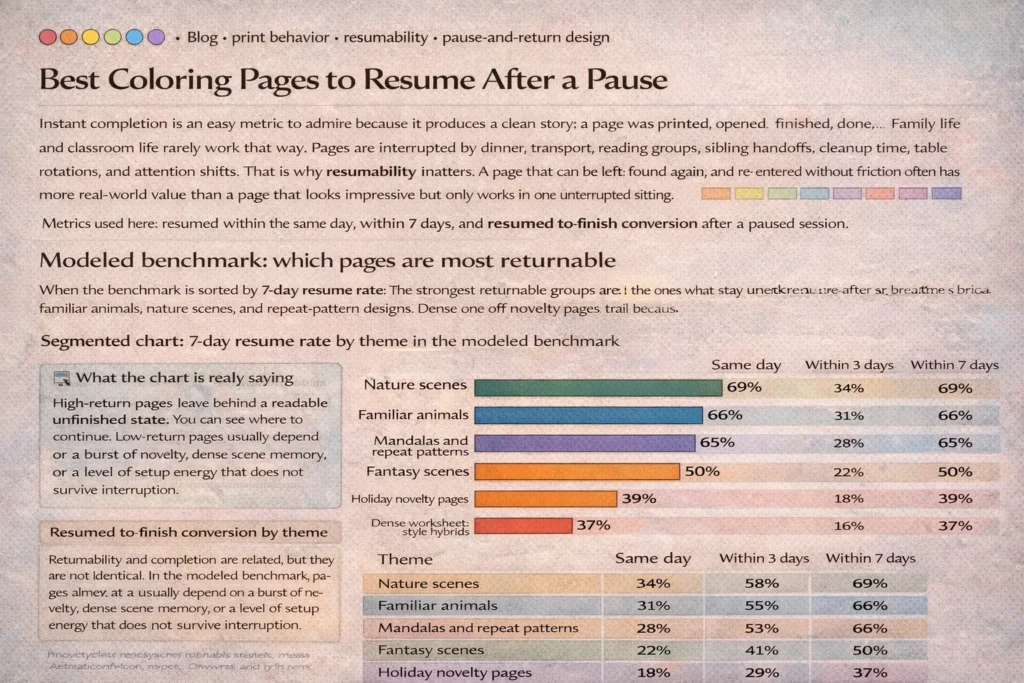
When the benchmark is sorted by 7-day resume rate, the winners are not the flashiest pages. The strongest returnable groups are the ones that stay understandable after a
break: familiar animals, nature scenes, and repeat-pattern designs. Dense one-off novelty pages trail because the second session often feels like starting from scratch.
energy that does not survive interruption.
| Theme | Same day | Within 3 days | Within 7 days |
|---|---|---|---|
| Nature scenes | 34% | 58% | 69% |
| Familiar animals | 31% | 55% | 66% |
| Mandalas and repeat patterns | 28% | 53% | 65% |
| Fantasy scenes | 22% | 41% | 50% |
| Holiday novelty pages | 18% | 32% | 39% |
| Dense worksheet-style hybrids | 16% | 29% | 37% |
Returnability and completion are related, but they are not identical. In the modeled benchmark, mandalas and repeat patterns have the best resumed-to-finish conversion at
77%, followed by nature scenes at 74% and familiar animals at 72%. Fantasy scenes fall
to 61%, dense worksheet-style hybrids to 52%, and holiday novelty pages to 48%. That split matters: a
page can win the first print and still lose the second start.
One-time novelty pages versus repeatable pages
One-time novelty pages are often optimized for the first reaction. They look exciting in a feed, at the printer, or on a classroom choice board. They do one thing very well: they create
immediate attention. The problem comes later. If the user leaves halfway through, the unfinished state can feel visually noisy, and the second session carries an extra decision tax. Where do I
resume? Which cluster matters? Was I matching colors? Does this still feel fun, or does it now feel like catching up?
Repeatable pages solve a different problem. They are less dependent on surprise and more dependent on stable re-entry. Repeat motifs, familiar object boundaries, visible
micro-completions, and calm distribution of detail all make the second sitting lighter. This is why pages that are merely “pretty” do not always outperform pages that are structurally easy to
continue.
that resumes well.
- Clear zones that still make sense after a break.
- Obvious stopping points that create a natural “come back here next” feeling.
- Enough open space to reduce second-start intimidation.
- Pattern or subject familiarity that lowers memory demands.
- A visual rhythm that allows small wins instead of all-or-nothing completion.
Complexity is the clearest drag on pause-and-return behavior
In the modeled benchmark, complexity produces the sharpest resumability split. Low-complexity pages do not simply finish earlier; they survive interruption better. Their unfinished state is
easier to decode, and the next action is usually visible. High-complexity pages, by contrast, ask the user to recover more state: what mattered, what was planned, which region was being
worked, and whether the remaining effort still feels worth it.
The timing pattern is consistent. Low-complexity pages move from 36% same-day resume to 62% within three days and 73% within seven.
Medium-complexity pages sit in the middle at 27%, 49%, and 60%. High-complexity pages lag at 17%, 31%, and
40%. The resumed-to-finish conversion also drops as complexity rises: 78% for low, 70% for medium, and 56% for high.
Age group patterns are really re-entry patterns
Age effects in resumability are less about age by itself and more about how much independent reconstruction the page demands. In the modeled benchmark, pages aimed at
ages 7–9 perform best on return behavior because they balance familiarity with enough structure to make continuation obvious. Very young users often depend on an adult
re-presenting the page, which lowers return consistency. Older users can handle more detail, but only when the page still protects their second start from feeling messy or juvenile.
Ages 4–6: 20% same-day, 38% within 3 days, 46% within 7 days, 58% resumed-to-finish conversion.
Ages 7–9: 30% same-day, 55% within 3 days, 66% within 7 days, 73% conversion.
Ages 10–12: 28% same-day, 50% within 3 days, 60% within 7 days, 68% conversion.
Ages 13+ and adult hobby use: 26% same-day, 48% within 3 days, 59% within 7 days, 71% conversion.
The adult result is worth noting. Adult hobby pages do not always dominate 7-day resume rate, but once the user returns, conversion is strong. That usually means the audience is willing to
finish; the friction sits earlier, in choosing to restart. For creators, that is a useful distinction. The design problem is not always motivation. Sometimes it is
re-entry cost.
Layout traits that support easy resumption
Visible islands of completion. Good returnable pages break the image into zones that can feel done before the whole page is done. That lowers the dread of re-entry
because the user sees progress immediately.
Clear object boundaries. Distinct shapes and calm outlines help the user understand where work stopped and where continuation can begin. This matters more after
interruption than during the first sit-down.
Pattern repeat instead of constant novelty. Repeated leaves, petals, fur sections, tiles, stars, or scales reduce memory demand. The user does not have to reconstruct a
plot; they can simply continue the rhythm.
Moderate density near the center, not everywhere. A page that is dense in every direction makes the second session feel cognitively expensive. A page with one richer area
and several lighter zones gives the user a gentler restart.
Low ambiguity about the next move. Returnable pages quietly answer the question “What should I do next?” without needing instructions. Ambiguity is one of the fastest
ways to turn a pause into a drop-off.
Tone that survives interruption. Age-respectful, calm pages come back better than pages built entirely on hype or novelty. The second session is usually quieter than the
first, so the page has to survive a lower-energy moment.
Why resumability matters more than instant completion in family and classroom life
Instant completion rewards ideal conditions. Resumability rewards real conditions. In homes, printables are often used in fragments: ten minutes before dinner, fifteen minutes during sibling
waiting time, twenty minutes on a rainy afternoon, seven minutes before leaving, or a second sitting on the weekend. In classrooms, the same page may be spread across transition windows,
center rotations, indoor recess, advisory, and quiet-entry routines. Under those conditions, the better product is not always the page that finishes in one shot. It is the page that
keeps working after the interruption.
That matters commercially as well. High resumability improves the chance that a printable is reprinted, revisited, recommended, and remembered as practical rather than merely attractive. It
makes the page more compatible with real schedules, which is exactly what parents and teachers notice when they decide which resources become staples.
FAQ about paused work
Is a paused session the same as an abandoned page?
No. A paused page still has a plausible path back into use. An abandoned page has effectively lost that path. The whole point of the resumability metric is to separate “not finished yet”
from “not coming back.”
Why can a page have a weak same-day result but a strong 7-day result?
Because same-day behavior captures immediate available time, while 7-day behavior captures whether the page stays understandable and worth returning to after interruption. Some pages are
not fast, but they are still easy to continue.
Does higher complexity always reduce resumability?
Not always. The bigger problem is unsignposted complexity. A detailed page can still resume well if it has clear zones, repeated structures, and obvious continuation points. Complexity
hurts most when it forces the user to reconstruct too much state.
Are reprints always true resumes?
No. Some reprints are duplicates for siblings, class sets, or clean copies. That is why pause-and-return analysis needs careful filtering and why the benchmark here is framed as a model
of the method rather than as a claimed public dataset.
Which pages usually convert best once the user does come back?
In the modeled benchmark, mandalas and repeat-pattern pages convert best after the resume because they offer a low-friction continuation rhythm. Nature and familiar animal pages also
convert well for the same reason.
What should creators optimize first: instant finish or returnability?
If the audience is families, teachers, or repeat printable users, returnability is often the better priority metric. Instant finish matters, but resumability tracks whether the page
still functions when life interrupts the session.