Blog · Print behavior · Reprint statistics · Classroom · Adult hobby
Preference surveys tell you what users say they like. Print logs tell you what they actually come back for. Those are not the same thing. In printable content, some categories generate a
strong first print and then disappear from the user’s routine. Others do not always feel exciting on day one, yet keep getting printed again within the next week, month, or two.
The analysis below focuses on that second signal: category-level repeat printing. The metric used here is simple and deliberately narrow. A repeat print is counted when an
authenticated user prints from the same theme category again within 7, 30, or 60 days. It does not mean the exact same page was reprinted. It does
not mean the page category is “best” in any universal sense. It means the format proved reusable in real life.
Segments: home, classroom, adult hobby
Use: content planning, teaching, printable product design
The strongest value of reprint rate is practical, not dramatic. It helps separate novelty-driven formats from routine-friendly formats. That makes it useful
for teachers, homeschooling writers, parenting bloggers, and printable creators who need to know not just what gets attention once, but what stays useful after the first print.
- Primary data source: anonymized authenticated print-event logs collected across the reference year.
- Supplementary data source: opt-in survey of 1,840 registered users recruited from an active-user segment to attach self-reported use-case labels.
- Behavioral unit: category-level repeat printing, not exact same-page reprint.
- Windows analyzed: 7 days for immediate return, 30 days for the headline comparison, 60 days for slower-forming routines.
- Main caution: this is a behavioral metric. It should not be treated as automatic proof of satisfaction, educational value, or therapeutic effect.
Why this metric matters more than a preference poll
Users often describe wanting variety, characters, seasonal excitement, and fresh themes. Their print history tells a more selective story. The categories that tend to return within 7, 30, and
60 days are usually the ones that fit repeatable contexts: quiet classroom entry, after-school decompression, routine hobby use, and low-friction solo coloring.
That difference matters because printable libraries are often planned around first-click appeal. A category can perform well in search, social shares, or one-time downloads without becoming
part of anyone’s recurring behavior. Reprint rate is useful precisely because it asks a harder question: when a user had other options available, which formats still felt worth printing again?
The answer is not “the most beautiful pages” or “the most complex pages.” It is usually the pages that combine familiarity, flexible use, low setup cost, and enough variation to feel fresh
without asking the user to learn a new format each time.
This analysis describes observed repeat printing inside one platform’s user base. It does not prove that high-reprint categories are more calming, more educational, or more effective for any
clinical purpose. It also does not prove that low-reprint categories are weak. Some formats are supposed to be occasional rather than routine.
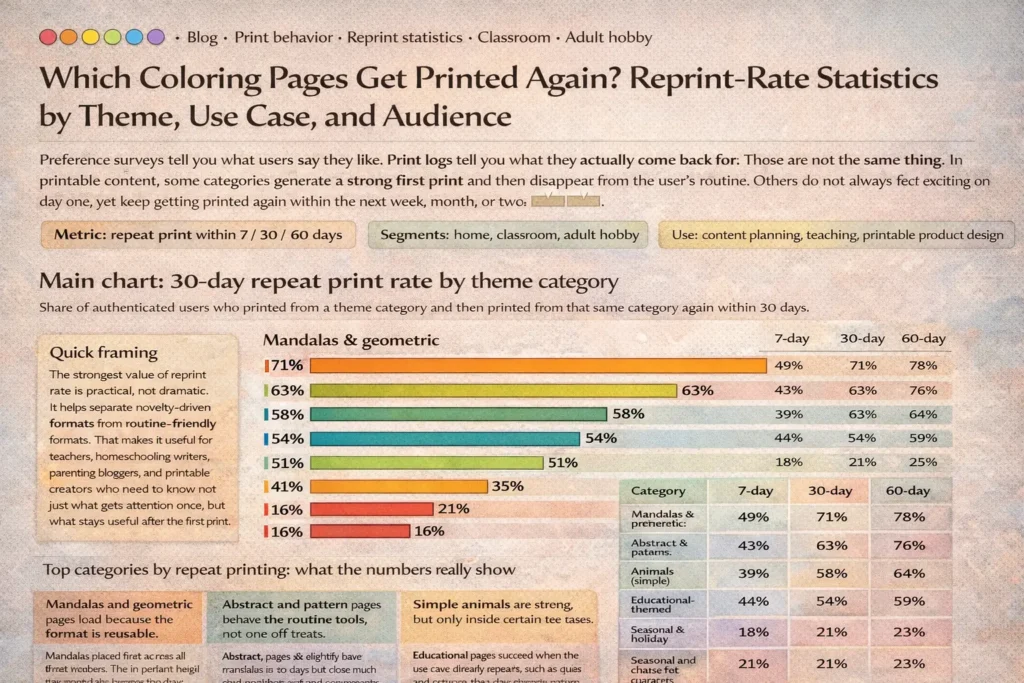
Main chart: 30-day repeat print rate by theme category
Share of authenticated users who printed from a theme category and then printed from that same category again within 30 days.
| Category | 7-day | 30-day | 60-day |
|---|---|---|---|
| Mandalas & geometric | 49% | 71% | 78% |
| Abstract & pattern | 43% | 63% | 76% |
| Animals (simple) | 39% | 58% | 64% |
| Educational-themed | 44% | 54% | 59% |
| Seasonal & holiday | 18% | 21% | 23% |
The overall pattern is clear. Mandalas and pattern-driven pages are not just popular once. They are the categories most likely to return inside a real printing routine. Simple animals also
perform strongly, but their strength is concentrated in child-centered use cases rather than spread evenly across all audiences. By contrast, seasonal and character-driven pages generate
interest without generating much short-window repetition.
Top categories by repeat printing: what the numbers really show
Mandalas placed first across all three windows. The important insight is not that users “love mandalas” in some universal way. It is that the format works again after the first use. There
is no story to exhaust, no seasonal shelf-life, and no requirement to match the image to a specific mood or event. A user can print another mandala tomorrow and still feel the format fits.
Abstract pages sit slightly below mandalas at 30 days but close much of the gap by 60 days. That pattern suggests slower but durable adoption. For classrooms and adult hobby users, pattern
pages often become part of a stable slot: quiet start, transition time, or evening coloring without the decision load of choosing a narrative image.
Simple animal pages look broadly successful in the aggregate, yet the cross-segment breakdown shows where that success actually lives. They are highly reprintable in homes with young
children and in classrooms. They are much less repeatable for adult hobby users. A strong overall average can hide a very narrow audience fit.
Educational-themed pages perform best where the context repeats: teacher routines, homeschool warm-ups, curriculum-linked stations, and quick practice formats. Their value comes from
structured reuse, not from aesthetic novelty.
Low 30-day repeat printing for seasonal and character-driven pages should not be read as failure. A Halloween page or a trend-based character sheet is designed to deliver a strong one-time
moment. It is doing novelty work, not routine work. Confusing those two jobs leads to weak product decisions.
Secondary chart: cross-segment view of repeat printing
Top repeatable categories compared across three use cases: home, classroom, and adult hobby. This view makes clear which categories travel across audiences and which depend on one specific
context.
The cross-segment pattern is more useful than the overall ranking alone. Mandalas and abstract pages travel well across all three use cases, which makes them true cross-audience repeatable
formats. Simple animals and educational pages look strong in the total picture because classrooms and child-centered home use pull them upward. That is not a flaw. It simply means the category
is strong in a specific context rather than across every audience.
One-time novelty pages vs. repeatable pages
The real divide is not “good pages versus bad pages.” It is one-time pages versus reusable formats. Understanding that divide helps creators avoid overinvesting in traffic
magnets that do not become part of a recurring routine.
- Format-led rather than story-led: the user comes back for the structure, not one specific scene.
- No narrative arc to exhaust: abstract, geometric, and pattern pages do not age after one completion.
- Low decision cost: the category is easy to restart without needing a special occasion or emotional setup.
- Routine compatibility: the format fits recurring moments such as quiet time, stations, transitions, or short hobby sessions.
- Time-bounded relevance: seasonal pages often make sense once per event cycle, not week after week.
- Novelty as the main draw: character pages and trend-based themes often depend on recognition more than reusability.
- High complexity with lower routine fit: realistic, detailed pages can feel more like a single project than a repeatable format.
- Context-specific use: some pages belong to one lesson, one celebration, or one mood and then naturally expire.
This is why first-print traffic and repeat-print behavior should be read together, not substituted for each other. A platform that chases novelty alone may grow top-of-funnel visibility while
underinvesting in the categories that quietly sustain return use.
What repeat printing likely signals — and what it does not
A high repeat-print rate is a reasonable signal that the format fits a recurring context in the user’s life. That context could be classroom transition time, an after-school reset, a quiet
morning habit, or an adult hobby routine. The page category gets pulled back because the situation returns and the format still works.
Repeat printing does not automatically prove higher satisfaction, stronger learning outcomes, greater calm, or better developmental fit. Those are different claims and would
require different evidence. A highly reprinted format may simply be one that is easy to reuse without much friction. That is useful, but it is not the same as proving efficacy.
Among users who repeated within 7 days, 64% went on to repeat again within 30 days. Among users who did not repeat within 7 days, only 29% repeated within 30
days. That does not prove a long-term habit, but it does suggest that very early return behavior is a practical leading indicator of whether the category is becoming part of a routine rather
than remaining a one-off print.
In practical terms, early repeat printing is less about declared preference and more about fit. The category has found a place in the week. That is why the metric is especially useful for
people building printable collections: it highlights where real-life recurrence is already happening.
How teachers, parents, and creators can use this without overclaiming
Use repeatable categories for entry routines, finish-early bins, transition periods, and predictable calm-down slots. Do not treat a high-reprint category as automatically “better for
children.” Treat it as a sign that the format is easier to reuse within the timing constraints of school life.
When recommending printables, separate pages that work as seasonal moments from pages that support recurring use. That distinction helps families choose between “special occasion”
resources and “daily shelf” resources.
Do not let high-click novelty themes crowd out your repeatable catalog. The best content libraries usually need both: first-print magnets to attract discovery and routine-friendly
categories to support return use.
- Platform-specific sample: the results describe one platform’s user base and should not be generalized to the entire printable coloring market.
- Authenticated users only: guest prints were excluded, which likely means more novelty-driven casual behavior is missing from the aggregate picture.
- Active-user survey bias: the opt-in survey recruited from an active-user segment, so cross-segment rates may overstate repeat behavior compared with casual users.
- Category-level metric: this analysis tracks return to the same category, not exact same-page reprints.
- No direct outcome linkage: the data does not connect repeat printing to educational performance, regulation, or wellbeing outcomes.
- Catalog depth effect: larger categories naturally offer more opportunities to print again, which can lift repeat rates independently of pure user preference.
FAQ
Does a high repeat-print rate mean a category is better for children?
No. It means the category is more likely to be printed again within the observed window. That may reflect routine fit, ease of reuse, or lower setup cost. It does not automatically prove
educational value, emotional benefit, or developmental superiority.
Why are classroom rates often higher than home rates?
Classrooms naturally contain repeating structures: morning entry, transition moments, quiet work blocks, stations, and finish-early bins. When a page category fits one of those routines,
the format gets repeated more consistently than it may in less structured home use.
Should platforms reduce seasonal and character pages because their repeat rates are lower?
No. Those categories often do a different job. Seasonal and novelty-driven pages can be excellent for discovery, search interest, and one-time excitement. The mistake is not offering
them. The mistake is assuming that strong first-print performance means they will also be strong routine formats.
Is this analysis about reprinting the exact same page?
No. The core metric here is category-level return. A user counted as a repeat printer could print a different page within the same theme category. That is why this analysis focuses on
reusable formats rather than exact same-page repetition.
Why not treat repeat printing as a direct satisfaction score?
Because behavior and self-report measure different things. A category can be easy to reuse without being a user’s declared favorite. Likewise, a category can be highly liked yet rarely
repeated because it belongs to special occasions rather than recurring routines.
What would make this analysis more rigorous in the future?
Three upgrades would help most: finer-grained page tagging inside each category, separate controls for catalog depth and first-print volume, and outcome linkage that connects repeat
printing to reported usefulness, classroom implementation, or user satisfaction without confusing correlation for causation.
Sources
Anonymized authenticated print-event logs across the reference year plus a matched opt-in survey used to attach use-case labels. This is the primary source of the repeat-print statistics
reported in the analysis.
Useful for the interpretation that repeated behavior in stable contexts is a meaningful signal of routine formation.
Helpful background on why repeated actions in recurring settings can persist even when people are not actively re-evaluating them each time.
Relevant to the distinction between externally prompted use and formats that users keep returning to because they fit low-friction, self-directed routines.
These findings describe platform-specific behavioral patterns and should not be read as clinical, developmental, or causal evidence.