When Journaling Feels Too Verbal: Why Coloring Can Help Before Words Arrive
Many people who say journaling does not work for them are not describing a failure of discipline. They are describing a timing problem: they are trying to produce language at the exact moment their verbal system has the least to give. A coloring page before the notebook is not a workaround. For some people, it is the sequence that makes reflection possible.
Journaling gets recommended constantly, and often by people for whom it genuinely works. The advice accumulates: write three pages every morning, keep a gratitude log, name the feeling and describe where you sense it in your body. For a certain kind of person on a certain kind of day, this is useful. For many others, it produces a specific kind of stuck — not laziness, but something closer to being asked to translate a book before finishing the reading.
The feeling exists. It is real and present somewhere in the body or the background of the mind. But it has not yet organized itself into sentences. Sitting down with a prompt and trying to force language out of something still pre-verbal does not produce insight — it produces either a stilted performance of introspection, or a blank page that confirms a story the person already carries about themselves: that reflection is not something they are capable of.
Neither outcome is accurate. The problem is sequencing, not capacity.
Why verbal reflection stalls when feelings have not named themselves yet
Expressive writing research — associated most closely with Pennebaker’s work beginning in the mid-1980s — consistently shows that translating difficult experience into language can reduce distress and support processing over time. That finding is real and has been replicated across many studies and conditions. What gets underemphasized, though, is that the research tends to study people who have already reached some coherence about what happened: people who have a thread to follow, even if it is tangled. The gap before that point is a different situation.
Not every emotional state arrives with a label. Some are experienced first as physical heaviness, or as irritability with no traceable cause, or as the pull toward the same piece of music on repeat, or as the inability to settle to anything. These are not vague experiences — they can be quite intense — but they are not yet verbal. The language system cannot explain what the rest of the system has not finished sorting.
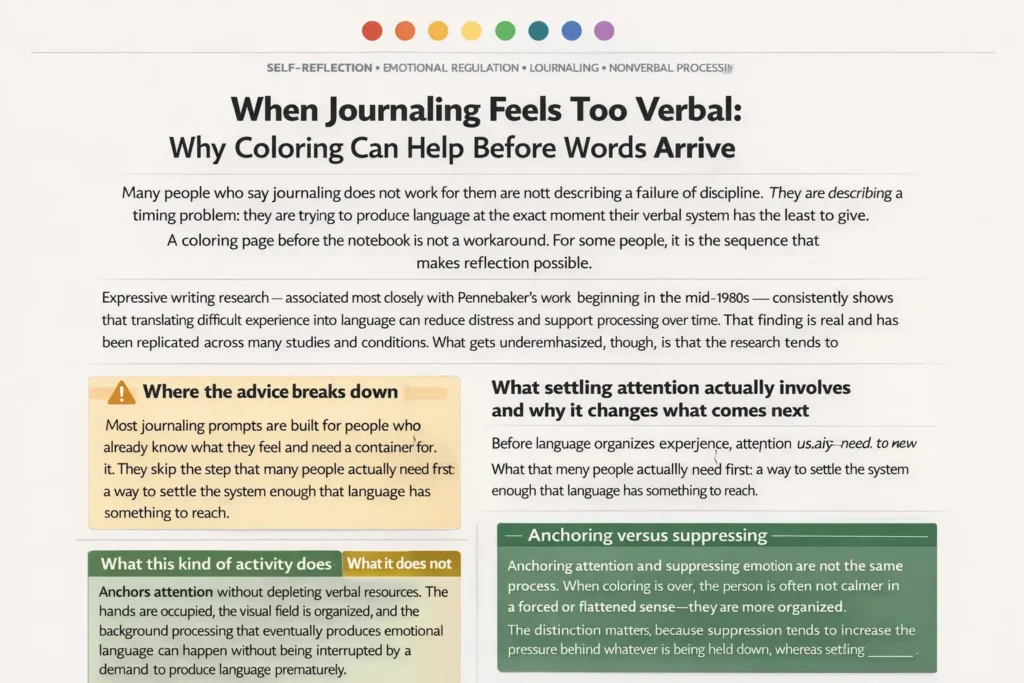
Most journaling prompts are built for people who already know what they feel and need a container for it. They skip the step that many people actually need first: a way to settle the system enough that language has something to reach.
Research on alexithymia provides useful context here, with an important qualification. Clinically significant alexithymia is a specific construct, typically measured by tools like the TAS-20 (Toronto Alexithymia Scale), and is associated with real difficulty in identifying and describing emotional states. The point here is narrower: the underlying difficulty exists on a continuum, and many people who would never score in a clinical range still find emotion-naming hard under fatigue, stress, or after socially demanding stretches. For them, “write about your feelings” lands as a demand the system genuinely cannot meet at that moment — not as a prompt they are unwilling to engage with.
This is a state variable, not a personality trait. The same person on a different morning, or after an hour of genuine rest, might open the notebook and write clearly and at length. What has changed is not their introspective ability — it is how much verbal capacity is available right now.
What settling attention actually involves, and why it changes what comes next
Before language organizes experience, attention usually needs to land somewhere first. This is not a clinical phenomenon specific to therapy — most people recognize it in ordinary life. A hard conversation becomes easier to think through after a walk. A decision that felt impossible at night looks different in the morning. The mind appears to process in the background when the foreground is given something bounded and manageable to do.
Coloring fits this function for specific reasons that are worth being concrete about. The structure is already there on the page — outlines exist, the task has an obvious completion point, and the activity occupies the hands and eyes without demanding verbal output or social performance. Nothing needs to be explained when it is finished. There is no correct way to have colored the page, and no follow-up question about what the colors meant.
Anchors attention without depleting verbal resources. The hands are occupied, the visual field is organized, and the background processing that eventually produces emotional language can happen without being interrupted by a demand to produce language prematurely.
It does not suppress, distract from, or resolve whatever is present emotionally. The feeling stays. The purpose is not to make it go away — it is to give the system time to reach its own level before being asked to speak.
The visual-motor rhythm of coloring — moving a pencil through bounded space — has a particular quality that open-ended rest often lacks. Many people find that unstructured quiet produces more rumination, not less, because there is nothing for attention to anchor to. A page with clear outlines provides that anchor without requiring sustained concentration in return.
Anchoring attention and suppressing emotion are not the same process. When coloring is over, the person is often not calmer in a forced or flattened sense — they are more organized. The distinction matters, because suppression tends to increase the pressure behind whatever is being held down, whereas settling allows processing to move forward.
The expressive pressure that blank pages create
One cost of journaling that often goes unnamed is the implicit performance demand. A blank page, even without a formal prompt, carries background questions: What did you feel? Is that the real reason? What does it mean? What should you do about it? These questions exist for many people regardless of what instructions they were given. The result can resemble stage fright — not fear of writing, but fear of producing an inaccurate account of one’s own inner life.
This matters for habit formation more than it may seem at first. When someone repeatedly sits down to journal, freezes, and gives up, they rarely conclude “I need a different entry point.” They conclude that they are not capable of reflection — and that conclusion gets reinforced each time the pattern repeats. The habit collapses not because the person lacks introspective ability, but because the entry cost exceeds what is available on the harder days, and those are the days that break the habit.
A coloring page does not ask for interpretation. Nothing needs to be explained when it is finished. The completion is visible and concrete, independent of whether any emotional insight occurred. That kind of low-stakes completion changes the relationship with the next step: the notebook opens without competing with an entirely unmarked start, and the bar for the one sentence that might follow has quietly dropped.
Coloring does not reveal the subconscious. There is no reliable color-to-emotion mapping that holds across individuals or cultural contexts, and the colors chosen during this activity are not diagnostic signals. The page does not need to be analyzed afterward. The mechanism being described here is reduced expressive pressure — not symbolic interpretation, and not therapeutic processing in the clinical sense.
Two other limits are worth stating plainly. First, this sequence is not a substitute for professional support. Persistent difficulty managing or identifying emotions — especially if it affects relationships or daily functioning — is a signal to work with a qualified clinician, not to find a better coloring page. Second, coloring does not function as a low-demand activity for everyone. Some people find it tedious or uninteresting. If the activity itself creates friction, it undermines its purpose. The underlying principle — settle attention before asking for language — can apply through other activities: a short walk, repetitive handcraft, washing up, music. The coloring page is one vehicle, not the only one.
The sequence: from page to one sentence to short reflection
The sequence is deliberately short. Longer is not automatically better here. The coloring step is not warm-up before the “real” work of journaling — it is the condition that makes the work reachable. Treating it as optional filler tends to reproduce the same stall that brought the person here in the first place.
Studies on affect labeling — most notably Lieberman et al., 2007 — show that even brief verbal identification of an emotional state can reduce its intensity through prefrontal engagement with the amygdala response. The mechanism is not proportional to length. One accurate sentence performs the same regulatory function as a page of accurate sentences. The difference between them is only in what you learn from the additional content — and on harder days, producing one sentence is the outcome worth protecting.
Who this sequence tends to help, and who it does not change much
This approach adds nothing for people who can open a notebook and find words without difficulty. For them, the coloring step is a detour. But there are several recognizable groups for whom the sequencing problem is real and consistent enough to be worth addressing directly.
| Who | What stalls journaling | What changes with this sequence |
|---|---|---|
| People who feel emotions physically before verbally | The feeling arrives as tension, restlessness, or weight — not as a labeled concept that language can reach yet | The coloring period gives the physical experience time to shift into something the verbal system can actually hold |
| People with high verbal perfectionism | The blank page triggers a need to write accurately and insightfully — which blocks the first word from appearing at all | Something is already done before the notebook opens; the entry anxiety no longer competes with a completely unmarked start |
| Teenagers who resist journaling prompts | Prompts feel like homework; putting feelings in writing feels exposing, especially if an adult might read it | Coloring requires no disclosure and produces no text that can be examined; the one-sentence step is low enough to feel private rather than surveilled |
| People after high-demand social days | Verbal capacity has been used heavily for hours; more verbal output is not just difficult but genuinely unavailable | The coloring step uses a different modality and allows verbal resources to partially recover before being asked for again |
| Anyone who keeps meaning to journal but stops after a few days | Entry cost is easy on good days and impossible on harder ones — so the habit never stabilizes past the first easy week | A consistent low-demand anchor makes the habit survivable on the harder days that were breaking it |
People who experience persistent, trait-level difficulty identifying or describing their emotional states — scoring consistently high on alexithymia measures — often find verbal journaling hard regardless of timing, rest, or prompting. For this group, a nonverbal entry point is not optional support. It may be the version of self-reflection that is genuinely accessible. Framing that as a motivation problem or a skill that more practice will fix tends to produce more frustration, not more reflection.
FAQ
Does this only work with coloring, or can other activities serve the same function?
Other activities can work. The relevant properties are: bounded (a clear start and end), low social demand, and occupying enough attention that rumination does not fill the space. A short walk, repetitive handcraft, washing up, or listening to one familiar piece of music can all qualify. Coloring fits well because it is quiet, requires minimal preparation, and produces a visible completion. If it adds friction — because you find it tedious, infantilizing, or simply uninteresting — use something else. The settling is the mechanism. The coloring page is one way to reach it, not the only one.
Do I have to journal afterward, or is the coloring page complete on its own?
The coloring is complete on its own. The one-sentence bridge is an option, not a requirement. Some days settling is all the system can use. If you treat the coloring as incomplete without a journal entry, you reintroduce the pressure the sequence is designed to reduce. Over time, if the habit stabilizes, more verbal reflection often becomes available naturally — not because the coloring trained it into existence, but because the entry cost has dropped enough that the notebook stops feeling like a demand.
What makes a page suitable for this purpose?
Clear outlines, moderate open space, and an obvious stopping point. A page that can be finished in 10 to 15 minutes without effort. Avoid highly detailed or pattern-dense pages — those require sustained concentration and function as a different kind of activity entirely. Avoid pages whose subject matter feels emotionally charged or stimulating before you begin; the goal is neutral engagement, not additional stimulation. If choosing a page is itself a decision that costs energy, prepare two options the night before and leave them out.
Does this work for teenagers who resist journaling?
It can, with specific adjustments. The page needs to feel age-respectful — for older children and teenagers, a pattern page, simple design sheet, or neutral line illustration works better than imagery that reads as childish. The one-sentence step should be genuinely optional and private, with no adult follow-up about what was written. Side-by-side presence — an adult doing their own quiet activity nearby rather than watching — lowers the social pressure considerably. The sequence tends to fail when the teenager perceives it as a technique for getting them to disclose feelings they want to keep.
Is this related to art therapy?
It draws on some of the same reasoning — that nonverbal activity can support emotional processing — but it is not art therapy. Art therapy is a clinical discipline practiced by trained professionals who use creative processes within a defined therapeutic relationship, with specific goals, ongoing assessment, and professional accountability. This is a self-directed sequence for everyday use. If you are working through something significant — trauma, persistent emotional dysregulation, or symptoms that are affecting daily life — please work with a qualified clinician rather than relying on a self-help approach.
Can I use this in the morning rather than at the end of the day?
Yes. The sequence is not specific to evenings or to decompression after school or work. Some people find it useful as a morning routine before demands begin. Others use it at midday when verbal fatigue has already accumulated. The timing that tends to work best is whatever consistently comes just before a moment when reflection would be useful but usually does not happen. Trying it at different times of day for a week or two is a practical way to find out where it actually fits your own pattern rather than where it is theoretically supposed to fit.
What if the page is finished and there are still no words at all?
That is a real outcome, and it is not a failure of the sequence. It usually means one of two things: the system needed more rest than a short coloring session can provide, or the feeling is not yet ready to become language. Both are legitimate states. On those days, the page was still a completed act — low-demand and concrete. Skip the notebook and try the following day. Over time, noticing when language is available versus when it genuinely is not is itself a form of self-knowledge that most journaling prompts skip entirely.
Sources and references
One of the foundational studies on expressive writing and health outcomes. Useful here as background for the idea that translating experience into language can reduce distress, especially once some narrative coherence has been reached.
Neuroimaging study on affect labeling and prefrontal regulation. Useful context for the idea that brief verbal identification of an emotional state can reduce its intensity.
Provides context for using alexithymia as a continuum concept. It helps explain why difficulty identifying and describing feelings can matter outside a narrowly clinical diagnosis.
Meta-analysis of expressive writing research. Useful for showing that the effects of verbal journaling are real but conditional, including on whether a person can engage narratively with the material.
Why Some People Need to Arrive with Their Hands Before They Can Arrive with Their Words
The misread I encounter most consistently
In over a decade of working with adults and adolescents, the pattern I see most often around self-reflection is this: the person is not unwilling. They are mistimed. They sit down with a journal at the exact point in the day when their verbal system has the least to offer — after school, after a long shift, after a conflict — and then interpret the resulting blankness as evidence that they are simply not introspective, or that journaling is not something they are capable of.
Neither conclusion is usually accurate. The same person, given genuine rest or approached at a different time of day, can often write clearly and at length. What changes is not capacity but the available bandwidth at that specific moment. In practice, many people simply open the notebook too soon, before anything inside has organized enough to meet them there.
Foggy versus flooded: a distinction that matters in practice
There is a distinction I find useful in clinical work that often collapses in popular self-help writing. A flooded state — high emotional arousal, racing thoughts, physical activation — sometimes does need grounding before any verbal work is possible. But a foggy state is different. In a foggy state, the person is not dysregulated in the clinical sense. They are pre-verbal: something is present and real, but it has not yet organized itself into a form that language can hold. Asking for verbal output in that state creates a bottleneck. The system is being asked to name something that is not named yet and explain something that is not structured yet — on demand and under implicit pressure to get it right.
In practice, some clients say very little during a coloring activity and then, five to ten minutes after putting down the pencil, can say something precise that was unavailable at the start. That should not be overstated: it is a clinical observation, not proof that coloring "unlocks" emotion. A more careful explanation is that the pause gives the internal organizing process time to finish before the demand to speak interrupts it.
What I actually tell clients about using this sequence
When I suggest a pre-reflection activity, I am direct about what I am and am not recommending. The page is not a diagnostic instrument. The colors chosen do not provide a reliable map of emotional state. The page simply gives the hands something to do while the rest of the system settles.
The test I ask clients to apply is simple: after the coloring period, was the first sentence easier to write? Not better, not more insightful — just easier to begin. If yes, the sequence is doing what it is supposed to do. If the coloring itself became a source of anxiety — if they found themselves wondering what their color choices revealed, or feeling pressure to complete the page correctly — the activity has stopped being low-demand, and something else should replace it. The value lives entirely in the activity remaining easy to start and easy to finish without performance attached. Once that quality is gone, the settling function is gone with it.