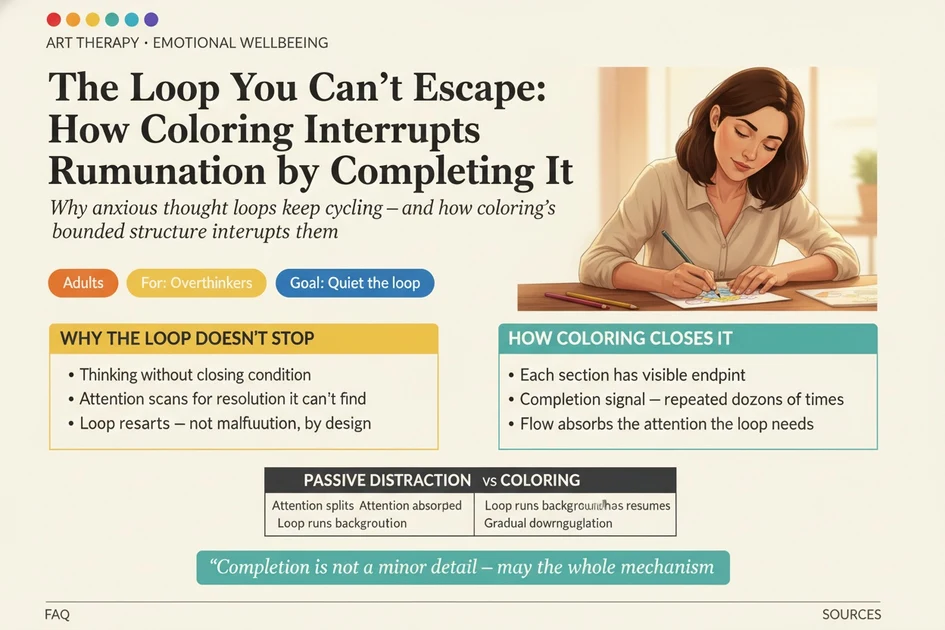
Why anxious thought loops keep cycling — and how coloring’s bounded, completable structure may interrupt rumination where other distractions can’t.
You’re in the middle of something ordinary — loading the dishwasher, lying in bed — and the same thought surfaces again. Not a new thought. The same one, wearing the same edges, arriving at the same dead end. You’ve already turned it over a dozen times and still arrived nowhere. This article explains what’s actually happening in that loop, why standard distraction so often fails, and why coloring — specifically the act of completing bounded sections — may interrupt rumination at the structural level, not just the surface level.
Mimi Panda is a creativity and coloring resource — not a therapy service. The information in this article is for general educational purposes only. Coloring and creative activities can support relaxation and self-care, but they do not diagnose, treat, or replace professional mental health care.
If you or someone you know feels unsafe, overwhelmed, or unable to function in daily life, please seek help from a qualified professional or contact your local emergency number.
Why the loop doesn’t stop on its own
Rumination is often described as “overthinking,” but that framing suggests the solution is to think less. It’s more accurate to say that rumination is thinking without a closing condition. Research on the attentional scope of rumination (Whitmer & Gotlib, 2013) describes how repetitive negative thinking narrows attentional focus toward unresolved stimuli — the mind keeps circling not because it wants to prolong distress, but because it’s scanning for a resolution it cannot find. Without a clear endpoint — a decision made, a problem solved, a question answered — attention has nowhere to land, so the cycle begins again.
This is why telling yourself to “just stop thinking about it” rarely works. You’re not fighting a bad habit; you’re working against an attention system that has flagged something as unresolved and is actively keeping it in view. The loop isn’t a malfunction — it’s the system doing exactly what it was built to do. The problem is that some situations genuinely don’t resolve: an uncertain outcome, a conversation that can’t be replayed, a decision whose consequences won’t be known for weeks. The loop runs, finds no exit, and loops again.
Why most distraction doesn’t work — and what’s different about coloring
The instinctive response to a thought loop is to redirect attention: scroll a phone, put on a show, talk to someone. These can work briefly, but they share a common structural weakness. Passive distraction — watching, scrolling, listening — doesn’t require the same quality of attentional engagement that the loop does. Attention splits: part follows the screen, part continues to monitor the unresolved item. The loop doesn’t end; it runs quietly in the background until the distraction stops.
Coloring introduces something different: a series of small, completable tasks. Each section of a coloring page has a boundary and an end state — filled or not filled. That seems trivial, but it isn’t. The act of completing a section, however small, produces something that rumination never can: a closed state. Something that was incomplete is now done. That completion signal — repeated across dozens of sections over twenty minutes — gives attention somewhere to land, repeatedly, with a different kind of finality than anything the anxious loop can offer.
Rumination is open-ended — it circles because it has no closing condition. A coloring section is closed-ended — it has a visible endpoint. Coloring doesn’t silence the anxious thought by competing with it; it offers attention a completable task the loop cannot.
The role of flow: why absorption matters more than mindfulness
A persistent assumption in coloring research has been that its benefits come primarily from mindfulness — the practice of present-moment, non-judgmental attention. The 2025 Flicker et al. study tested this directly and found something more nuanced: flow state was the stronger predictor. Mindfulness contributed, but flow and enjoyment were what actually moved the needle on anxiety.
Flow, in Csikszentmihalyi’s original formulation, is the state of absorbed engagement that emerges when task challenge and personal skill are matched. In flow, self-referential thought — including rumination — temporarily recedes. There is simply no attentional capacity left to sustain the loop. The key word is “absorbed”: flow doesn’t require effort to suppress intrusive thoughts; absorption uses up the attention that would otherwise sustain them.
Too simple a page — large, blank areas requiring no decisions — and attention has spare capacity to wander back to the loop. Too complex — microscopic detail requiring constant strain — and frustration blocks flow entirely. The anxiety-interrupting sweet spot sits in between: pages with defined sections that each require a small decision and can be completed in a few strokes.
Fredrickson’s broaden-and-build theory suggests that positive emotion expands attentional scope — the opposite of what rumination does. The pleasure of coloring, including the mild satisfaction of completing a section, may actively counteract the attentional narrowing that keeps the loop running. This is sometimes called the “undoing effect” of positive emotion.
The Flicker study specifically identified anxious mind-wandering during coloring as a negative predictor of relief. This means that coloring while still mostly thinking about the stressor does not produce significant benefit. The task needs to actually hold attention — which is a design question, answered by page choice and coloring approach.
What to actually do when the loop is running
The research points to specific variables — complexity, duration, and attentional approach — that determine whether coloring can interrupt a rumination loop or simply coexist with one.
Some people find the first 5 minutes of coloring while anxious uncomfortable — the contrast between the quiet page and the loud loop is stark. This is normal. The goal at the start is not to feel calm; it is to keep attention returning to the next small decision. Relief, when it comes, tends to arrive gradually rather than as a sudden shift.
At a glance: what matters and why
| Variable | What to do | Why it matters |
|---|---|---|
| Page complexity | Medium density — sections completable in 3–6 strokes | Enables flow; too simple = mind wanders, too complex = frustration |
| Duration | 15–20 minutes minimum | Flow states need time to develop; brief sessions may not reach absorption |
| Attentional approach | Follow section boundaries; redirect to color decisions | Mind-wandering during coloring negates anxiety relief (Flicker et al., 2025) |
| Completion awareness | Notice each section as finished before moving on | Completion signals provide what rumination cannot — a closed state |
| Framing | Aim for absorption and enjoyment, not relaxation | Flow and enjoyment — not mindfulness — are the strongest predictors of anxiety reduction |
The strategies in this article are for everyday self-care. If what you’re experiencing is persistent, significantly affects your daily life, or feels beyond what self-care can address, please speak with a qualified mental health professional. Coloring is not a substitute for professional care.
Frequently Asked Questions
Is coloring just a distraction — am I avoiding the problem by doing this?
It depends on what the rumination is about. If a decision genuinely needs to be made or a conversation needs to happen, coloring delays that — and avoidance isn’t helpful. But much of what we ruminate about is truly unresolvable in the moment: an uncertain outcome, a past conversation that can’t be changed, a future event that hasn’t happened yet. For those situations, continuing to loop doesn’t help; it just prolongs distress. Coloring doesn’t erase the situation — it allows the nervous system to downregulate so that you can return to the problem (if it is solvable) with more capacity than you had mid-loop.
Why do I feel worse when I stop coloring and the thoughts rush back?
That contrast effect is real. When attention has been absorbed in a task, returning to an unresolved concern can feel sharper by comparison. This doesn’t mean coloring made things worse — it means the break made the loop more noticeable when it resumed. If this happens regularly, it may be worth treating the coloring session as a transition rather than an endpoint: follow it with a brief, structured activity (a short walk, making tea) rather than returning immediately to the environment where the loop started.
Does the type of image matter, or is any coloring page the same?
Page design does matter. The mechanism depends on flow — absorbed engagement that uses up attentional capacity — and flow requires the right match of challenge to skill. Pages with very large, simple areas tend to under-engage attention, leaving capacity for mind-wandering. Pages with extremely fine detail can induce frustration rather than flow. For interrupting an active thought loop, medium-complexity pages with clear, completable sections tend to work better than either extreme. Mandalas with defined geometric segments, botanicals with visible leaf and petal boundaries, or animal illustrations with clearly separated markings are good starting points.
I can’t stop thinking about the problem even while coloring. Am I doing it wrong?
Not wrong — just in the early phase. The first several minutes of coloring when a rumination loop is active often feel uncomfortable: the gap between the quiet page and the loud internal noise is stark. Research suggests that absorption takes time to develop, typically after 8–10 minutes for some people. Rather than trying to suppress the thoughts, keep redirecting attention to the next small decision — what color, where the boundary ends — without judgment about the fact that thoughts keep returning. The goal at the start isn’t to feel calm; it’s to keep returning to the page.
Can coloring replace therapy for anxiety or rumination?
No. Coloring is a self-care tool for everyday stress and ordinary worry loops — not a substitute for professional support. If rumination is persistent, significantly interferes with sleep, relationships, or work, or is accompanied by depression or other symptoms, a qualified mental health professional can offer approaches — such as cognitive behavioral therapy or mindfulness-based cognitive therapy — that are specifically designed for these patterns. Coloring can be a useful complement to those approaches, but it addresses surface-level distress, not underlying patterns.
How is this different from just watching TV or scrolling my phone?
Passive media — TV, social feeds — is processed receptively: you receive content without making continuous micro-decisions. This leaves spare attentional capacity, which the rumination loop can occupy simultaneously. Coloring requires ongoing decisions — where the next stroke goes, what color to use, where a boundary ends — which engage attention more actively. Research consistently shows that coloring achieves greater state mindfulness and flow than passive leisure activities, which is what makes it more effective at occupying the attentional resources the loop needs to sustain itself.
Sources
References with evidence type and scope notes.
Completion is not a minor detail — it may be the whole mechanism
The following commentary reflects patterns observed in clinical practice with adults and families presenting with anxiety and repetitive thought patterns. It is not a substitute for individualized professional assessment or treatment.
The pattern I see most consistently in clients who ruminate
When clients describe their thought loops, they almost always use spatial language: going in circles, stuck, can’t find a way out. This is accurate. What they are experiencing is attention that has been assigned to an open problem and cannot be released because the problem remains open. The difficulty isn’t that they are weak-willed or poor at coping — it’s that the cognitive system is doing exactly what it was designed to do in the presence of an unresolved threat. Telling someone to “stop thinking about it” is asking their nervous system to stand down a surveillance function that believes something important is still at stake.
What I find clinically interesting about the coloring-and-completion approach is that it doesn’t try to override this function. It offers a different kind of object for attention to complete. A filled section is closed. Done. The system can release it and move to the next. Over the course of a session, this happens dozens of times — a quiet accumulation of closed states that may gradually lower the urgency the nervous system is assigning to the open problem. I think of it less as distraction and more as a kind of attentional re-patterning by repetition.
What the research doesn’t fully capture
The studies measure anxiety scores before and after coloring, and those numbers move in useful directions. What they can’t capture is the quality of the shift — the difference between someone who has genuinely downregulated and someone who has simply paused. In my experience, the clients who benefit most from creative self-care practices are the ones who notice, even briefly, the satisfaction of a completed section. Not as a mindfulness exercise — not as “notice what you are feeling right now” — but as a simple, quiet acknowledgment that something is now finished. That acknowledgment seems to matter. The clients who report coloring “doesn’t work for them” are often the ones who rushed through it, or who were so focused on not thinking about the stressor that they couldn’t engage with the task at all.
Flow is real, but it doesn’t feel like anything dramatic in the moment. Clients often describe it retrospectively: “I looked up and twenty minutes had passed and I hadn’t thought about it for a while.” That gap — not the euphoria of artistic creation, just the quiet gap in the loop — is what the technique is actually producing. It’s modest, and it’s enough.
How I tell if it’s working
The question I ask clients is not “did you feel better while you were coloring?” Most people feel neutral during — absorbed in something low-stakes, neither better nor worse. The more useful question is: “After you stopped and the thoughts came back, did they feel different in any way — less urgent, even slightly?” For some clients, the answer is yes. The loop returns, but at a lower intensity, as if the system has partially accepted that the threat level is not what it was thirty minutes ago. That shift — small, unremarkable, not a cure — is what we’re aiming for. Not silence. Just a different register.