Why Your 3–5 Year Old Melts Down Without Words: How Coloring Faces Builds the Emotional Vocabulary They’re Missing
A guide for parents of children who feel everything but can name almost nothing — and how coloring pages with expressive faces start building the bridge.
Your child is on the floor. The crying started — you’re not entirely sure why — and asking “what’s wrong?” produces either more crying or “I don’t know.” This isn’t drama or defiance. At ages 3–5, children feel intensely but often cannot name what they feel, because emotional vocabulary is built from the outside in, not from the inside out. This article explains the developmental reason behind that gap, and how coloring pages with expressive faces give your child a concrete tool to start naming emotions before they can produce the words on their own.
Mimi Panda is a creativity and coloring resource — not a therapy service. The information in this article is for general educational purposes only. Coloring and creative activities can support relaxation and self-care, but they do not diagnose, treat, or replace professional mental health care.
If you or someone you know feels unsafe, overwhelmed, or unable to function in daily life, please seek help from a qualified professional or contact your local emergency number.
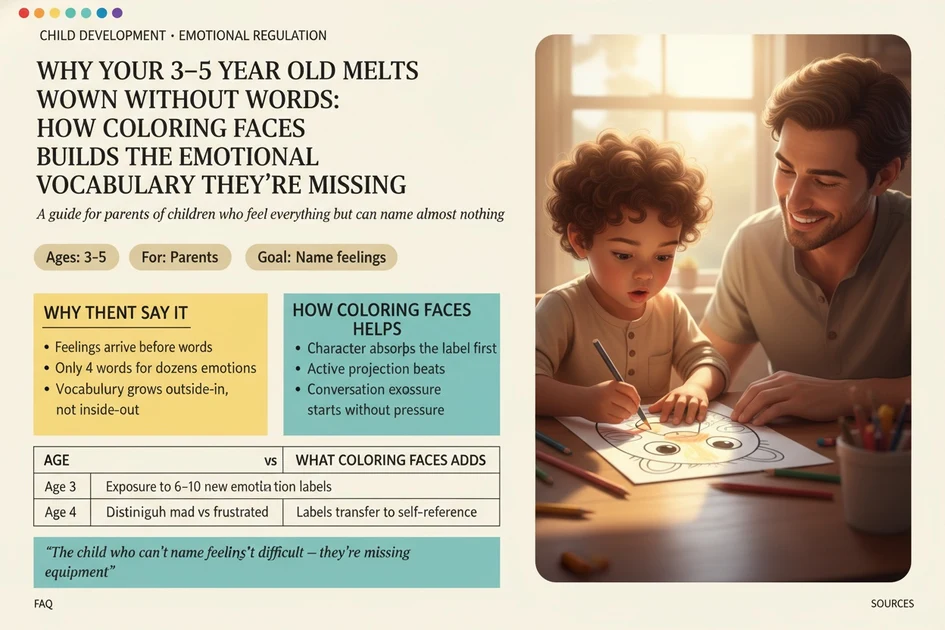
Why “Use Your Words” Doesn’t Work at Age 4
Most parents assume that when a 3 or 4-year-old can’t explain what’s wrong, they’re choosing not to. They’re not. Emotional experience and emotional language are developmentally separate systems — and in early childhood, the feeling always arrives long before the word does.
Children this age feel the full range: fear, frustration, shame, excitement, jealousy, overwhelm. But the emotional vocabulary most 3-year-olds have available is: happy, sad, mad, scared. That’s four words for dozens of experiences. When the experience doesn’t match any of the words they know, silence or screaming is not avoidance — it’s an honest response to a vocabulary gap.
Research published in Child Development (2022) found that the ability to categorize emotions using language has long-term implications for social and emotional development — but that this ability develops through external exposure to labeled emotion examples, not through prompting children to search for words internally. You can’t draw vocabulary from a well that hasn’t been filled yet.
The practical consequence: asking a child “what are you feeling?” when they don’t yet have the word is like asking someone to name a color they’ve never seen labeled. The answer isn’t hidden. It simply doesn’t exist yet in accessible language.
How Emotional Vocabulary Actually Develops: The Outside-In Pathway
Before a child can label an internal state (“I feel frustrated”), they need to have encountered that word attached to a clearly visible, external example of that state. This is why children learn “sad” most reliably from pictures of crying faces — not from their own crying. The external image gives the word somewhere to land.
Developmental researchers describe this process as affect scaffolding — building internal emotional language through external representations the child can observe, describe, and eventually internalize. It works the same way children learn color words: not by introspecting about “redness” but by pointing at objects that are red and hearing the label applied repeatedly in context.
The developmental sequence is not: feel something → name it.
The actual sequence at ages 3–5 is: see a face (or character) that expresses something → hear the label → recognize a match in your own body → eventually name it.
A child who has encountered “frustrated” thirty times while coloring a character whose block tower fell — and has said “she’s frustrated” while pointing at the face — has that word available when their own block tower falls. The child who was only ever told “use your words” doesn’t.
Once the word is anchored to an external image, it becomes available for internal use. The transfer is gradual and requires repetition. It doesn’t happen from a single conversation — but it does happen reliably from regular, low-pressure exposure.
Why Coloring Faces Creates This Bridge Specifically
Not all coloring is equally useful for emotional vocabulary. A page of flowers or vehicles gives a child nothing to project onto emotionally. A page with expressive character faces gives the child three things that don’t happen with other methods:
A child who cannot say “I’m scared” can readily say “the rabbit is scared” while coloring the rabbit’s wide eyes — without any self-exposure. The character takes the emotional statement so the child doesn’t have to. Over time, the label migrates inward.
The child is making the face — choosing colors for the sad mouth, the angry brow, the worried eyes. This active engagement creates stronger memory encoding for the emotion-word pairing than looking at a flashcard passively.
A child asked “how do you feel?” often shuts down. The same child coloring a face, asked “what’s this dog feeling right now?”, answers spontaneously, at length, and often with surprising detail.
This is the mechanism that makes coloring faces qualitatively different from looking at a feelings chart on the wall. The child isn’t just reading a label. They are constructing the connection between the visible expression and the word, by hand, in an activity they control.
How to Use Coloring for Emotional Vocabulary: Five Specific Steps
The following guidance is grounded in the developmental mechanism above — not general coloring advice. Each step has a specific reason.
For a 3-year-old, the entire practice can be reduced to: color a face together, name one feeling (“that one looks sad to me”), and move on. There is no discussion required. Repetition across many sessions does the work — not any single conversation.
What to Expect at Each Age
| Age | Typical emotional vocabulary | What coloring faces adds |
|---|---|---|
| 3 years | Happy, sad, mad, scared (4–6 words) | Exposure to 6–10 additional labels attached to visible faces; no verbal output required from the child |
| 4 years | Happy, sad, mad, scared, surprised, silly (6–10 words) | Begin distinguishing similar emotions (mad vs. frustrated); projection onto characters becomes active and spontaneous |
| 5 years | 10–20 emotion words; beginning to understand mixed feelings | More nuanced expressions, stories about why the character feels that way; vocabulary beginning to transfer to self-reference |
Vocabulary ranges are approximate and vary significantly by individual child and language environment.
The strategies in this article are for everyday developmental support. If your child’s meltdowns are very frequent, intense, or significantly affecting daily life and family functioning, please speak with your pediatrician or a child psychologist. Coloring is not a substitute for professional assessment or care.
Frequently Asked Questions
My child just colors without talking — is that still useful?
Yes, with some structure from you. If your child doesn’t comment spontaneously, you provide the observation: “Look at his face — he looks nervous to me. See his eyebrows?” You’re modeling the connection between expression and label. Your child is listening and encoding even when not responding. Over many sessions, words start appearing.
How is this different from feelings flashcards?
Flashcards ask the child to retrieve a label on demand — precisely what children in emotional arousal cannot do. Coloring builds the label into memory through active construction rather than passive recall. The physical activity also lowers arousal, creating a better state for encoding. Flashcards have their place for calm review; coloring is better for building the connection in the first place.
Does this work during a meltdown, or only after?
Only after. Mid-meltdown, your child’s nervous system is flooded and both fine motor control and language processing are offline. Introducing coloring during a meltdown is likely to escalate rather than help. The best window is 15–20 minutes after the storm passes — when the child is calm but still emotionally accessible. Use it regularly between difficult moments too, not only reactively.
Isn’t this just avoidance — giving the child something to do instead of dealing with the feeling?
This is a fair concern, and the distinction matters. If you use coloring to redirect a child away from an emotion that needs acknowledgment (“stop crying, let’s color”), that is avoidance. If you use it in a calm window to build the vocabulary the child needs to name future emotions — that is preparation, not avoidance. The goal is that next time the feeling arrives, the word is already there. That’s the opposite of avoiding it.
At what age should a child reliably name their feelings?
Most developmental guidelines expect children to begin using basic emotion labels — happy, sad, mad, scared — between ages 2.5 and 3.5, expanding to a wider range through ages 4–6. Reliably naming complex feelings under stress takes much longer, often developing through early elementary years. If your child at 5 still cannot label any feelings in calm moments, it is worth mentioning to your pediatrician.
Do I have to buy special emotion-focused coloring pages?
No. Any coloring page featuring a character with a visible face works. Animals with expressive faces, cartoon people, storybook characters — all of these provide enough visual information for a conversation. The most important feature is a readable expression: not a neutral or unclear face, but something your child can look at and form a hypothesis about. Simple, bold, exaggerated expressions work better than realistic ones for children under 5.
Can coloring replace talking about feelings with my child?
No — it is a vocabulary-building tool, not a replacement for connection and conversation. What it does is give your child the words so that later conversations become possible. A child who has heard “frustrated” labeled many times while coloring is much more likely to say “I’m frustrated” in the moment when you ask. The coloring creates the vocabulary; the relationship is where the vocabulary gets used.
Sources
References with evidence type and scope.
The child who can’t name what they feel isn’t being difficult — they’re missing equipment
I work with children and families navigating school transitions, anxiety, and the behavioral fallout of emotional dysregulation. Meltdowns in preschool-age children — especially those where the child genuinely cannot explain what went wrong — are among the most common concerns parents bring to me.
The pattern I see most consistently in practice
When a parent describes a 4-year-old who screams over “nothing,” what I find most often is not a behavior problem or defiance. I find a child with a large emotional experience and a small emotional vocabulary. The feeling is genuinely overwhelming — the body knows something is very wrong — but there is no internal label the child can reach for. The dysregulation is, in part, the language failure itself. Not having words for what is happening to you is frightening at any age. At four, it’s developmentally normal, but it doesn’t feel that way from the inside.
The intervention I see parents attempt most often is “use your words.” This asks the child to produce vocabulary they haven’t yet acquired. It’s the equivalent of asking someone to speak in a language they’ve never been taught. The frustration this creates on both sides compounds the moment — the child feels misunderstood; the parent feels ignored. Neither is true, but both feel true.
What I’ve found much more effective is what I call the vocabulary-before-the-moment approach: you build the words during calm, low-pressure activities — and then those words are available when the storm arrives. Coloring pages with expressive faces are one of the most natural versions of this I’ve seen parents use successfully at home, because the activity is already familiar and the emotional content enters through the side door, via a character rather than a direct question.
What the research doesn’t fully capture
The studies on affect labeling and emotional vocabulary are clear: naming emotions can reduce their intensity. But what the research doesn’t fully capture is what happens in the room when a child who has been coloring characters and naming their feelings for three weeks suddenly, mid-argument, says “I’m frustrated” for the first time — instead of throwing something.
It shifts the relationship, not just the behavior. The parent hears it differently. They respond differently. The child experiences being understood — possibly for the first time in that way — and that experience is regulatory in itself. The word opened the connection, and the connection did the calming. Research on affect labeling tends to measure the word’s effect on the individual nervous system. In a child-parent context, the relational effect is often larger than the neurological one.
I also notice that children who have done a lot of emotional vocabulary work through character-based activities — not just coloring, but books and imaginative play — develop what I’d call emotional hypothesis-making: they start wondering about other people’s feelings, not just their own. “Is she sad?” asked about a classmate or a character on television is a sign that the vocabulary has generalized into empathy. That broader capacity is not something you can teach directly; it emerges once the vocabulary is in place.
How to tell if it’s working
The question I ask parents after a few weeks isn’t “did the meltdowns go away?” — they often don’t, immediately. The question is: “Is your child naming feelings in any context at all — even for characters in books, even for animals, even as guesses about what you might be feeling?”
If yes, the vocabulary is growing. The transfer to self-labeling during stress comes later — it requires that the word be well-established in calm contexts first. Progress looks like a child who talks freely about characters’ feelings during coloring, before it looks like a child who says “I’m frustrated” mid-meltdown.
If after several weeks a child still cannot label any expressed emotion in any external context — not a book character, not a face in a photo, not a toy — that warrants a conversation with a pediatrician. Not because something is necessarily wrong, but because some children have language or processing profiles that mean this pathway needs a different entry point. Identifying that early makes a meaningful difference.