Why Some Kids Refuse to Color: Sensory, Control, and Skill-Match Reasons
When parents look up why kids refuse to color, they often find explanations that are too narrow. One text reduces everything to sensory sensitivity. Another treats refusal as fear of mistakes. Another frames it as attitude, stubbornness, or short attention span. In daily life, the reason is usually more specific. A child may dislike the feel of the materials, resist how the activity is being directed, find the page mismatched to their current ability, worry about doing it “wrong,” or simply feel no interest in the task.
That is why the most useful question is not “How do I make my child color?” but “What exactly is my child avoiding inside this task?” The answer changes what the adult should do next. A child who dislikes waxy drag or marker smell needs different tools. A child who shuts down at tiny shapes needs a simpler page. A child who resists because every choice has already been made may be reacting to control, not to art itself.
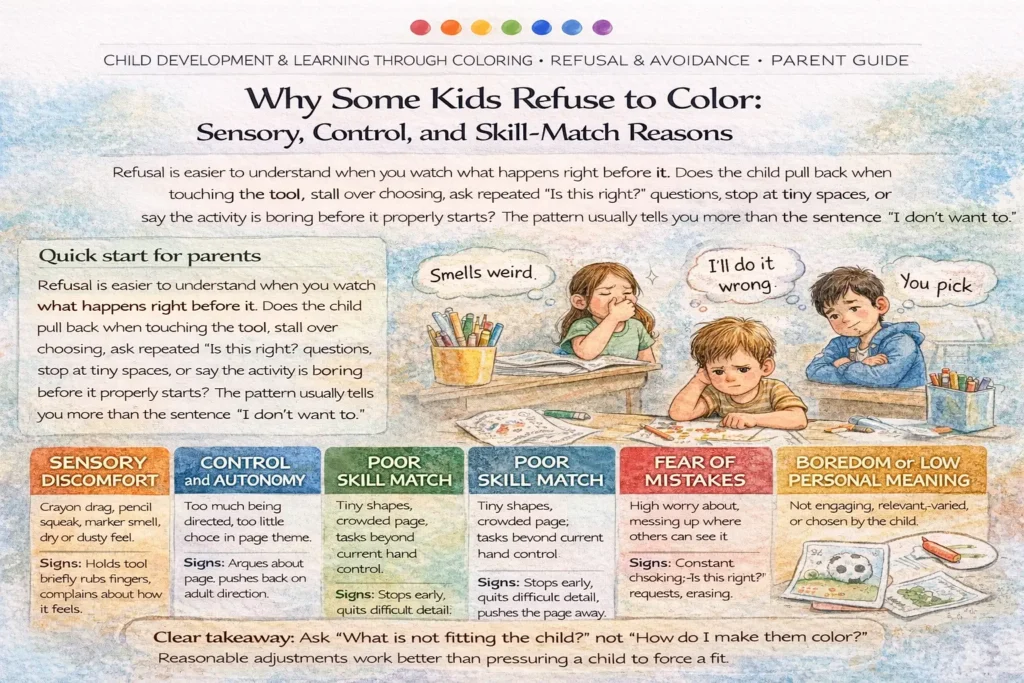
Why refusal is usually information, not simple defiance
Adults often see coloring as a low-pressure activity. From the outside, it looks easy: sit down, pick a color, fill the page. But children do not experience tasks from the outside. They experience them from inside the body, inside the moment, and inside the relationship with the adult presenting the task. If the tool feels unpleasant, the page looks crowded, the instructions feel controlling, or the child expects correction, the activity stops feeling simple.
This is why the same child may color willingly one day and refuse the next. The difference may be the page, the materials, the timing, the amount of adult direction, or how visible mistakes feel in that moment. A child can enjoy open coloring on blank paper and still refuse a worksheet full of tiny shapes. They can join when the activity feels self-chosen and resist when it feels supervised. These differences matter because they show that the problem is not always “coloring” as a category. The problem is often the specific demand built into that version of coloring.
Refusal also becomes easier to read when adults stop treating it as a personality statement. It does not automatically mean laziness, poor behavior, or a deeper issue. Sometimes the child is simply protecting themselves from a task that feels too uncomfortable, too controlled, too difficult, too risky, or too dull.
The main reasons some kids refuse to color
Some children dislike the physical experience of coloring. The crayon may drag too hard. The pencil may squeak. The marker smell may feel too strong. Dusty, waxy, sticky, or dry textures can bother the hand. Visual density can also play a role: a page packed with small shapes may feel unpleasant before the child even starts.
The signs are often fast and practical. The child touches the tool and drops it, rubs their fingers, complains about smell or feel, shakes their hand, or leaves the task quickly. In these moments, the child is not necessarily rejecting art. They may simply be avoiding a body-level discomfort.
Some children do not mind coloring itself. They mind being managed through it. If the adult chooses the page, the theme, the colors, the timing, the seat, and how long the child should stay, the task can stop feeling like play and start feeling like compliance.
This often sounds like “I don’t want that one,” “You choose,” “Not now,” or “I’ll do it later.” The child may argue before the activity even begins. In that case, the refusal often points to ownership. A small amount of real choice can make a large difference.
A child may refuse because the page asks for more precision, patience, visual organization, or hand control than feels manageable that day. Tiny spaces, dense patterns, long sessions, and adult-style neatness can make the task feel impossible before it begins.
This often shows up as “It’s too hard,” “You do it,” or early quitting at the most detailed part of the page. In that situation, pushing for better effort usually increases frustration. A better first move is to reduce demand by simplifying the page.
Some children avoid coloring because they expect visible mistakes to feel bad. They may worry about choosing the wrong color, going outside the lines, making the picture look ugly, or hearing correction. This is not the same as a broad label like perfectionism. In this task, the child is trying to avoid the feeling of doing something wrong where others can see it.
Common signs include repeated checking, frequent “Is this right?” questions, erasing, watching the adult’s face for reaction, or quitting after one disliked mark.
Some children refuse coloring because the activity feels flat. The page may not connect to their interests. The format may feel repetitive, passive, or too controlled. A child who likes building, storytelling, designing, or movement may experience standard coloring pages as busywork rather than engagement.
This kind of refusal often sounds direct: “This is boring,” “This is babyish,” or “Can I do something else?” That response usually points to low relevance rather than inability.
How refusal usually looks in real life
The same sentence — “I don’t want to color” — can mean very different things depending on what happens around it. Watching the sequence matters more than treating every refusal as the same kind of problem.
| What you notice | What it may point to | What to say | Best first adjustment |
|---|---|---|---|
| Drops the crayon, rubs fingers, complains about smell or feel | Sensory discomfort | “This one may not feel good. Let’s try a different tool.” | Switch materials before talking about behavior |
| Argues before starting, rejects the page, resists setup | Control or autonomy issue | “You choose this page or that page.” | Return one or two real choices |
| Says “too hard,” stops at tiny spaces, asks you to do it | Poor skill match | “This page looks crowded. Let’s make it easier.” | Use larger shapes and shorter coloring time |
| Checks constantly, erases, quits after one “wrong” mark | Mistake pressure | “There isn’t one correct way to color this.” | Reduce correction and model flexible choices |
| Says it is boring, rushes, leaves quickly, asks for another task | Low interest or low meaning | “What would make this feel more like yours?” | Link coloring to the child’s interests or let them create the page |
How age can change the pattern
In younger children, refusal often reflects sensation, sitting tolerance, visual overload, or basic mismatch between the page and the child’s current ability. Large shapes, short sessions, and simple materials matter more than finished results.
At this stage, visible mistakes and comparison often become more important. A child may notice whether they seem “good” at the activity, avoid pages with detailed sections, or ask repeated questions because they want to avoid public failure.
Older children are more likely to resist when the activity feels childish, repetitive, or disconnected from their interests. Autonomy and relevance often matter more than the basic act of coloring itself.
How to identify the real cause instead of guessing too fast
The easiest mistake is changing everything at once. A parent sees refusal and tries encouragement, rewards, new pages, more help, and firmer direction in the same session. That usually makes the situation harder to read. A better approach is to change one variable at a time and watch what changes.
What usually makes refusal worse
Long explanations, repeated encouragement, or constant reminders can increase pressure. Some children do better with a short, calm invitation.
Comments like “Stay in the lines,” “Use a better color,” or “Try harder” can quickly turn a manageable task into a performance task.
Dense detail, tiny sections, and visual clutter can trigger avoidance before the child really begins.
Children often notice fake choice immediately. If the adult has already decided everything important, resistance usually rises.
Once the child is read as lazy, difficult, or stubborn, the adult often stops looking for the actual obstacle.
When the pattern deserves a closer look
Disliking coloring by itself does not automatically point to a broader concern. Some children simply prefer other activities. But a repeated pattern can deserve more attention when it is intense, broad, or clearly interfering with daily participation.
- the same strong avoidance shows up across many table tasks, not only coloring;
- the activity triggers marked distress, shutdown, or repeated conflict at home or school;
- the child frequently complains of strong discomfort with common tools and textures;
- fear of mistakes begins to block many learning tasks, not only art tasks;
- avoidance is affecting classroom participation, homework, or confidence across settings.
In those cases, the question is not only whether the child likes coloring. The wider question is whether participation demands, sensory comfort, performance worry, or task fit are creating a broader pattern.
What helps in the moment
In a tense moment, specific language usually works better than motivational language. The child does not need a speech. They need the adult to lower friction fast enough that participation remains possible.
Useful scripts
If the problem may be sensory: “This marker may feel better. Let’s test it.”
If the problem may be control: “You choose the page, and we stop after this part.”
If the problem may be skill match: “This one has too many tiny spaces. Let’s pick a simpler one.”
If the problem may be mistake pressure: “There is no one correct way to do this page.”
If the problem may be boredom: “Do you want to color this page or make your own?”
A clear takeaway
The best answer to why kids refuse to color is rarely one grand theory. It is usually a better observation question: what exactly is this child avoiding inside the task? If the answer is sensation, change the materials. If the answer is low control, return choice. If the answer is skill mismatch, simplify the page. If the answer is fear of error, lower the pressure. If the answer is boredom, make the task more meaningful or switch to a different kind of creative activity.
Once refusal is treated as information instead of instant misbehavior, the adult gets something more useful than short-term compliance. They get a clearer picture of what helps the child participate well.
FAQ
Why do some kids refuse to color even when they like other art activities?
Because coloring is only one kind of art task. A child may enjoy painting, drawing, cutting, or building while still disliking coloring pages. The obstacle may be the feel of the materials, the structure of the page, the amount of adult control, mistake pressure, or low interest.
Does refusing to color usually mean a sensory problem?
Not always. Sensory discomfort is one common reason, but it is not the only one. Some children refuse because the page is too demanding, the task feels controlled, they worry about mistakes, or the activity feels boring and disconnected from their interests.
How can I tell whether the problem is control rather than ability?
Watch when the refusal starts. If the child resists before beginning, argues over the page, or engages much better once they can choose materials or timing, control is often a major factor. If they start willingly and then stop at narrow spaces or detailed sections, skill match is more likely.
What if my child starts coloring and then suddenly quits?
Sudden quitting often points to a specific trigger. The child may have reached a crowded section, made a mark they disliked, become physically uncomfortable, or simply lost interest once the task became repetitive.
Should I encourage my child to keep trying anyway?
Gentle encouragement is fine, but pushing through without understanding the obstacle often backfires. It usually helps more to adjust one part of the setup first. When the task fits the child better, effort becomes more realistic and less conflict-driven.
Is it a bad sign if my child says coloring is boring?
Not necessarily. Boredom may simply mean the activity lacks relevance. Some children engage much better when they can color their own drawing, use unusual themes, add storytelling, or mix coloring with design and choice.
When is refusal worth discussing with a specialist?
It deserves a closer look when the same pattern shows up across many table tasks, causes strong distress, affects school participation, or seems tied to broader sensory discomfort or performance anxiety. Coloring refusal alone is not enough to explain a child, but a broad pattern may need more support.
Sources (primary references)
Expert Commentary: Refusal Often Protects the Child From a Demand That Feels Too Costly
Comment by expert reviewer profile
Why adults often misread the moment
One of the most common mistakes adults make is to treat refusal as the whole story. Usually it is only the final visible step in a chain that started earlier. The real strain often begins before the first color touches the page. The child may already be scanning the situation: Do I get to choose? Is this page too hard? Will somebody correct me? What if I do it badly? What if the marker feels unpleasant? By the time the adult hears “I don’t want to,” the child may already be protecting themselves from a demand that feels too costly.
What changes when the adult looks for the demand
The most effective adults do not rush to win the standoff. They try to identify the pressure point inside it. That difference matters. When the response is “Come on, it’s easy,” the adult is reacting to the visible behavior. When the response is “This page may be too crowded,” “You want more choice,” or “That marker may feel bad in your hand,” the adult is responding to the actual friction. Children usually become less defensive when they feel accurately understood. That does not mean removing every challenge. It means adjusting the setup enough that the child can participate without starting from overload, embarrassment, or immediate failure.
The most useful mindset shift for parents and teachers
In practical terms, the most helpful question is not whether the child can color. It is whether this version of the task is asking for the right thing, at the right level, in the right format, at the right moment. Some children need larger spaces. Some need less talking. Some need better tools. Some need a shorter entry point. Some need reassurance that there is no single correct result. Once adults shift from behavior control to demand-matching, refusal becomes much easier to understand. The child no longer has to defend themselves from the activity, and the adult no longer has to mistake self-protection for bad behavior.