Screen-Fatigue and the Return of Printable Activities: Why Parents Download More Printables
In many homes, the tension isn’t “screens vs. no screens.” It’s the feeling that screens never end. That’s why printable activities for kids are back: one page creates a clear start, a calm middle, and an obvious finish. Used well, printables become reliable screen free activities and a repeatable offline family activity that supports attention, transitions, and calmer routines—without turning parents into full-time planners.
Why printables feel easier than “planning activities”
Planning sounds simple until you’re the one doing it at 6:30 p.m. with a child who’s hungry, wired, and not in the mood for “suggestions.” The hidden cost isn’t the activity itself—it’s the executive function required to choose it: picking an idea, gathering materials, explaining rules, adjusting for age, and managing clean-up. That’s where decision fatigue shows up, and kids feel the friction immediately.
Printables remove a lot of that friction. They are compact by design: a prompt, a boundary, and a finish line—right on the page. And because they’re pre-structured, they don’t ask a parent to invent a whole plan on the spot. For families feeling screen fatigue, a printable can be the gentlest kind of reset: quiet, contained, and predictable.
- Harder transitions when a device is turned off (more bargaining, more big feelings).
- Lower tolerance for boredom (“What do I do now?” even when options exist).
- Restless mood after fast content (kids feel “wired” but not satisfied).
- Shorter attention for slow tasks (books, puzzles, building toys).
- Conflict spikes around timing (“just five more minutes”) instead of shared routines.
Choose a page, not a project. The instructions and constraints are already built in.
Most pages need only a pencil, crayons, or a short scissors/glue step—more realistic on weekdays.
“One page” is easier to agree on than “let’s do something.” The page becomes a calm container.
Strong quiet time printables are understandable after one quick demo, so kids can keep going on their own.
Practical pediatric guidance tends to emphasize balance, context, and family routines—especially for younger children. When parents create a predictable offline option, it becomes easier to reduce passive, unplanned screen use without constant conflict. In practice, that’s exactly where printable activities fit: they are fast to start, simple to finish, and easy to repeat.
The “15-minute reset” routine
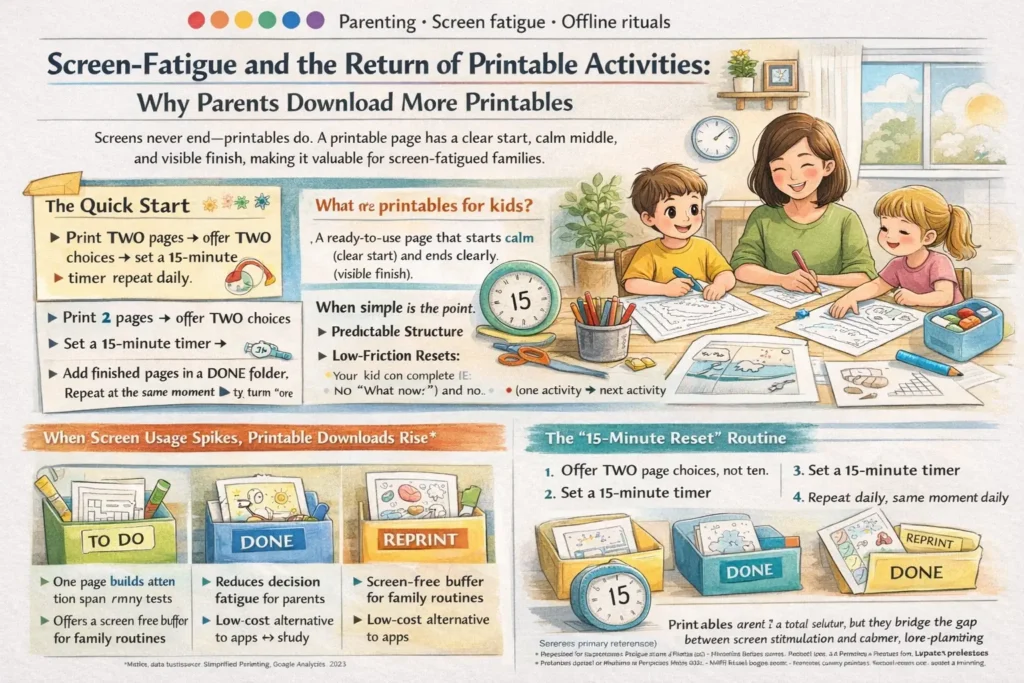
If you want printables to work as true screen free activities rather than a novelty, attach them to a repeatable moment. The “15-minute reset” is a short ritual that supports regulation for kids and breathing room for adults. The goal isn’t perfect output. It’s a predictable transition that helps the household downshift.
- Minute 0–1: Clear one small surface. Put out only the tools you’re willing to manage (two markers, not a full bucket).
- Minute 1–2: Offer two page choices, not ten. Too many options recreates decision fatigue.
- Minute 2–12: Start a timer. Explain that the timer is the “boss,” not the parent.
- Minute 12–14: Ask one question: “Show me one part you like.” Keep it warm and short.
- Minute 14–15: Put the page in a “DONE” tray or folder. That visible completion is the reward.
| Minute | Child task | Parent role | What it builds |
|---|---|---|---|
| 0–2 | Choose one page and tools | Offer two choices, set the timer | Predictability + autonomy |
| 2–12 | Work quietly | Do a 10-minute adult micro-task nearby | Sustained attention |
| 12–14 | Share one favorite detail | One warm question, no “fixing” | Connection without pressure |
| 14–15 | File the page away | Reset the table together | Closure + responsibility |
Age tweaks that keep it calm
- Ages 3–5: Choose bold, simple pages with big shapes, traceable lines, and “find and color” prompts. Keep scissors tasks short (one strip, not a full collage).
- Ages 6–8: Add puzzles and logic-lite challenges (mazes, word searches, spot-the-difference, simple “color by number” or math coloring). Offer a “challenge level” by adding one extra rule.
Where mindful play fits (two easy modes)
Script: “One slow breath. Now pick one shape to color very slowly.” This turns a page into quiet time printables with a regulation cue, without making it feel like a “lesson.”
Script: “Choose three items to find. Point to them first, then color.” Great for “find-and-color” pages and hidden picture activities when attention is scattered.
Mindful play doesn’t have to look like meditation. For kids, it’s often a tiny body cue paired with the page: “Notice your hand pressure—light or heavy,” or “Color one section slowly before you speed up.” These micro-prompts turn printables into a practical reset that fits real family schedules.
How parents choose pages (age, theme, complexity)
Parents download printables because they want an easy yes. But “easy” depends on fit. When a page is too hard, it creates conflict. When it’s too easy, it becomes boring. The best pages land in the sweet spot: slightly challenging, but doable without adult rescue.
A practical selection checklist
- Age fit: Match fine-motor skills. Cutting tiny shapes is advanced even if the topic seems easy.
- Theme fit: Kids stick longer when the theme matches their current obsession (animals, trucks, space, fairy tales).
- Complexity: Check density. Too many tiny items, long instructions, or multi-step tasks can overwhelm.
- Purpose: Are you aiming for calm (quiet time printables) or energy (movement prompts, scavenger hunts)?
- Time: If you need a 10-minute buffer, choose a one-page activity, not a mini-book.
A more “expert” shortcut: choose by the skill you need today
| Need | Best page type | What to avoid | Why it works |
|---|---|---|---|
| Calm down | Large-shape coloring, slow patterns | Tiny details, long instructions | Low cognitive load, steady rhythm |
| Focus | Mazes, spot-the-difference, hidden picture | Multi-step crafts | Clear goal + feedback loop |
| Connection | Draw-and-tell, mini story prompts | Pages that invite correcting | Easy “share moment” at the end |
| Motor practice | Trace lines, simple cut-and-paste | Intricate cutting for young kids | Skill repetition without pressure |
| Age band | Best-fit printable activities for kids | Complexity cues | Adult support |
|---|---|---|---|
| 3–5 | Big-shape coloring, trace-and-draw, matching pairs, simple cut-and-paste | Large images, short prompts, minimal text | Start it once, then step back |
| 6–8 | Mazes, word searches, dot-to-dot, math coloring, mini writing prompts | Clear rules, medium density, optional challenge | Quick check-in, not full supervision |
| 8–10 | Multi-step puzzles, short journaling, mini STEM worksheets | Longer instructions, smaller details | Help with the first example |
| Mixed ages | “Choose your level” sheets (two difficulty options on one page) | Built-in choice, clear paths | Let older kids teach younger |
Three rules that prevent frustration
- Print one page, not a stack. Too many pages can feel like “work,” not play.
- Start with success. Use a slightly easier page first, then rotate to a challenge.
- Don’t over-correct. If the goal is screen fatigue relief, perfection isn’t the point.
Tips to keep it sustainable (storage, rotation)
Printables work best when they’re treated like a tiny system, not a random pile of paper. Sustainability is mostly logistics: where pages live, how you avoid printing duplicates, and how you keep novelty without chasing new downloads every week.
Storage that stays tidy
- The three-folder method: TO DO (fresh pages), DONE (completed pages), REPRINT (favorites worth repeating).
- A binder with plastic sleeves: turn a few pages into reusable activities (dry-erase markers) if you want to print less.
- A shallow “printable tray”: keep it visible but contained, so it’s easy to start and easy to clean up.
Printing strategy that reduces waste
- Keep master files digital and print only what you need for the week.
- Default to black-and-white unless color is essential (kids often prefer choosing their own colors).
- Promote favorites to “core pages” and reprint them on slightly thicker paper when they become a hit.
| Day | Bucket | Page type | Refresh rule |
|---|---|---|---|
| Mon | Calm Color | Coloring + “find and color” | Keep if it lowers energy |
| Tue | Puzzle/Focus | Maze or spot-the-difference | Replace if too easy |
| Wed | Create/Write | Draw-and-tell or mini story | Keep if the child asks to share |
| Thu | Cut/Build | Cut-and-paste scene | Replace if it causes stress |
| Fri | Choice | Any bucket | Reprint the week’s favorite |
| Weekend | Mix | Longer page or mini-pack | Reset buckets on Sunday |
Make it feel like a ritual, not a chore
- Name the routine (“quiet page time,” “reset page,” “15-minute desk time”).
- Add one predictable cue: a timer, low music, or the same “start question.”
- End with closure: finished pages go in DONE. The growing stack of completed pages becomes its own motivation.
Parents don’t reach for printables because paper is magic. They reach for them because paper is simple. The right printable gives kids a clear task, and it gives parents a short, humane pause. Over time, those small pauses add up into steadier offline family activities with less negotiating around screens.