Perfectionism and “Staying Inside the Lines”: What Coloring Reveals (and How to Help)
Coloring looks simple—until it becomes a performance. For many kids, teens, and adults, the page quietly turns into a test: do it right, don’t mess up, don’t “ruin it.” This is one reason perfectionism in kids activities often shows up during coloring. The good news: coloring is also one of the gentlest places to practice fear of mistakes recovery, build flexible thinking, and use growth mindset activities without turning creativity into a lecture.
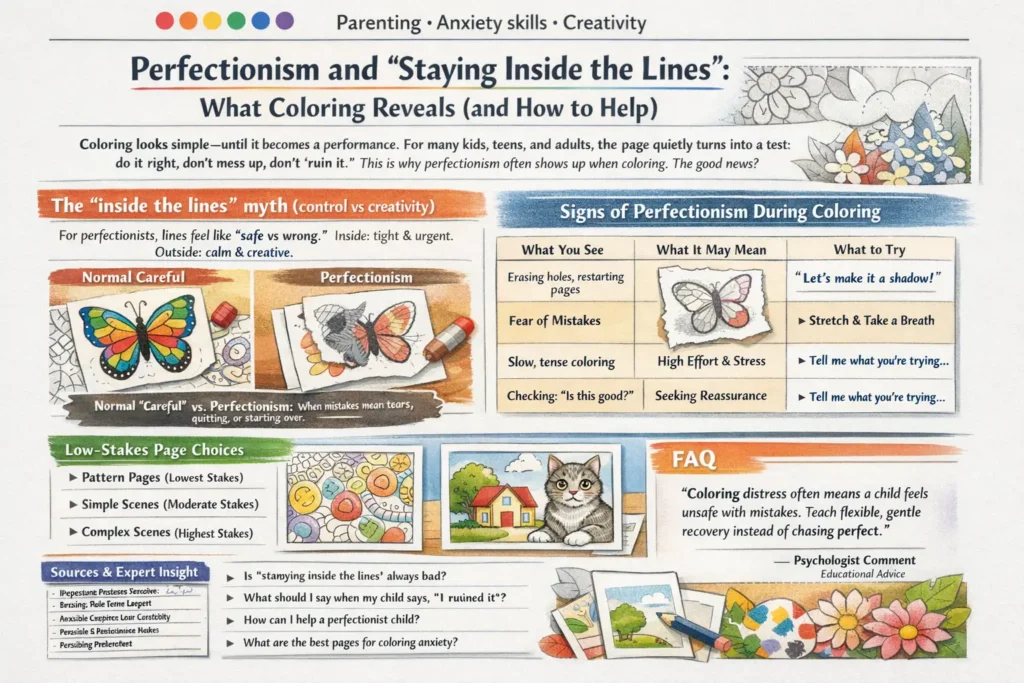
The “inside the lines” myth (control vs creativity)
“Stay inside the lines” is often taught as a fine-motor goal. But when a child (or teen, or adult) leans toward perfectionism, those lines can start to mean “safe vs wrong.” That’s where coloring anxiety grows—not from art itself, but from what the page represents.
Lines can be helpful structure. They reduce decision-making, give a starting point, and support coordination. The myth is the idea that staying inside the lines is the main purpose of coloring. For a perfectionistic brain, the line becomes a scoreboard: a tiny slip equals failure. On the outside it looks “careful.” On the inside it often feels tight, urgent, and fragile.
A pressure-reducing reframe is simple: the goal is not “perfect coloring.” The goal is tolerating imperfection while staying engaged. When kids learn “I can keep going after a slip,” they build flexibility that transfers to homework, sports, music practice, and social risk-taking. Control is not the enemy—many anxious kids use control to feel steady. The key is helping them choose control when it helps, and loosen it when it starts to hurt.
Signs of perfectionism during coloring
Perfectionism often hides behind “good behavior.” A child may look focused and quiet—but their body, pacing, and words tell the real story. Below are common signs, what they often signal, and a low-pressure response.
| What you see | What it may mean | What to try |
|---|---|---|
| Erasing holes, restarting pages, or refusing to continue after a small slip | Mistakes feel irreversible; all-or-nothing thinking; fear of being judged | Name it gently, then offer a repair step: “Let’s make it a shadow” or “Let’s turn it into texture.” |
| Slow, tense coloring (strong grip, shallow breathing, tight shoulders) | High effort to maintain control; stress response is running the show | Micro-break: shake hands, stretch fingers, 3 slow breaths, then return with a softer tool (crayon vs fine liner). |
| Checking for approval: “Is this good?” every few minutes | Outcome-based self-worth; reassurance loop that doesn’t last | Shift to process: “Tell me what you’re trying” and “What’s your next step?” |
| Avoiding new colors or using only “safe” choices | Fear of mistakes + fear of regret; decision paralysis | Limit choices to 3–4 colors and call it an “experiment palette.” |
| The classic “I ruined it” child moment after one line goes wrong | Catastrophizing; perfection rules louder than joy | Validate feeling, then add a next step: “It makes sense you’re upset. Let’s choose a fix—or choose to keep it.” |
The goal is not to argue a child out of these reactions. The goal is to build skills: noticing stress, naming it, and practicing recovery—again and again, in low-stakes ways.
Low-stakes page choices (patterns vs scenes)
One of the fastest ways to reduce pressure is to pick pages that naturally allow “imperfection.” Some pages invite realism and comparison; others invite rhythm and play. Page choice becomes a quiet support for how to help perfectionist child tendencies without a big conversation.
Repeating shapes (dots, waves, mandalas, tiles) make tiny slips almost invisible. They also support a calming rhythm. Start with larger repeats and fewer tiny zones, then gradually add detail as confidence grows.
Simple scenes with big shapes and fewer tiny areas let kids practice choices without getting “trapped” in micro-details. Pick pages with bold outlines and generous spaces to reduce the “one slip ruins everything” feeling.
Highly detailed faces, animals with realistic fur, or “perfect-looking” references can trigger fear of mistakes. If a child wants them, add supports: a timer, a smaller section goal, and the mess-friendly repair moves below.
Language swaps (praise process, not outcome)
Perfectionism grows when the brain learns: “I’m safe when it’s correct.” You don’t need to remove praise—you just need to shift what you praise. This is the heart of practical growth mindset activities: reinforce effort, strategy, and flexibility.
What to stop doing (gently)
- Don’t over-focus on neatness as the “win.” It quietly teaches: messy = bad.
- Don’t rescue immediately. Instant fixing can teach: “I can’t handle mistakes.”
- Don’t debate feelings. “It’s not ruined!” may be true, but it can feel invalidating in the moment.
10 practical phrases parents can use
Use these as scripts. They reduce shame, interrupt the “test” feeling, and teach recovery. Pick a few and repeat them often.
- “Show me your plan.” (Shifts attention from outcome to strategy.)
- “That was a brave color choice.” (Rewards experimentation.)
- “Mistakes are information.” (Turns fear of mistakes into curiosity.)
- “What could we do with that line?” (Invites repair thinking.)
- “Let’s try one tiny change, not a restart.” (Reduces all-or-nothing.)
- “I notice your hands got tight—want a reset?” (Builds body awareness.)
- “You can choose: fix it, blend it, or keep it.” (Restores autonomy.)
- “This page is practice, not a performance.” (De-activates the test.)
- “What would you tell a friend who said ‘I ruined it’?” (Builds kinder self-talk.)
- “I’m proud of how you kept going.” (Praises persistence—the key skill.)
“Mess-friendly” techniques (shading, blending, background-first)
Many kids fear mistakes because they don’t know how to recover. Teach “repair moves” that naturally hide wobbly edges and uneven patches. These techniques also help teens and adults who freeze, avoid starting, or feel stuck in perfectionism.
1) Shading turns slips into shadows
A line that crossed a border can become a shadow edge. Add light pressure shading near one side of an object (under a leaf, beneath a cloud, behind a character). The brain learns a powerful message: imperfection can become style.
2) Blending makes “uneven” look intentional
Instead of trying to fill perfectly, teach a simple blend: one color down, then a second color overlapping the edge, then gentle back-and-forth. Even basic crayons can blend if pressure is light. Blending rewards flexibility because it’s supposed to look soft.
3) Background-first lowers the “ruin risk”
Many perfectionists freeze because the main object feels too important. Flip the order: color the background first. Skies, water, grass, and soft color transitions create momentum. When the background is done, the page already looks “real,” and fear drops.
4) Texture rules: dots, lines, and “scribble fill”
Add texture on purpose: tiny dots for sand, short lines for fur, loops for clouds. When kids learn that not everything must be flat and solid, staying perfectly inside the lines becomes less central.
Micro-exposures: intentional “tiny mistake” practice
The most effective way to reduce fear is not reassurance—it’s safe experience. Micro-exposures are tiny, controlled “mistakes” that teach the nervous system: “I can handle this.” They’re small enough to feel doable, and repeated enough to build confidence.
How to do it (2–5 minutes)
- Step 1 — Choose a low-stakes page. Patterns work best at first.
- Step 2 — Pick one “tiny mistake.” Example: one stroke outside the line, or one “unexpected” color once.
- Step 3 — Pause and notice. Ask: “Where do you feel it in your body?” (tight belly, hot face, clenched hands).
- Step 4 — Practice recovery. Options: blend it, turn it into texture, add a shadow, or simply leave it.
- Step 5 — Name the win. Not “it looks good,” but “you stayed with the feeling and kept going.”
Add one dot “in the wrong spot.” Color one leaf a silly color. Let one stripe be uneven. Make one cloud have a funny edge. Keep it tiny and repeatable.
Set a timer for 8 minutes and stop mid-perfect area. Use your non-dominant hand for one small section. Choose a color without testing it first. Practice “good enough” on purpose.
Progress is not fewer mistakes. Progress is faster recovery: less panic, less restarting, more flexibility, and more willingness to try.
When extra support can help
- Big reactions to small mistakes happen frequently (panic, shutdown, or intense anger).
- Perfection rules spread beyond coloring into schoolwork, sports, or daily routines.
- Harsh self-talk shows up often (“I’m stupid,” “I can’t do anything right”).
- Constant reassurance is needed to start or finish tasks.
- Avoidance becomes the main strategy (won’t try unless success is guaranteed).
Over time, micro-exposures build a message stronger than pep talks: I can make a mistake and still be okay. That is the core skill behind reducing fear of mistakes—and it’s why coloring, when treated as play rather than performance, can become a surprisingly powerful practice.
FAQ
Is “staying inside the lines” always a problem?
No. Many kids enjoy precision and feel proud of neat work. It becomes a concern when small slips repeatedly trigger “I ruined it,” restarting, or refusing to continue—especially when it blocks enjoyment.
What should I say when my child says, “I ruined it”?
Validate first, then offer choices: “That felt frustrating. You can choose: fix it, blend it, or keep it.” This reduces shame and helps the child move into problem-solving.
How do I help a perfectionist child without pushing too hard?
Lower stakes first (patterns and simpler pages with larger spaces), praise strategy and effort, and practice tiny, voluntary micro-exposures. The goal is confidence through recovery, not a perfect page.
What if my child keeps asking, “Is this good?”
Answer once warmly, then redirect to process: “Tell me what you’re trying” or “What’s your next step?” Over time, this replaces reassurance-seeking with self-guidance.
Do micro-exposures make anxiety worse?
They can if they’re too big or forced. Keep them tiny, predictable, and chosen by the child. The point is teaching the body “I can handle this,” not proving toughness.
What are the best pages for coloring anxiety?
Start with repeating designs and large spaces. Patterns are often easiest because slips blend in naturally. Simple scenes are a good next step when confidence improves.
Which tools work best for “mess-friendly” coloring?
Softer tools (crayons and soft colored pencils) are often more forgiving than fine liners. Blending, shading, and texture techniques can also turn uneven areas into an intentional look.
Expert Assessment: When Coloring Becomes a Perfectionism Trigger
Educational use only. This expert commentary does not create a psychologist–client relationship. It is not a clinical assessment and does not replace individualized mental health care. The goal is to support healthy skill-building, not to label a child.
What “staying inside the lines” often means clinically
When a child becomes distressed by minor coloring slips, the problem is rarely the page itself. More often, the page turns into a “certainty task”: the child tries to control the outcome to reduce uncomfortable feelings (uncertainty, shame, fear of being wrong). This can look like carefulness, but the nervous system may be running a stress response—tight grip, shallow breathing, urgency to erase, or the belief that one mistake “ruins” everything. In practice, this is a common pathway from fear of mistakes into avoidance: if perfection is required, starting becomes risky.
How to support without feeding the perfection loop
The most helpful stance is calm and skill-based: validate the feeling, reduce the stakes, and teach recovery. If adults rush to reassure (“It’s fine!”) or fix the page immediately, the child may learn that mistakes are emergencies. Instead, treat mistakes as manageable events with options. A useful sign of progress is not “neater coloring,” but faster recovery: fewer restarts, less checking, and more willingness to keep going after discomfort.
- Keep sessions predictable: short, repeatable routines help regulation more than long sessions.
- Limit choices: too many colors can increase overload and decision paralysis.
- Emphasize process: praise strategy and persistence, not “perfect results.”
- Teach repair moves: shading, blending, and texture turn slips into style.
- Use micro-exposures only by consent: the child chooses one tiny “imperfect” mark, then practices recovery.
If coloring distress is frequent and spills into schoolwork or daily life (intense meltdowns, harsh self-talk, strong avoidance, constant reassurance), extra support from a qualified specialist can be helpful. The goal is not to remove standards, but to build resilience: “I can make a mistake and still be okay.”