When Kids Say “I Ruined It”: How Coloring Builds Mistake Recovery Without Shame
A coloring mistake can look tiny to an adult and huge to a child. A wrong color, a line that goes too far, a bent page, a smudge in the wrong place, and suddenly the whole picture feels “bad.” The child wants to crumple the paper, throw it away, or quit before anyone can look too closely. That is the moment that matters most. The real job is not rescuing every page. The real job is helping a child move from alarm and self-blame toward repair, flexibility, and re-entry.
This article stays on the post-mistake response: what to say right after a child thinks the picture is ruined, what makes the moment worse, how to offer repair without pressure, how this looks at different ages, and when a strong reaction may point to something bigger than ordinary frustration. The focus is not perfectionism in general. The focus is what happens in the minute after the mistake.
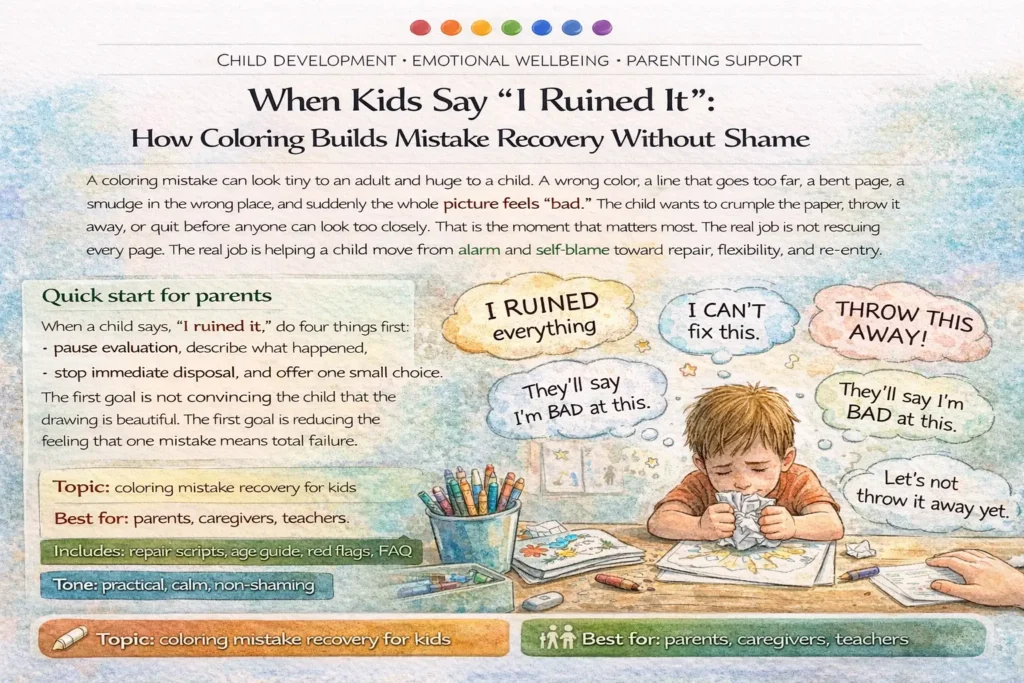
Why this moment feels so big to a child
Adults often see coloring as leisure. Children often experience it as a live test of control. They had a plan. The plan felt clear. Their hand moved differently than they expected. Now the gap between what they meant to do and what is on the page feels exposed and final. Even when nobody else is criticizing them, the child may suddenly feel that the evidence is sitting in front of them.
That is why a coloring mistake does not always bring simple disappointment. It can bring fast, global language: “It’s ugly.” “I can’t do this.” “I messed everything up.” “Throw it away.” The child is no longer reacting only to the mark. They are reacting to what the mark now seems to say about them.
In that state, correction usually lands badly. Telling a distressed child, “It’s fine,” may sound gentle, but many children hear: “You do not understand why this feels awful.” A child in shame does not need quick reassurance first. They need the moment slowed down enough that it becomes workable again.
Not “the page is objectively unusable,” but: “The picture no longer matches what I meant to make, I do not know how to recover, and I feel bad being the one who made the mistake.”
The first response shapes whether the child moves toward repair or shame
A useful response does not deny the mistake and does not dramatize it. It gives the child enough structure to stay with the moment without being swallowed by it.
A calm voice, simple observation, slower pace, and one next step. Examples: “You noticed something you don’t like,” “That line went farther than you wanted,” “Let’s not throw it away yet,” or “We can decide what this page needs next.”
Fast praise, correction, comparison, or problem-solving before the child is settled. Examples: “No, it’s beautiful,” “You have to calm down,” “Your sister wouldn’t cry about this,” “Just stay inside the lines next time,” or taking the marker and fixing the page without permission.
It is a chance to practice recovery after a small frustration. It is not a character test, not proof that the child is “too sensitive,” and not a good moment for a lecture about attitude.
The adult’s job is not to erase frustration. The job is to stop frustration from hardening into identity language. A child can be upset and still feel guided. A child can dislike the mark and still stay connected to the activity. That difference matters because resilience does not come from never minding mistakes. It comes from learning, again and again, that mistakes can be worked with.
A simple repair sequence that works better than arguing
When a child believes the page is ruined, many adults rush into persuasion. A more reliable sequence is: notice, name, contain, choose, continue or close. The order matters because children usually cannot accept repair while they still feel misunderstood.
What to say in the exact moment
Children borrow emotional language from adults. If the adult brings structure, the child is more likely to move from ruined to changed, from bad to fixable, or from I can’t to I need help with this part. The shift sounds small, but it changes how the child experiences mistakes.
| Moment | What to say | What to avoid | Why it helps |
|---|---|---|---|
| Wrong color chosen | “That wasn’t the color you wanted. Do you want to keep it, layer over it, or make this part into something new?” | “It doesn’t matter,” or “That color is fine, stop fussing.” | It validates the mismatch and gives back a sense of control. |
| Line crossed too far | “Your hand moved past the edge. Let’s see whether this needs a fix or a new plan.” | “You need to be more careful.” | The child hears an event, not a character flaw. |
| Page crumpled or bent | “The page changed shape. We can smooth it, trim it, or keep going with the wrinkle.” | “Now it’s spoiled.” | It turns damage into a practical decision instead of total loss. |
| Child wants to throw it away | “We can choose later. First let’s put it on the table and take one breath.” | “No, you are not allowed to feel that way.” | It interrupts impulsive disposal without shaming the feeling. |
| Child says “I’m bad at this” | “Right now you’re having a hard moment in this picture. That is different from being bad at coloring.” | “Don’t say that,” or praise that skips over the distress. | It separates identity from the event. |
| Child compares self to others | “You are looking at your page and their page at the same time. Let’s come back to what your page needs next.” | “You should be more like them.” | It redirects attention from ranking to repair. |
The most useful wording is specific, low-drama, and forward-facing. It names the problem clearly enough that the child feels seen, but not so dramatically that the child becomes even more convinced that everything is lost.
What repair can actually look like on the page
Not every page should be forced into rescue mode. Sometimes the best repair is a second attempt. But many children benefit from learning that there is more than one path after a mistake. That is how coloring stops feeling fragile and starts becoming flexible practice.
If the child picked the “wrong” color
Help them shift from judgment to design. Ask: “What could this color become now?” The blue roof might become a night roof. The green sun might become a magic sun. The brown flower might become a dried flower in autumn. This is not forced positivity. It is cognitive flexibility in plain language: the mark is real, and meaning can still move.
If the child went outside the line
Try a containment repair. Add a thicker outline. Turn the extra mark into shadow, grass, glow, fur, smoke, rain, or texture. The point is not hiding every error perfectly. The point is showing that one crossed line does not automatically end the drawing.
If the page got wrinkled, torn, or bent
Use honest language. Do not pretend the page is unchanged. Say: “This page has a crumpled part now. We can flatten it, tape it, cut around it, or call this version the practice page.” Children often settle faster when the adult does not ask them to agree that damage is invisible.
If the child wants to start over
Starting over is not failure by itself. The real question is why. If starting over is a chosen reset after a hard moment, it can be healthy. If starting over happens every time anything goes off-plan, the adult can widen the options: “You can start a new page, and first let’s see whether this one has one more move left.”
Instead of asking, “Can we save it?” ask, “What is the next workable move?” That wording lowers the pressure to make the picture perfect and keeps attention on recovery.
How the same mistake can look different by age
The repair logic stays similar across childhood, but the wording and expectations should change with development. A two-minute recovery for one child may be a ten-minute recovery for another. The question is not whether the child reacted “too much.” The question is what kind of support matches their age, language, and frustration tolerance.
Ages 3–5: keep it concrete and external
Younger children usually need very concrete language and very small choices. They are less able to separate what happened on the page from who they are when they feel flooded. Say: “The marker slipped,” “This paper bent,” or “This part needs help.” Offer two choices, not five: “Fix or new page?” At this age, co-regulation matters more than explanation.
Ages 6–8: name the plan and the mismatch
Children in this range can usually understand the difference between intention and outcome. A useful line is: “You had one picture in your head and the page went another way.” This age also benefits from simple repair roles: cover, outline, change the idea, pause, or restart. Too much verbal analysis can still overwhelm them, but they can begin to learn that a mistake is a problem to solve rather than proof of failure.
Ages 9 and up: protect dignity while keeping the task workable
Older children often feel the social meaning of mistakes more sharply. They may worry about looking childish, careless, or less capable than others. Here the adult should avoid sounding patronizing. Try: “You do not like how this turned out yet. What kind of recovery makes sense here?” Older kids usually respond better when the adult respects their judgment while still interrupting all-or-nothing thinking.
The younger the child, the more they need co-regulation and concrete choices. The older the child, the more they need dignity, collaboration, and language that separates identity from outcome.
Why fake reassurance often backfires
Many adults respond to children’s distress with automatic comfort language: “It’s perfect,” “No one can even tell,” “It looks great,” or “You’re the best artist.” The intention is kind, but the effect is mixed. A child who feels clearly upset by a visible mistake often does not experience those words as support. They experience them as a mismatch.
When the adult jumps straight to praise, the child may feel pressure to stop feeling what they are feeling before it has been processed. Then one of two things often happens. Either the child argues harder — “No, it’s not!” — or the child gives up on being understood. Neither response teaches repair.
Instead of trying to overwrite the child’s experience with praise, make room for the experience and then lead it toward action. That is what reduces shame: not the message that nothing went wrong, but the message that something went wrong and you are still capable of staying with it.
How repeated coloring moments build mistake recovery over time
One repaired coloring page will not transform a child overnight. What matters is repetition. Coloring creates a rare kind of practice because the stakes are low enough for mistakes to happen often and safely. A child can choose, adjust, cover, re-outline, reframe, or restart many times in one session. That gives adults repeated chances to teach a pattern: notice, breathe, decide, repair, continue.
Over time, children begin to internalize that sequence. They may still get upset, but the upset becomes shorter and more specific. Instead of “I ruined everything,” the child begins to say: “I need another page,” “Can I make this darker and fix it?” or “I don’t like this part yet.” That language matters because it is repair language instead of collapse language.
Not “My child never gets upset anymore,” but: “My child gets upset, stays with the page longer, asks for help more clearly, and no longer treats one mistake as proof of failure.”
This is also why adults should notice and name the recovery process, not only the final picture. A child gains more from hearing “You kept going after a hard part” than from hearing only “Pretty picture.” The first response builds an internal skill. The second can make the child depend too much on outcome approval.
When the reaction may point to more than an ordinary frustration moment
A strong reaction to one coloring mistake does not automatically mean something broader is wrong. Children get tired, overloaded, embarrassed, and rigid for many ordinary reasons. Still, patterns matter. The page is not a diagnostic tool, but repeated reactions can tell adults that the child may need more support than a single repair script can provide.
| Pattern | What it can look like | Why it matters | What to do next |
|---|---|---|---|
| All-or-nothing collapse | Every small mistake leads to tears, self-attack, or quitting. | The child may not have enough frustration tolerance for the task demands. | Reduce demands, shorten sessions, and watch whether the same pattern appears in schoolwork, games, or handwriting. |
| Strong shame language | “I’m stupid,” “I’m bad,” or “Everyone will laugh at me.” | The child may be turning small performance errors into global self-judgment. | Respond gently, document the pattern, and pay attention to whether the same language shows up in other performance situations. |
| Extreme avoidance | The child refuses coloring, drawing, writing, or any task where mistakes stay visible. | Avoidance may be widening beyond one activity. | Lower exposure pressure and consider whether anxiety, school stress, or motor frustration may be part of the picture. |
| Distress that does not settle | The child stays dysregulated long after the page is put away. | The mistake may be hitting a larger stress load, not just a brief disappointment. | Look at sleep, transitions, overload, and whether extra support from a pediatric or mental health professional is needed. |
If the child regularly uses harsh self-talk, panics over small visible errors across different activities, or avoids participation because mistakes feel unbearable, the issue may be bigger than coloring. The goal then is not stronger correction. The goal is broader support.
What to do when the child wants to quit completely
Sometimes the mistake is the end of the session, and that does not automatically mean the adult failed. A child may simply be overloaded. The question is how to end without turning the exit into shame.
- Keep the tone neutral. Say: “We can stop for now,” instead of “Fine, then stop.”
- Preserve the page if possible. Put it in a folder, on a shelf, or under another sheet instead of throwing it away immediately.
- Name the unfinished state without judgment. “This one is paused,” or “This is today’s try.”
- Return later with choice. “Tomorrow you can fix it, change it, or leave it as your practice page.”
Children often recover better when the adult leaves the door open. If every hard page is instantly discarded, the child learns one pattern: mistakes make things disappear. If some pages are paused, revisited, or partially repaired, the child learns a different pattern: mistakes can remain visible without becoming unbearable.
Do not force a child to finish a page in the middle of distress just to prove a lesson. Recovery is about widening tolerance, not trapping the child inside the exact moment that overwhelmed them.
Parent scripts that are worth keeping nearby
These short lines work because they reduce evaluation and increase orientation. They are useful in the moment before a child tears the page, throws the pencil, or says they never want to color again.
- You noticed something you don’t like.
- This part went differently than you planned.
- Let’s not call it ruined yet.
- Do you want to fix it, change the plan, or pause?
- We can keep this as a practice page.
- You do not have to love it to keep working with it.
- This is a hard moment, not the whole picture.
- You can dislike this part and still decide what happens next.
- The page changed. Now we choose the next move.
The logic behind these scripts is simple: they keep the child connected to agency. Shame says, “I am the problem.” Repair language says, “There is a problem, and I can do something next.”
FAQ
Should I tell my child the picture is perfect after a mistake?
Usually no. Fast perfection praise can feel dismissive when the child is clearly upset. It works better to name what happened and offer a next step: “You don’t like this part. Do you want to fix it, change it, or pause?”
Is starting over a bad habit?
Not automatically. Starting over can be a healthy reset. It becomes unhelpful only when it is the child’s only response to any imperfection. The goal is not banning restarts. The goal is teaching that restart is one option among several repair options.
What if my child wants to throw every “bad” page away?
Pause disposal first. Put the page aside and say you can decide later. Children often judge harshly in the heat of the moment. A delayed decision reduces impulsive rejection and gives the child time to recover enough to consider repair or a calmer ending.
Should I fix the page for my child?
Only with permission, and preferably after offering choices. If the adult takes over too quickly, the child may learn that mistakes are solved by someone else or that the page becomes acceptable only when an adult rescues it.
What if the mistake happens during class or group coloring?
Lower the social pressure immediately. Use a quiet voice, reduce attention on the page, and offer a simple private choice. In a group, the child is often reacting not only to the mistake itself but also to feeling seen while upset.
Does strong upset over coloring mistakes always mean perfectionism?
No. It can reflect low frustration tolerance, fatigue, embarrassment, sensory overload, high effort investment, or a child who had a very specific plan. Pay more attention to patterns than labels. If the same shame response shows up across many activities, the child may need broader support.
What is the main skill coloring can teach after a mistake?
That an error can be noticed, felt, named, and worked with without becoming a verdict about the child. That is the heart of mistake recovery: not pretending the problem is nothing, and not turning it into everything.
Sources (primary references)
Expert Commentary: Recovery Language Protects the Child More Than Reassurance Does
Why adults often miss the most important window
The hardest part of a coloring mistake is usually not the visible mark. It is the fast internal meaning the child gives it. In a few seconds, a crossed line can become evidence that the child was careless, not good enough, behind everyone else, or suddenly exposed. Adults often respond to the visible problem and miss the identity problem underneath it. They correct the technique, praise the page, or urge the child to calm down, but the child is already reacting to something more painful than the line itself. That is why the most helpful first response is usually neither instruction nor praise. It is orientation: “You didn’t want that to happen. Let’s see what this page needs now.”
What healthy repair actually looks like in real life
Parents sometimes imagine that successful recovery means the child smiles quickly and goes back to coloring as if nothing happened. In real life, healthy recovery is often quieter than that. The child stops trying to destroy the page. They stay near the table. They accept one small choice. They let the adult name the problem without arguing that everything is ruined. Or they start a second page without turning the first one into proof that they are bad at art. Those are meaningful gains. Recovery is not the absence of emotion. Recovery is the return of enough control that the child can make one workable decision.
Why this skill matters beyond coloring
Coloring is useful because it creates visible, low-stakes mistakes. That makes it a good place to teach a pattern children need everywhere else: in writing, sports, homework, music, and peer situations. A child who learns, “I can make an error, stay connected, and choose what happens next,” is learning more than how to finish a picture. They are learning that mistakes do not have to become shame. Parents do not need perfect words for this. They need steady words, honest words, and a pace slow enough for the child to feel that the mistake is real but still survivable.