Co-Coloring: Using Coloring to Improve Parent–Child Connection
If you’re looking for parent child bonding activities at home that don’t turn into another “task,” co-coloring is a surprisingly strong option. The goal is simple: use coloring as a shared, side-by-side experience that can build trust, emotional safety, and everyday conversation—without pressure.
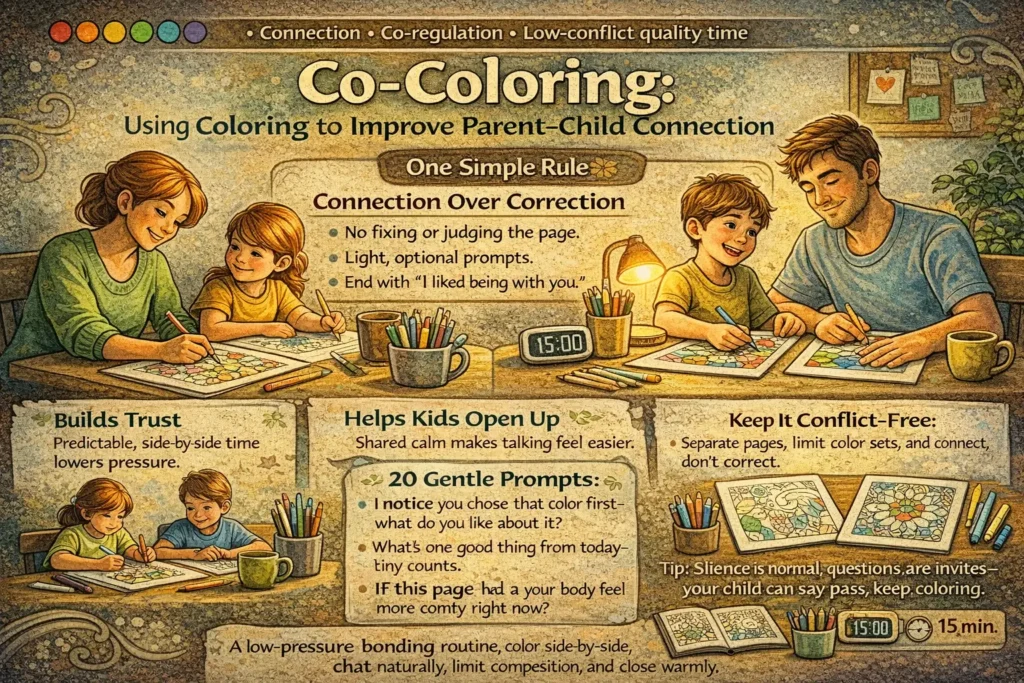
Co-coloring is not “teaching your child to color better.” It’s a relationship tool: a calm shared activity that can lower defensiveness and make it easier for a child to talk—especially after school, during transitions, or during phases when everything feels like negotiation. Compared with many quality time ideas, coloring has a built-in advantage: hands stay busy, eye contact is optional, and the pace is naturally slower.
You can rotate materials to keep it fresh (crayons one week, markers the next), or switch themes by choosing different page styles (simple shapes, animals, patterns, story scenes). But the real “magic” is not the page. It’s the message your child feels: “I’m with you. I like being with you. You don’t have to perform.”
Why side-by-side activities reduce pressure
Face-to-face talks can feel intense for kids—especially when they suspect they’re about to be corrected, questioned, or evaluated. Side-by-side activities often reduce that “spotlight effect.” When your child is coloring, their body may stay in a more regulated state: shoulders can drop, breathing can slow, and it can feel easier to share thoughts without feeling cornered.
Kids don’t have to “say the right thing.” Silence is allowed. Conversation can drift in and out naturally.
You’re both focused on the page. This can make connection feel gentle instead of intense.
Repetitive, predictable motion may support regulation—especially after overstimulation (school, screens, busy days).
Set the scene in 60 seconds
- Same spot. A small table corner or kitchen counter becomes your “ritual place.”
- Small palette. Put out 6–10 colors, not the whole box (less distraction, fewer arguments).
- Two pages, not one. Each person has a page (or a section). Shared space can come later.
- Timer is your friend. A short time limit makes it predictable and reduces “I don’t want to stop” battles.
Quick age tuning (4–12)
- Ages 4–6: keep language concrete (“Pick two colors”), add story play (“Who lives here?”), and praise effort (“You kept going”).
- Ages 7–9: lean into “today” topics (friends, rules, funny moments) and use choices (“quiet or chatty?”) to prevent power struggles.
- Ages 10–12: reduce “kid voice,” respect privacy, and use low-pressure openings (“Anything stuck in your brain today?”).
“Parallel play” for older kids (yes, it works)
Parallel play is often described for toddlers, but the principle can still help older kids: doing something alongside a parent without constant interaction. For ages 7–12, it often looks like two people coloring quietly with occasional comments. In this age range, it’s closer to side-by-side time or companionable quiet than a developmental “stage”—same idea, more mature form.
Three side-by-side formats that work
- Two pages, one theme. “Let’s both color animals” or “Let’s both do patterns.”
- One page, two zones. You each claim a section. No comments about the other zone unless invited.
- Pass-and-pause. Each person colors for 60 seconds, then passes the page. Keep it silly, not competitive.
If you’re hoping for a child to open up, side-by-side time can be a quiet doorway. Your child gets to choose how close the connection feels that day: quiet closeness, small talk, or deeper sharing. That flexibility is part of what keeps it low conflict.
Conversation prompts that don’t feel like interrogation
The fastest way to shut down connection is to turn coloring into an interview. Instead of stacked questions, try “soft openings”: noticing, wondering, or sharing a small piece of yourself first. Then leave room for your child to accept or ignore the invitation.
How to ask in a gentle way
It’s less demanding than “Why?” and it doesn’t require a defense.
“Want a quiet session or a chatty session?” Choice increases cooperation.
Silence is often where emotional safety builds—especially for sensitive kids.
20 gentle prompts (pick 1–3 per session)
Tip: tell your child they can always say “pass” and keep coloring.
- I notice you chose that color first—what do you like about it?
- If this page had a title, what would you call it?
- What part feels easiest right now? What part feels tricky?
- Want company or quiet for a bit? (Both are okay.)
- What’s one good thing from today—tiny counts.
- What’s one annoying thing from today—tiny counts too.
- Is your brain feeling fast, slow, or medium today?
- What would help your body feel more comfy right now?
- If your day was a weather report, what would it be?
- Who felt kind today? (It can be you.)
- Was there a moment you felt proud of yourself today?
- What’s something you wish adults understood better?
- What’s a rule you’d change at school/home if you could?
- What’s a win you had this week that nobody noticed?
- Want a “fix-it” response or a “just listen” response?
- What’s one thing you’re looking forward to, even a small one?
- Is there anything that’s been “sticking” in your brain lately?
- If you could give your future self one message, what would it be?
- What’s a question you wish I asked you more often?
- How can I support you this week: reminders, help starting, quiet time, or hugs?
These prompts work best when they stay light and optional. They’re invitations, not demands. Over time, a predictable, low-pressure routine can make “child opens up” moments more likely—because the child expects presence, not correction.
How to handle critique/competition between siblings
Sibling dynamics can turn even calm activities into comparison: “Mine is better,” “You copied me,” “Mom likes yours more.” The fix isn’t a lecture—it’s structure. You want rules that prevent competition before it starts, while still protecting each child’s dignity.
Prevent problems with “set-up rules”
- Separate supplies. Two small color sets (6–10 colors each) reduce grabbing and “you took my best marker.”
- No borrowing without asking. A tiny rule that prevents big blowups.
- Show-and-tell only at the end (optional). If both want, each shares one thing they like about their own page.
Use “separation first” rules
- Separate pages by default. Shared pages are optional and earned, not assumed.
- No scoring language. Retire “best,” “prettiest,” “winner,” “perfect.” Replace with “different,” “bold,” “soft,” “detailed.”
- Ask permission for comments. “Do you want feedback or just company?” works with siblings too.
If critique shows up anyway
You’re not trying to erase sibling rivalry. You’re teaching a relationship skill: “I can have my own style without putting yours down.” That’s a long-term win for family connection.
Weekly ritual template (15–20 min)
Ritual beats motivation. When co-coloring is predictable, it becomes easier to show up even on hard days. Here’s a simple template you can repeat weekly.
If your child resists (common, not a failure)
- Lower the bar: “Just sit with me for 3 minutes” is often enough to start.
- Offer roles: “Do you want to pick the pages or pick the colors?” Choice invites cooperation.
- Stay neutral: No bribing, no disappointment voice. Calm consistency builds trust.
Over time, co-coloring can become a dependable “landing pad” where your child decompresses, feels seen, and reconnects—one small session at a time.
FAQ
What is co-coloring, and how is it different from teaching a child to color?
Co-coloring is a side-by-side activity focused on connection, not performance. The goal is to create a calm, low-pressure space where a child can feel emotionally safe, with no coaching, correcting, or judging the finished page.
How long should a co-coloring session be for kids ages 4–12?
A short, predictable session works best for most families—typically 15–20 minutes. A clear start and finish (often with a timer) helps reduce conflicts about stopping and makes the routine easier to repeat weekly.
What if my child doesn’t talk during co-coloring?
Silence can still be successful. Co-coloring is designed to reduce pressure, and conversation often comes after a child feels safe. Keep the tone relaxed, color alongside them, and offer only gentle, optional invitations to talk.
How can I adapt co-coloring for different ages (4–6, 7–9, 10–12)?
For ages 4–6, keep prompts concrete and playful (colors, characters, simple choices). For ages 7–9, use light questions about the day and offer choices like “quiet or chatty.” For ages 10–12, avoid a childish tone, respect privacy, and use low-pressure openings such as “Anything stuck in your brain today?”
How do I prevent sibling competition or criticism during co-coloring?
Start with structure: separate pages by default, separate supplies, and a simple rule of “no judging each other’s pages.” If conflict starts, pause, name the need (wanting their work to feel special), restate the boundary, and offer a choice to reset or take space.
What should I do if my child shares something upsetting or serious?
Pause the prompts and stay calm. Thank them for telling you, focus on safety and support, and follow up after the session. If a child indicates they are unsafe, harmed, or severely distressed, prioritize protection and seek appropriate professional help.
What supplies work best for co-coloring to keep it low-conflict?
Use a small, limited set of colors (about 6–10) to reduce distraction and arguments. Give each child their own page (and ideally their own small color set), and keep the setup consistent so the activity feels predictable and calming.
Why co-coloring can strengthen connection
In family practice, I often see a mismatch: a parent wants closeness, but the child experiences direct conversation as pressure. Co-coloring changes the channel. Side-by-side, the child is not “on stage.” Their attention can rest on a neutral object (the page), which often lowers defensiveness and makes it easier to share small thoughts that can later become meaningful conversations. This can be especially helpful after school, during transitions, or for children who are sensitive, anxious, perfectionistic, or easily overwhelmed.
Clinically, the value is not the finished picture—it is co-regulation. A calm adult presence, predictable routine, and gentle pacing may help the child’s nervous system settle into a workable state. When a child feels safer, they may be more likely to engage, cooperate, and “open up.” If a child shows ADHD-like restlessness or quick frustration, short, structured sessions can be a supportive transition tool. Co-coloring should not be framed as a treatment or cure; it is a relationship-based routine that can support emotional safety and trust over time.
How to use co-coloring safely and effectively
- Keep it short and predictable. Brief, repeatable sessions are often more regulating than long sessions that end in conflict.
- Limit choices. Too many tools or colors can increase distraction or sibling conflict; a small palette supports calm.
- Protect the “no evaluation” rule. Avoid correcting, comparing, or praising results. Focus on presence: “I like being with you.”
- Let your child lead closeness. Some days are quiet. Quiet can still build trust.
- Take serious disclosures seriously. If a child indicates they are unsafe, harmed, or severely distressed, prioritize protection and follow-up with appropriate professional support.
When co-coloring is consistent and non-judgmental—connection over correction—it becomes a small weekly ritual that strengthens family trust. Over time, many parents notice fewer power struggles around conversation, because their child learns: “I can be close to you without being fixed.”