After-School Decompression with Coloring: Low-Demand Pages for the Hardest 20 Minutes of the Day
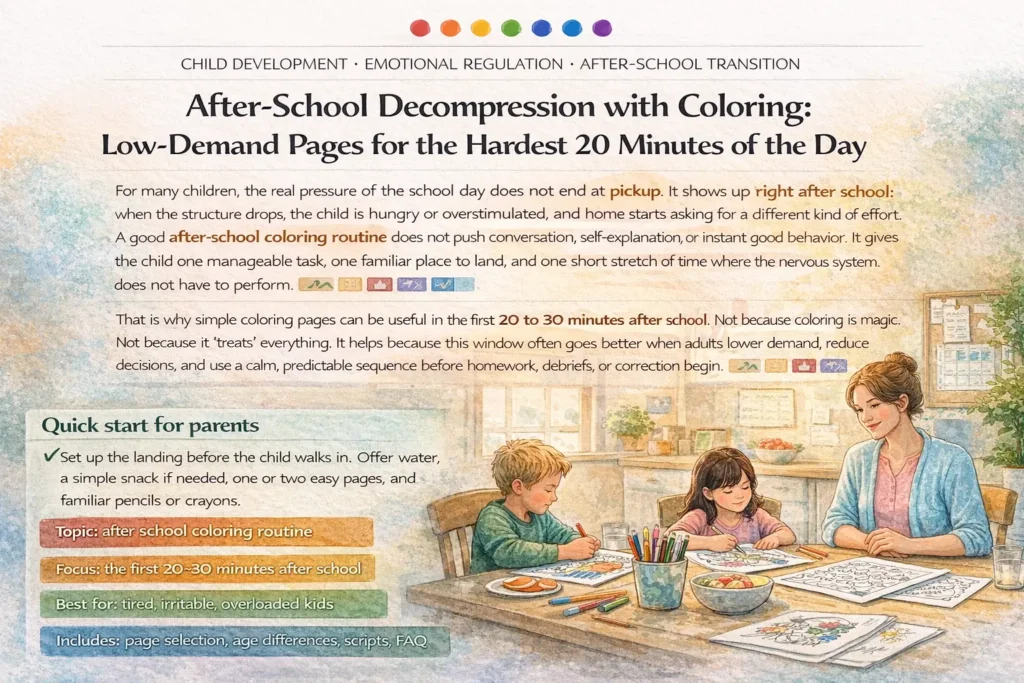
For many children, the real pressure of the school day does not end at pickup. It shows up right after school: when the structure drops, the child is hungry or overstimulated, and home starts asking for a different kind of effort. A good after school coloring routine does not push conversation, self-explanation, or instant good behavior. It gives the child one manageable task, one familiar place to land, and one short stretch of time where the nervous system does not have to perform.
That is why simple coloring pages can be useful in the first 20 to 30 minutes after school. Not because coloring is magic. Not because it “treats” everything. It helps because this window often goes better when adults lower demand, reduce decisions, and use a calm, predictable sequence before homework, debriefs, or correction begin.
Why the first 20 minutes after school can go wrong so fast
School uses a huge amount of regulation. Even children who look “fine” all day may spend hours managing noise, waiting, transitions, peer friction, teacher instructions, frustration, self-control, and the effort of staying composed in public. By the time they get home, the outward behavior can change quickly. A child who held it together for six hours may become sharp, tearful, silly, resistant, or flat over something small.
That does not automatically mean the child is being oppositional. Often it means the child has entered a high-friction transition: no longer held by classroom structure, but not yet settled into home rhythm either. When adults immediately ask for a report, fix the mood, correct the tone, discuss homework, or offer too many options, the child has to do even more mental sorting at the exact moment recovery is weakest.
Predictable routines matter here because they reduce uncertainty. Pediatric guidance consistently points to regular, predictable routines as a stabilizing factor for children, especially under stress. That does not mean every child needs a rigid system. It means many children handle transitions better when they do not have to guess what happens next.
Fewer words, fewer choices, less social performance, and one short activity with a clear beginning and an easy stopping point.
Ask five questions at the door, insist on eye contact, start homework negotiations, comment on the child’s tone, or treat the first visible stress signal as a behavior problem to solve immediately.
After school is not just “free time.” For many children, it is a narrow recovery window. If that window is handled badly, the whole evening gets harder.
Why coloring can work better than talking in this window
A strong after school coloring routine helps because it gives the child one controllable job. The page stays still. The outline is already there. The pencil moves only when the child wants it to. There is no quiz, no turn-taking pressure, no demand to summarize the school day, and no need to say, “Here is exactly why I am overwhelmed.” That reduction in verbal load matters.
Coloring also creates structure without creating performance. Some children do badly with “Go relax in your room,” because unstructured quiet can feel blank, lonely, or too open when their system is still buzzing. A page with visible borders, familiar imagery, and a seat at the same table each day can feel gentler than open-ended downtime. It is quiet, but not empty.
The best pages in this slot are rarely the most intricate ones. In the first 20 minutes after school, the child usually does better with clear outlines, moderate open space, familiar themes, and obvious stopping points. Tiny details, novelty-heavy scenes, or pages that feel like another assignment can push the child right back into effort mode.
What usually helps — and what usually backfires
This is also why decompression should not be confused with avoidance. A child who colors quietly before speaking is not necessarily refusing connection. They may be making connection possible by lowering their own stress first. In many homes, ten calm minutes now prevents ninety minutes of conflict later.
When coloring should not be the very first step
Coloring is helpful only when it fits the child’s state. Some children need food first. Some need five minutes of silence. Some need a short burst of movement before they can sit. If a child is shaky with hunger, dysregulated from a long bus ride, or desperate to move after sitting all day, pushing coloring first can feel just as wrong as pushing homework first.
| What you notice first | Better first move | Why this works better | When to bring in coloring |
|---|---|---|---|
| Child is hungry, pale, shaky, or instantly melting down | Snack, water, no questions | Basic physical needs are still driving the behavior | After the first edge of hunger comes down |
| Child is full of motor energy | Short movement burst, backyard time, hallway laps, jumping, heavy work | Some children must discharge motion before seated regulation is possible | After 5–10 minutes, when breathing and pacing slow |
| Child covers ears or looks sensory overloaded | Silence, lower lights, less talking, reduce clutter | The nervous system needs less input before it can manage any task | Once the space feels quieter and visually simpler |
| Child looks sad or socially worn out | Side-by-side presence and one low-demand page | This state often responds better to gentle companionship than direct questions | Right away, if the setup stays quiet |
Age differences that make the routine work better
Ages 4–6: keep it concrete and short
Younger children usually do best with big shapes, thick lines, and a very short sequence: arrive, wash hands if needed, snack, color, done. They often need the adult physically close and the language very simple. “Your page is here” works better than a big debrief about feelings.
At this age, too much talking can increase friction. So can too many choices. One page or two choices is often enough.
Ages 7–9: offer a little control without opening the floodgates
Early elementary children often respond well to a small choice set: two pages, two pencil cups, or “snack first or color first.” That preserves control without creating more decision fatigue. They may start talking in the middle of the activity once the pressure drops.
This is also the age when adults should be careful not to turn coloring into evaluation. “That looks amazing” is fine in small doses, but repeated commentary can make the child feel watched.
Ages 10+ : protect dignity and don’t make it feel babyish
Older children and tweens may still need decompression, but they usually reject anything that feels overly cute, forced, or childish. For them, simple graphic pages, patterns with moderate open space, nature themes, fantasy scenes, or even a doodle-style printable may work better.
The key is not to sell the activity too hard. “Here if you want it” often works better than “This will calm you down.”
How to build a low-demand after school coloring routine
Most families do not need a complicated plan. They need a repeatable landing pattern that the child recognizes without having to negotiate it every afternoon. The simpler the sequence, the more likely it is to survive real family life.
“You don’t have to tell me about school yet. Take a minute, color if you want, and we’ll do the next thing after that.”
What pages are best for the after-school transition window
Low-demand pages are not “empty” pages. They are pages the child can enter without mentally gearing up first. In this window, that matters more than complexity, cuteness, or educational value.
| Situation | Best page type | Why it helps | What to avoid |
|---|---|---|---|
| Child is tired and cranky | Big shapes, bold outlines, familiar animals or objects | Low visual load makes starting feel possible | Tiny details, dense patterns, perfection-heavy pages |
| Child is overstimulated | Open space pages with only a few areas to fill | Reduces scanning and decision fatigue | Busy scenes with many characters and background clutter |
| Child needs quick success | Pages that can look “done” in 5–10 minutes | A short completion loop lowers friction and builds calm | Long projects that turn into another unfinished task |
| Child resists demands | Two quiet choices only | Gives control without creating overload | A large stack and “pick anything you want” |
| Child looks sad or socially worn out | Comfort-themed pages: pets, cozy rooms, nature, simple fantasy | Familiar imagery often lowers emotional friction | Competitive, school-like, or highly stimulating themes |
What parents should do during the coloring window
The adult’s job is not to extract a full report. It is to keep the landing calm enough that a report becomes possible later. That means the adult should often do less, not more.
- Stay nearby without hovering. Physical presence can regulate even when the child does not want to talk.
- Comment on the setup, not the child’s mood. “Your page is here” usually lands better than “Calm down.”
- Avoid evaluating the art. This routine is not about neatness, talent, or staying inside the lines.
- Delay correction when possible. The first priority is stabilization, not moral instruction at the doorway.
- Notice patterns over time. Which days need more decompression? Which pages start easiest? Does the child need snack first, movement first, or quiet first?
What to do if the child refuses coloring
Refusal does not automatically mean the routine failed. Some children need movement first. Some need food first. Some need two minutes alone with no activity at all. The key is to protect the low-demand principle, not to force coloring specifically.
If the child says no, keep the structure but widen the doorway. You can place the page nearby and say, “It’s here if you want it.” You can offer one second option such as picture books, a quiet puzzle, a snack at the same table, or brief doodling on blank paper. What matters is that you do not replace one supportive landing with a power struggle about compliance.
If refusal happens every day and the after-school period stays explosive for weeks, that is useful information. It may point to a harder school-day load than adults are seeing, chronic hunger, sleep debt, sensory strain, social stress, or a routine that still contains too many early demands.
When the problem is probably bigger than a normal after-school slump
Many children are tired, irritable, or “thin-skinned” after school sometimes. That alone is not alarming. The pattern deserves a closer look when it becomes intense, frequent, and hard to interrupt even with a calmer setup.
Daily meltdowns that last a long time, strong distress before school and after school, repeated school refusal, headaches or stomachaches tied to school days, appetite collapse, sleep problems, social withdrawal, or a level of reactivity that spills through the entire evening.
In that situation, the answer is not “just do more coloring.” A low-demand routine can still help, but it should be treated as a support tool, not the whole explanation. It may be time to compare notes with teachers, look at workload, transitions, peer stress, sensory load, and the child’s overall coping capacity.
FAQ
What is an after school coloring routine?
It is a short, predictable coloring window placed right after school to lower demand during the most fragile transition part of the day. It works best when the activity is ready before the child arrives and talking stays optional.
How long should the routine last?
For many children, 10 to 20 minutes is enough. The goal is decompression, not a long art session. Some children need only five quiet minutes; others need a longer landing.
What kind of coloring pages are best after school?
Choose low-demand pages: bold outlines, familiar themes, moderate open space, and obvious stopping points. Avoid intricate pages that feel like another assignment.
Should I ask about school while my child is coloring?
Usually not at first. Let the routine lower the pressure before you ask for details. Many children talk more easily after the first edge of stress has come down.
What if my child wants a snack before coloring?
That is often the better sequence. Hunger can intensify irritability, so snack and water may need to come first. Coloring can follow once the child is no longer running on empty.
What if my child refuses coloring every day?
Keep the low-demand structure but change the entry point. The child may need decompression, not coloring itself. Try one other quiet option without turning the transition into a fight.
Can coloring replace a deeper look at school stress?
No. It can be a useful support tool, but if the after-school period is persistently intense, prolonged, or tied to broader problems with school, sleep, mood, or regulation, the bigger picture needs attention too.
Sources (primary references)
Expert Commentary: After School, Social and Emotional Load Usually Drops Best Through Structure, Not Pressure
Why adults often misread this window
One of the biggest misunderstandings about after-school behavior is the belief that once a child leaves school, they should immediately be easier to be around. In practice, many children arrive home carrying the leftover cost of the day: noise, correction, waiting, social comparison, transitions, and the effort of behaving under observation. That is why the first signs of strain often show up at home instead of at school. The child is not necessarily “worse” at home. Home is simply the first place where the strain becomes visible.
Why low-demand coloring fits this window so well
Coloring works here not because it is profound, but because it is modest. It offers structure without pressure and action without explanation. For a tired child, that combination matters. The page asks less than school asked. The child does not have to be funny, verbal, socially smooth, or immediately reflective. They only have to begin. That “beginning without performance” is exactly what makes the activity useful in the hardest 20 minutes of the day.
What improves outcomes fastest in real families
The biggest improvement usually does not come from fancier materials. It comes from timing and restraint. Families tend to see the most progress when they shorten the first conversation, lower the number of choices, and stop using the arrival moment for correction. A prepared table, one clear script, and permission not to explain everything right away can change the feel of the entire afternoon. In other words, the child often needs a softer landing, not a faster one.