Families do not use printables in one single moment. They usually save at one time,
print at another, and start the page in a completely different
window of the day. That timing matters. In real family life, weekend behavior is often about stocking up and organizing,
while weekday behavior is about friction, transitions, and whether one page can begin without a full setup.
That is why the most useful question is not “Do parents like printables?” but
“When do printables actually fit the rhythm of home?”
Angle: behavioral timing analysis
Focus: save, print, start behavior
Use case: weekday resets and weekend batching
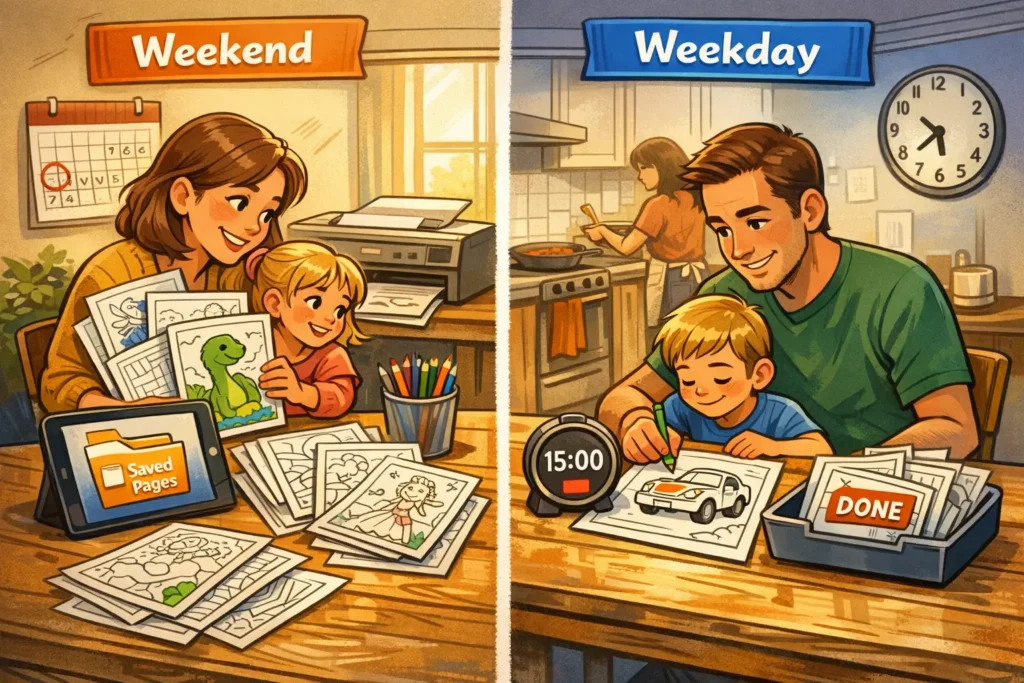
and a weekday tray with only 2–4 easy pages ready to go. The best weekday page is not the most creative one.
It is the one a child can begin in under two minutes.
It combines anonymized internal time-of-week usage patterns around printable behavior
(save, print, start, finish) with external reference points from public time-use data, family media research,
and pediatric guidance. The internal patterns help describe when printable use tends to fit family life;
the public sources help explain why those timing windows make sense.
Why timing matters more than enthusiasm
Printable activities often get discussed as if all usage happens in one simple decision: a parent finds a page,
prints it, hands it over, and the child begins. That is not how most homes work.
In practice, printable use tends to split into at least four separate behaviors:
saving a page for later, printing a batch when there is margin,
starting a page in a live moment that may already be tense or rushed,
and finishing it in a way that feels contained rather than messy.
Once you separate those steps, weekend and weekday behavior stop looking inconsistent.
They simply serve different jobs inside the family routine.
Weekday behavior = launch fast and finish clean.
This framing is also more realistic than the vague idea that parents “just need more activity ideas.”
Families are not only looking for attractive pages. They are looking for formats that survive real household timing:
after-school decompression, pre-dinner containment, bedtime wind-down, rainy-day backup, or the moment right after a device is turned off.
Why this topic needs a timing model, not just generic advice
On weekdays, adults with young children often operate inside tighter time budgets and denser transition points.
That matters because a printable is rarely competing with “nothing.” It is competing with fatigue, hurry, hunger,
screen momentum, noise, and adult decision load. In those moments, the page that wins is not necessarily the prettiest one.
It is the one that can begin without negotiation.
On weekends, the problem changes. The family is less likely to need a rescue tool for the next ten minutes
and more likely to need a preparation tool for later in the week. That is where browsing, saving, co-choosing,
sorting by difficulty, and printing a short stack start to make sense.
This shift is exactly why a behavioral timing lens is useful. It helps explain why the same family can love printables,
save many of them, and still fail to use them on weekdays unless the start moment is carefully reduced.
The real printable funnel: save, print, start, finish
A printable is not successful when it gets downloaded. It is successful when it gets started without drama and finished without exhausting the adult.
This is often a low-pressure moment: scrolling after bedtime, browsing on a Saturday morning,
collecting ideas for a holiday week, or building a “maybe later” folder.
Parents are open to themes, bundles, seasonal sets, and pages that look slightly more ambitious
because the task is only to choose, not to execute.
Printing is usually a batch behavior, not a fully spontaneous one.
It often happens when an adult already has access to the printer,
is planning ahead for an after-school gap, or wants to prepare for a weekend, travel day, or indoor afternoon.
This is the point where “I like this page” becomes “I have this page ready.”
This is the hardest moment and the one most printable libraries under-design for.
The child is home, tired, wired, bored, or transitioning off a screen.
A page succeeds here only if setup is tiny, the first move is obvious,
and the adult does not have to explain too much. The biggest weekday win is not variety.
It is clarity.
Completion is what makes a printable feel calming instead of unfinished.
One page, one folder, one tray, one visible end point.
That finish line is not a decorative extra. It is part of why the activity feels manageable in the first place.
Beautiful pages get collected, but weekday family life rewards pages that begin fast, contain attention,
and end cleanly.
What the internal timing pattern suggests
When printable behavior is viewed through time-of-week usage rather than simple downloads,
one practical pattern becomes easier to see:
weekend interactions tend to behave more like replenishment,
while weekday interactions tend to behave more like immediate-use attempts.
In plain language, weekends support wider browsing. Families are more likely to compare options,
save themed pages, print in small batches, and organize material for later use.
Weekdays, by contrast, reward pages that can be launched in a narrow transition window with minimal explanation.
That does not mean every family behaves the same way, and it does not mean weekends are “free.”
It means the dominant question changes:
on weekends, parents are more often asking “What should we have ready for later?”;
on weekdays, they are more often asking “What can begin now without making the evening harder?”
It is strong enough to guide printable design and family organization,
but it should not be presented as a fixed schedule for all households.
What weekend behavior usually looks like
Weekend printable behavior is less about urgency and more about inventory.
Parents browse differently when they are not trying to solve an immediate 5:40 p.m. problem.
They are more willing to download by theme, compare difficulty, save pages for later,
and think in sets instead of one-offs.
- Parents save more broadly. Themes, holiday packets, challenge pages, and “maybe for next week” options all make sense here.
- Batch printing feels logical. One printer session can cover several future moments.
- Sorting becomes possible. Families can separate easy pages, puzzle pages, coloring-only pages, and “adult help needed” pages.
- Children can co-choose. Weekend involvement helps later because the page already feels familiar when weekday use begins.
Weekend behavior also supports a broader planning mindset. Adults are more likely to think in categories:
calm pages, quick pages, weather backup pages, bedtime pages, longer pages for slower afternoons,
or pages that need a bit more supervision.
A small labeled stack works better than a giant mixed stack.
What weekday behavior actually rewards
Weekday printable behavior is different because the child is usually arriving into a transition:
after school, before dinner, between chores, before bedtime, or right after a device is turned off.
In those moments, the printable is not being judged as a piece of content.
It is being judged as a tool for regulation, containment, and ease of launch.
That is why the best weekday pages usually share the same features:
bold shapes, obvious starting points, one-page scope, low material demand,
and an easy finish line. The page should feel like an available yes,
not another negotiation.
One clear page is more valuable than ten good options.
This is also where family routine guidance matters. Pediatric and early-childhood recommendations consistently point toward
predictable structure, screen-free windows, and smoother transitions rather than purely abstract limits.
Printables work best when they are attached to a repeatable moment in the day,
not when they remain buried in a downloads folder.
When pages are most likely to get started
Families often imagine usage around “free time,” but printable pages usually begin in transition windows, not in long empty afternoons.
This window often calls for a soft landing and a low-verbal reset.
Simple coloring pages, find-and-color tasks, and large-shape pages work well because they bridge the shift
from outside stimulation to home rhythm.
This is usually a containment window while adults multitask.
One-page quiet tasks with minimal supplies tend to outperform anything that looks like a full craft setup.
Gentle coloring pages, calm-theme pages, and trace-and-color formats fit best here.
They support screen-free bedtime routines because they lower activation instead of escalating it.
A ready-to-go stack matters more than novelty here.
When energy is uneven, the family benefits most from pages that are already printed, visible, and sorted by ease.
They need the right page for the window.
Why some saved pages never become used pages
A saved page still has to survive several forms of friction.
It has to be visible. It has to be easy to print.
It has to be physically near the tools.
It has to feel doable for the child’s current state.
And it has to ask for less energy than the alternative, which is often a screen.
When families say they “have lots of printables but never use them,”
the problem is usually not lack of interest. It is a broken path between saved and started.
- Too many choices: abundance becomes delay.
- No visible storage: out of sight means forgotten at the exact moment of need.
- Wrong difficulty: a beautiful page still fails if the first step feels too small, too dense, or too long.
- Too much setup: weekday success drops when the adult must gather many materials.
- No routine slot: random availability is weaker than a repeatable family cue.
printed, visible, sorted, and easy enough for the current part of the day.
A simple family timing model that actually holds
The most durable printable habit is usually not daily creativity.
It is weekly preparation plus short weekday repetition.
Choose by rhythm, not only by theme: two calm pages, two quick pages, one puzzle-lite page, and one backup page.
Print a small stack and divide it into “easy now,” “needs help,” and “for later.”
Put crayons or pencils in the same zone so the start moment stays small.
Two pages are enough. Ten recreates decision fatigue.
The adult’s job is to reduce launch friction, not to present a catalog.
Use a tray, folder, magnet board, or one clear “DONE” pocket.
Completion is part of the reward, especially for younger children.
This model is also more robust than relying on motivation alone.
It turns printable use into a household rhythm: prepare when there is margin,
start when transitions are tight, and protect the finish so the activity feels successful.
Limitations worth stating clearly
A stronger expert reading of this topic requires acknowledging what the model cannot prove on its own.
Timing patterns vary by child age, school schedule, printer access, caregiver workload,
how families save content on mobile vs desktop, and whether the household treats printables
as quiet-time tools, educational prompts, or simple coloring breaks.
In other words, the pattern is useful, but it is still a pattern.
It should guide better design and better organization, not replace observation of a specific child and a specific home routine.
It is “printables are more likely to be used repeatedly when their design matches the timing logic of family life:
weekend preparation and weekday low-friction starts.”
The bigger takeaway for printable design
If you want families to return, do not build only for the weekend browse.
Build for the weekday start.
That means naming difficulty honestly, making page purpose obvious,
reducing setup, and helping parents separate “save for later” pages from “use right now” pages.
The pages most likely to earn repeat use are not always the most elaborate.
They are the ones that respect family timing:
a clear beginning, a calm middle, and an obvious finish inside the real pace of home.
FAQ
1) Do families usually use printables more on weekends or weekdays?
Usually they use them differently rather than simply “more.”
Weekends are better for browsing, saving, co-choosing, and batch printing.
Weekdays are the real test of whether a page can launch quickly in a narrow transition window.
2) Why do so many downloaded pages never get used?
Because saving and starting are different behaviors.
A page may look attractive when a parent is browsing calmly,
but still fail later if it needs too much setup, too many explanations, or the wrong level of effort for the child’s state.
3) What is the best weekday printable format?
One-page activities with obvious starting points, large enough zones, minimal supply needs,
and a clear finish line. Quiet coloring, trace-and-color, and simple find-and-color pages usually work best.
4) When are children most likely to actually begin a page?
Often during transition windows: after school, before dinner, before bedtime,
or during a rainy-day or sick-day lull. These are moments when a family needs a contained offline option that starts quickly.
5) Should parents keep a large library of pages ready?
Usually no. A huge mixed pile creates friction.
A smaller, visible, sorted stack works better: a few easy-now pages, a few calm pages, and a few longer pages for slower moments.
6) What is the best family system for repeat use?
Shortlist on the weekend, print in small batches, store visibly,
and offer only two choices in live weekday moments.
Repetition beats abundance.