General audience • Search behavior • DIY art
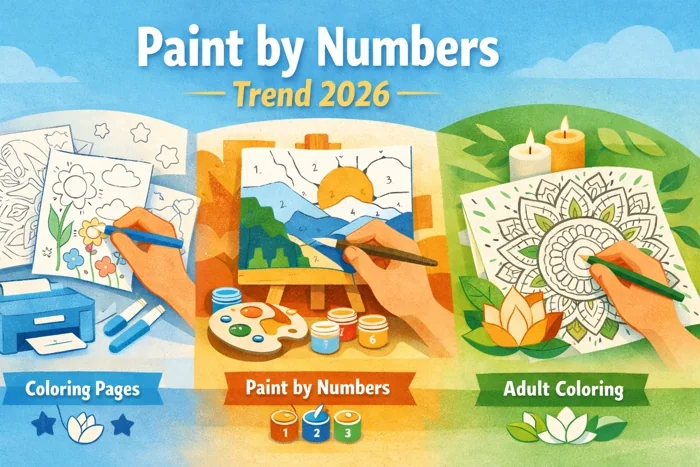
The paint by numbers trend and the steady “adult coloring” wave are related, but they are not the same thing. Search wording shows three different expectations: print something immediately, finish a guided project, or calm down with a repeatable routine. When you treat those as three separate lanes—coloring pages, paint by numbers, and adult coloring—the topic becomes a clear picture of how people spend short pockets of time in 2026.
Keyword clusters and what they signal
Search is everyday language, not a survey. People usually don’t type an abstract desire like “I need a low-effort creative habit.”
They type the practical thing they want next: a download, a kit, or a calming activity.
That’s why the small words around the main term matter.
- “Free / printable / PDF” → quick access, low setup, often used repeatedly.
- “Beginner / tips / how to / fix” → confidence and problem-solving (“help me finish this”).
- “Relaxing / mindfulness / stress relief” → mood change and focus, usually in short sessions.
| Cluster | Typical add-ons | What people usually want | Best content format |
|---|---|---|---|
| Coloring pages | free • printable • PDF • kids • school • holiday • easy | Instant sheets, variety, fast results | Printable hubs, clear categories, quick download paths |
| Paint by numbers | beginner • kit • canvas • custom • from photo • tips | A guided project with a finish line | Step-by-step guides, setup + troubleshooting |
| Adult coloring | relaxing • mindfulness • mandala • intricate • calming | A repeatable calming routine and focus time | Curated collections by mood/time + simple techniques |
Search terms map (text-based): how wording changes meaning
Here is a simple map of how people branch from a main term into different expectations. The same hobby can mean different things depending on the add-on words.
- “Coloring pages” → “free / printable / PDF” (download now) • “kids / school” (activity in a routine) • themes (“animals / holidays”) (browse and repeat).
- “Paint by numbers” → “beginner / easy / tips” (finish successfully) • “kit / canvas” (materials matter) • “custom / from photo” (personal meaning) • “fix / blend” (make it look better).
- “Adult coloring” → “relaxing / stress” (downshift) • “mindful” (focus) • “mandala / intricate” (absorption and time) • style words (“botanical / aesthetic”) (mood and look).
By the numbers: what shows up in public data
Exact search volumes usually sit behind paid tools, but public numbers still show how big structured coloring became and how it evolved over time.
These figures are useful because they capture real market behavior and platform scale.
Adult coloring books (U.S.)
1M → 12M copies (2014 → 2015)
Nielsen BookScan reported about 12 million coloring books sold in the U.S. in 2015, up from about 1 million in 2014.
Title supply expanded fast
~300 → 2,000+ titles (2014 → 2015)
In the same period, the number of published coloring-book titles rose sharply, indicating that “adult coloring” turned into a full category.
Tools followed the habit
$128.2M colored pencils (+47%)
Nielsen also reported U.S. colored pencil spending reaching about $128.2 million (year ended April 30), about 47% higher than the prior year.
The wave later cooled
December: -2M books YoY
TIME reported that adult coloring sales rose overall in 2016, but December sales were down by about 2 million books year over year (NPD BookScan).
In plain terms: coloring pages often mean “give me something I can use right now,”
paint by numbers often mean “help me complete a project,” and adult coloring often means “help me feel calmer and focused.”
The overlap is real, but the “win condition” is different in each lane.
Why adults choose structured art
Adults have endless entertainment options, yet many still choose a structured, hands-on activity. The simplest explanation is friction.
A blank page asks for decisions—what to draw, what colors to pick, how to start—and that can feel like work after a long day.
Structured formats move those big decisions out of the moment. What’s left is a small, clear next step: fill this shape, paint this number, continue.
- Short sessions still count: 15 minutes feels like progress, not “barely started.”
- Visible progress is motivating: you can see change quickly, which encourages returning.
- It’s private: no performance pressure, no need to “be artistic” in public.
Not “childish,” but low-friction
The adult coloring boom in 2015 shows how quickly a structured hobby can become mainstream when it solves a common problem.
But the later slowdown matters too: it suggests the market moved from “everyone tries it” to “a stable group keeps doing it.”
That’s why adult coloring remains visible without constant hype—it works as a routine for the people who keep it.
Paint by numbers sits slightly differently. It offers the same structure, but it also promises a stronger “finished object.”
The canvas format, the paint, and the idea of framing the result align with the DIY art trend: people want something calming,
but they also like the feeling of completion—something that looks intentional on a wall.
“Photo to paint-by-numbers” curiosity (privacy + use cases)
One of the strongest modern signals inside the paint-by-numbers lane is personalization: “custom,” “from photo,” “my pet,” “family portrait.”
This interest isn’t only about making a prettier image. It’s about turning something digital and endless (a camera roll) into something physical and finishable.
- Pets and family keepsakes: a memory with an emotional hook makes it easier to finish.
- Handmade gifts: personal, but still guided enough to complete.
- Home décor with meaning: a piece that fits a room and carries a story.
- “I want to succeed” projects: a personal subject can reduce drop-off.
Privacy concerns are real—because photos contain more than the subject
When people upload personal images, risk often comes from two places: what’s visible in the frame (documents, badges, school logos, house numbers),
and what’s invisible inside the file (metadata). EXIF fields can include timestamps, device details, and GPS coordinates when location services are enabled.
- Crop out identifiers: logos, signs, badges, certificates, mail, and house numbers.
- Avoid reflections: mirrors and screens often reveal more than expected.
- Use a “clean copy”: export a copy that removes or limits metadata when possible.
- Choose low-risk subjects for sensitive situations: pets, landscapes, silhouettes.
- Think about rights: avoid screenshots or artwork you don’t have permission to reuse.
In 2026, this “from photo” curiosity is part of the broader mindful hobbies conversation: people want a calming activity,
but they also want it to feel personally meaningful. That meaning is what helps a project compete with short-form content.
Age and intent differences (kids entertainment vs adult stress relief)
The biggest difference is not age—it’s the goal behind the click. A parent or teacher searching “free printable coloring pages”
is often optimizing for speed and availability. An adult searching “adult coloring relaxing” is optimizing for mood.
Someone searching “paint by numbers beginner tips” is optimizing for success: they want to avoid the frustration that makes them abandon a canvas.
Kids’ lane (often): quick wins, short cycles, lots of variety. The activity is part of a routine—rainy day, classroom station, travel.
That’s why “free,” “easy,” and themed pages dominate.
Adults’ lane (often): decompression and focus. The output matters, but the main value is how it feels during and after the session.
That’s why mood words appear more often in adult coloring searches.
Paint by numbers bridges both: it can be relaxing, but it has a stronger “project” identity and a clearer finish line.
That hybrid helps explain the paint by numbers trend: it offers structure like coloring, but the result can feel more “made,” not just “filled in.”
What people will likely keep searching in 2026
The common thread across these clusters is structured simplicity: activities that reduce decision load, fit into short time blocks, and reliably shift attention.
Public signals point in the same direction: print booms when a format goes mainstream, then stabilizes; digital versions keep the habit alive at massive scale;
and institutions keep publishing free printables because demand is steady.
DIY buying shifted online fast
E-commerce $211.5B; +44.5% YoY (U.S., Q2 2020)
U.S. Census reported retail e-commerce sales reaching $211.5B in Q2 2020, up 44.5% year over year, and 16.1% of total retail sales.
Craft retail saw extreme online growth
Michaels: +353.1% e-commerce (Q2 FY2020)
Michaels reported e-commerce growth of 353.1% in its Q2 fiscal 2020 results.
Digital “by number” stays huge
Hundreds of millions of downloads (public estimates)
Public app analytics sources list large download totals for major “color by number” apps, indicating ongoing mass adoption.
Institutions still publish free pages
10-page packet (Smithsonian, 2022)
Smithsonian Libraries and Archives released ten free downloadable coloring pages as part of Color Our Collections.
- Short sessions: quick pages, small canvases, “finishable” sections.
- Personalization: “from photo” tools and guides that simplify details for better results.
- Quality upgrades: simple techniques (blending, shading, brush control) that make outcomes look smoother.
- Safer sharing: practical questions about photos, privacy, and what gets stored during uploads.
Put simply: in 2026, people are looking for small, reliable ways to transition out of a high-stimulation day,
spend 15–45 minutes doing something tactile, and end with either a calmer mind or a visible result.
That is why the three search clusters keep returning—each one solves a slightly different version of the same modern need.
FAQ
What is the difference between “coloring pages,” “adult coloring,” and “paint by numbers”?
Coloring pages usually means fast, printable sheets and variety. Adult coloring typically emphasizes calm and focus (mandalas, intricate patterns, “relaxing” language). Paint by numbers is more project-like: it’s guided, but it aims for a finished piece that looks display-worthy.
Is adult coloring “proven” to reduce stress?
Public health sources commonly describe coloring as a simple relaxation activity that can help many people feel calmer. It should be framed as a supportive routine, not a clinical treatment. If stress or anxiety is severe or persistent, professional support is the safest path.
How long does a typical session need to be to feel useful?
Many people use these activities in 10–20 minute blocks because the structure creates visible progress quickly. Longer sessions (30–60 minutes) are common when the goal is deep focus (intricate adult coloring) or completing a meaningful section (paint by numbers).
What makes “photo to paint-by-numbers” so popular?
It turns an endless digital archive into a finite, finishable project. Personal subjects (pets, family moments, trips) increase motivation to return and finish. It’s also a “safe creativity” shortcut: the subject is already chosen, so the user can focus on execution.
What are the biggest privacy risks when uploading a photo?
Two main risks: visible identifiers (school names, house numbers, badges, documents in the background) and metadata (EXIF fields like timestamps, device info, and sometimes location). Cropping and exporting a clean copy are simple ways to lower risk.
Can kids use “adult coloring” books and intricate designs?
Some kids enjoy complex patterns, but many prefer quicker reward cycles. A practical approach is matching complexity to attention span: simpler pages for short sessions, more intricate pages for older kids who enjoy detail and longer focus.
What supplies matter most for a better result?
For coloring: consistent pencils/markers and a smooth paper surface help. For paint by numbers: decent lighting, a comfortable brush grip, and thin, even layers usually improve results more than expensive upgrades. Small habits—like keeping paint from drying out—often matter more than new tools.