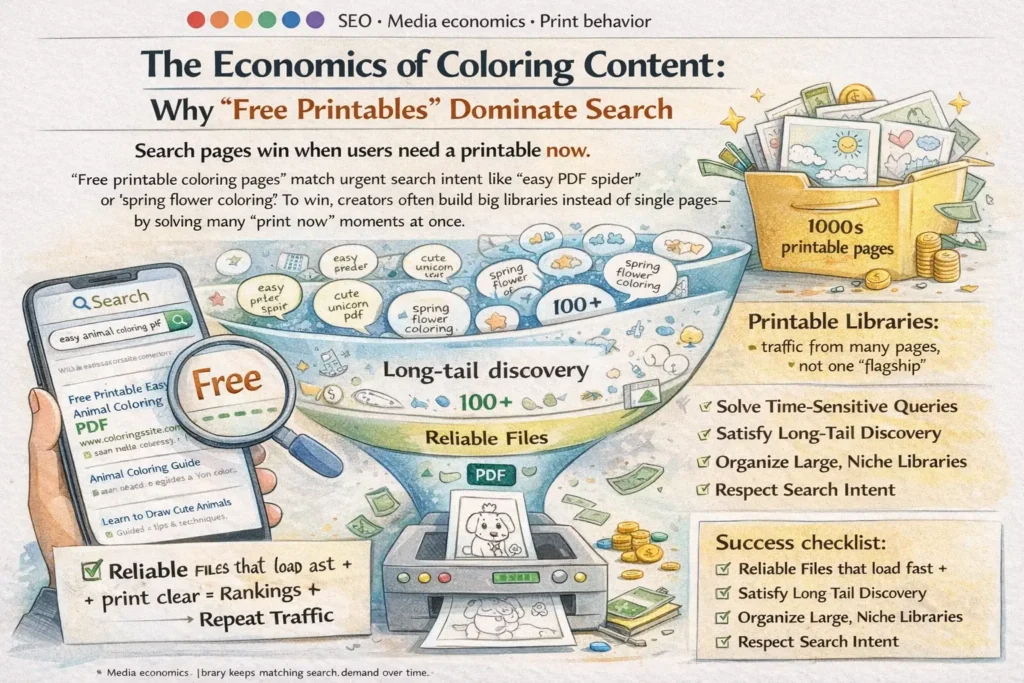
Search engines are marketplaces of attention. In that marketplace, free printable coloring pages often rise to the top because they match a very
specific, high-confidence need: “I want something I can print right now.” This article explains why that happens—how search intent, long-tail discovery,
and printable-first user behavior shape results, and why creators keep building large printable libraries instead of relying on a few “flagship” pages.
Search intent: “print now” behavior
When people type “free printable coloring pages,” they are usually not browsing for inspiration the way they might browse a gallery, a tutorial, or a long
guide. Many are trying to solve a time-sensitive, practical problem: keep a child engaged, set up a classroom activity, prepare a holiday
table, or create a calm moment at home.
mind—download → print → use. That clarity tends to reward pages that finish the task with minimal friction.
This action-first mindset often creates a short loop. The user searches, clicks, checks whether the page looks printable, and then either prints or returns
to results to try a second option. In printable terms, “success” is not spending five minutes reading; it’s getting a usable page onto paper quickly and
without surprises.
holiday coloring · quick print
Those modifiers matter because they sharpen search intent printables. A user adding “PDF,” “A4,” “easy,” or “worksheet” is describing what
“useful” looks like in their context. Even when the query is informational, the underlying expectation is resource-first: preview quickly, download, print.
A basic media-economics point explains why “free” dominates this intent. Free reduces decision cost. On a tight timeline, people are less likely to compare
pricing tiers, read long explanations, or create accounts. They want a low-risk option that works immediately. In that sense, “free” functions like a shortcut
around hesitation: it turns the search into a fast trial.
There is also a page-scanning reality. Users commonly scan web pages before committing, focusing attention near the top and in the first visible screen of
content. For printables, that means above-the-fold clarity is unusually valuable: a clear preview, a simple download path, and basic printing details visible
early. When those cues are missing, many users leave quickly and try another result.
page they can print in under a minute. The result that shows an obvious preview and a predictable printable file is more likely to satisfy that moment than
a page that hides the file behind multiple steps.
This is why “free printable” pages can win even against technically richer content. A long guide may be excellent, but if the user’s job is “print now,” the
guide is not the fastest route to success. Search results tend to reflect that by favoring pages that match the job-to-be-done most directly.
Long-tail themes (animals, holidays, cartoons, learning)
The printable ecosystem is powered by the long tail: countless small, specific queries that don’t look huge individually but add up to massive total demand.
In practice, long tail keywords coloring means people rarely search “coloring pages” alone. They search for what they actually need: a theme, a moment,
a skill level, and often a context (school, party, bedtime, travel).
This is why the library model often dominates. A single “big” coloring page can do well, but a site with hundreds (or thousands) of variations can capture
demand from many micro-intents. One parent wants “easy unicorn coloring page for preschool.” A teacher wants “printable rainforest animals coloring worksheet.”
Someone planning an event wants “Halloween pumpkin printable coloring page.” These are different problems, and the long tail rewards publishers who can meet them
consistently.
How the long tail creates a compounding advantage
The more specific the situation, the more specific the search. Specificity reduces noise and increases the chance that a single page matches the user’s
exact intent.
Printables are modular. Creators can publish many variations by changing theme, age level, or format while keeping the printable structure stable.
Each page becomes a new doorway from search. Over time, a library can earn steady traffic from a wide range of low-volume queries—especially when pages
are organized clearly.
Economically, this is attractive because the marginal cost of each additional page can be relatively low once the format is established, while the shelf-life
can be long. A “Christmas ornament printable” or “alphabet animals coloring” page may receive seasonal or evergreen demand year after year. That encourages
breadth: creators build catalogs that match many repeatable needs.
Why organization wins (not just volume)
Scale alone isn’t enough. Libraries that tend to perform well usually make the catalog easy to navigate for both people and search systems. Two patterns are
especially common:
-
Category hub pages that group a major theme (animals, vehicles, cute characters, learning worksheets) and help users choose quickly by subtype (easy
vs detailed, preschool vs older kids, single page vs bundle). -
A dedicated holiday hub that collects seasonal printables (Halloween, Thanksgiving, Christmas, Valentine’s Day, Easter, back-to-school) and makes it
simple to download multiple pages without repeated searching.
For readers, hubs reduce effort: you land once and pick what fits. For creators, hubs prevent the site from becoming a messy pile of pages. They turn “many
pages” into “many pages with a map,” which increases the chance that users stay on-site instead of returning to the search results.
30 theme ideas grouped by intent
Below are 30 theme ideas organized by the “job” the user is trying to accomplish. These groups reflect printable download behavior: fast single
pages, seasonal bundles, learning worksheets, and situation-based activities.
a discovery path.
Intent A — Instant calm & “keep them busy” (fast print, low setup)
- Easy pets: puppy, kitten, bunny (big shapes, thick outlines)
- Simple vehicles: fire truck, tractor, airplane
- One-page dinosaurs: T-rex, triceratops, stegosaurus
- Weather icons: sun, clouds, rainbow, snowman
- Food favorites: pizza slice, ice cream, cupcake
- Bedtime friendly: stars & moon, sleepy owl, gentle forest
Intent B — Character-like fun (original, non-franchise)
- “Cute monster” set: expressive creatures (happy, shy, silly)
- Robot buddies: friendly robots with simple panels and faces
- Fairy-tale archetypes: knight, dragon, princess, wizard (original designs)
- Space explorers: astronaut kid, rocket, planets with faces
- Underwater friends: mermaid (original), clownfish, sea turtle
- Superhero silhouettes: capes, masks, action poses (generic, non-branded)
Intent C — Holidays & event preparation (seasonal “need it now”)
- Halloween: pumpkins, bats, friendly ghosts
- Thanksgiving: turkey, fall leaves, gratitude banner letters
- Christmas: ornaments, stockings, reindeer
- Valentine’s Day: hearts, love bugs, “to/from” card coloring page
- Easter: eggs, chicks, baskets
- Back-to-school: pencils, backpacks, first-day signs
Intent D — Learning & skill-building (classroom + home practice)
- Alphabet animals: one letter per page (A–Z series)
- Numbers: count-and-color (1–10 with matching objects)
- Shapes: circle/square/triangle scenes to color
- Fine motor: trace-and-color lines, patterns, spirals
- Color words: “Red,” “Blue,” etc. with matching objects
- Simple science: life cycle of a butterfly (colorable stages)
Intent E — Bundles for groups (party packs, centers, rainy-day kits)
- Animal safari pack: lion, zebra, giraffe, elephant, hippo, rhino
- “Around the world” pack: landmarks (generic) + flags coloring (original layouts)
- Sports day pack: soccer, basketball, skateboarding, swimming
- Garden pack: flowers, bees, butterflies, vegetables
- Fairy garden pack: mushrooms, tiny houses, woodland creatures
- Calm corner pack: mandala-lite patterns, breathing prompts, soft nature scenes
The pattern is simple: “topic” matters less than “scenario.” “Dinosaurs” is a topic. “One-page dinosaurs for preschool while traveling” is a scenario.
Scenarios create long-tail searches, and long-tail searches are where printable libraries accumulate demand over time.
What makes a printable useful (file quality, simplicity)
The printable format looks simple, but usefulness is engineered. When a page truly satisfies “print now” intent, it usually shares predictable traits:
clear line art, printer-friendly layout, fast loading, and a preview that matches the downloaded file.
The winning pages don’t rank only because they are free. They often rank because they reduce failure points. If someone prints a page with clipped margins,
fuzzy lines, or an unexpected watermark, they experience wasted time. Many users will return to results and choose another option next time. At scale, those
small frustrations can influence which libraries earn repeat visits and which pages get shared in classrooms or parent groups.
A practical checklist creators use (and users feel)
| Printable signal | Why it matters | Good default | Common failure |
|---|---|---|---|
| Clean line art | Kids can follow shapes; printers reproduce it sharply. | High-contrast black lines; fewer micro-details in “easy” pages. | Thin gray lines that fade on home printers. |
| True print margins | Home printers often can’t print edge-to-edge. | Safe margin around the design; centered composition. | Important parts clipped at the edges. |
| Predictable format | Users want one click to a printable file, not surprises. | PDF for printing; optional PNG/JPG previews. | Multi-step downloads, forced signups, or blockers before print. |
| Simplicity first | The goal is the activity, not reading a long page. | Large preview + clear download/print action near the top. | Clutter that hides the file and slows the page. |
What users notice instantly (even if they don’t describe it)
- Preview-file match: the preview should look like the printed output (line weight, cropping, and cleanliness).
- Paper size clarity: many users print on US Letter or A4; mismatch can cause clipping or odd scaling.
- Single-page certainty: lots of searches imply “one page right now,” not a surprise 12-page download.
- Minimal obstacles: intrusive overlays, heavy watermarks, or repeated popups can make a page feel unusable.
This connects directly to printable download behavior. A printable is “good” when it behaves like a tool: it works the first time, it’s easy to swap
for another option, and it doesn’t demand extra attention. That is why many top-performing printable pages are intentionally simple around the file.
Simplicity also supports distribution. Teachers prefer predictable files they can print for a class set. Parents bookmark sites that print correctly without
surprises. Even when a query is informational, the mindset is often “acquire a resource,” and the lowest-friction option tends to win.
Ethical note: copyright and fan art boundaries
The printable boom has an ethical edge: users often request cartoons, movie characters, and game icons. Popularity does not automatically equal permission.
Creators who publish printables should understand the boundary between “inspired by” and “derivative copying.”
A conservative, creator-friendly rule is: don’t reproduce protected characters, logos, or signature elements in a way that substitutes for the original
brand’s artwork. Attribution does not automatically grant rights. And “fair use” is a context-specific analysis, not a blanket permission—risk can increase
when a site distributes content commercially or at scale.
deliver the same mood without copying protected designs.
You can still meet demand for “cartoons” by focusing on what users often want in practice: expressive faces, familiar story roles, and recognizable
situations. That demand is about emotion and narrative, not necessarily about reproducing an exact IP. When you design with that lens, you protect your
project and give users printables they can share more confidently.
For publishers, ethics can also be an economic advantage. Original printable libraries become long-term assets: they can be expanded, organized into category
hub pages, refreshed seasonally in a holiday hub, and reused in bundles without constant takedown anxiety. That stability matters because the printable market
is built on scale: many small pages serving many specific queries over time.
Bottom line: free printables often dominate because they match a powerful “print now” intent and because long-tail discovery rewards organized libraries.
The sustainable path is to serve that demand with reliable file quality, simple delivery, and original art that respects boundaries.