In many homes, the tension is not simply “screens vs. no screens.” It is the feeling that screens never really end.
That is why printable activities for kids are returning in a practical way:
one page creates a clear start, a calm middle, and an obvious finish.
Used well, printables can become reliable screen-free activities and a repeatable
offline family routine that supports transitions without turning parents into full-time planners.
Repeat it at the same moment each day. The goal is not “perfect art.” The goal is a calmer handoff.
Why this feels bigger right now
Families are not imagining the intensity. For many young children, digital media is now a daily backdrop rather than an occasional extra.
Common Sense Media’s 2025 census reports that children age 0–8 average about 2 hours 27 minutes of screen use per day,
and that by age 2, 4 in 10 children already have their own tablet.
Many parents also report concern about overuse, mental health effects, and exposure to inappropriate content.
In this article, screen fatigue does not mean a formal diagnosis. It refers to the everyday mix of overstimulation,
transition friction, low patience for slower tasks, and family tension that can build when screens become the default filler between activities.
That frame matters because the problem is often not one dramatic moment. It is the repeated daily handoff:
after school, before dinner, during a parent’s last work task, or in the final stretch before bed.
That is where printables regain value. A printable does not need to “beat” a screen on excitement.
It helps because it is often lower-friction than inventing an activity from scratch.
There is no app to load, no account to manage, no long setup, and no hidden clean-up cost.
One page can begin quickly, finish cleanly, and repeat tomorrow without a whole new plan.
something a child can begin in under two minutes, with tools already at home, and with a visible end.
Why printables feel easier than “planning activities”
Planning sounds simple until you are the one doing it at 6:30 p.m. with a tired child, a cluttered table, and unfinished adult tasks.
The hidden cost is not only the activity itself. It is the executive load required to create it:
choose an idea, gather materials, explain rules, adjust for age, prevent mess, and manage clean-up.
That is where many well-meant “screen-free ideas” break down.
Printables remove a large part of that invisible labor. They are compact by design:
a prompt, a boundary, and a finish line already exist on the page.
A parent does not have to invent the structure because the structure is already there.
For children who are coming down from fast digital content, that can matter.
Attention often responds better to something contained,
predictable, and doable
than to something open-ended and demanding.
- Harder transitions when a device is turned off.
- Lower tolerance for boredom, even when options exist.
- Restless mood after fast content: wired, but not satisfied.
- Shorter attention for slower tasks like books, puzzles, or drawing.
- Conflict spikes around timing instead of smoother routine.
In that context, a printable can work because it asks for one decision instead of ten.
Choose a page. Pick a pencil. Start with one section.
That reduction in decision load is not trivial.
For many families, it is the difference between “We should do something offline” and “We actually started.”
A useful frame: printables are a bridge, not a ban
Printables do not replace imaginative play, outdoor time, conversation, rest, or sleep.
They work best as a bridge between high stimulation and calmer engagement.
That is why they often fit well into transition moments:
after school, before dinner, before bedtime, or during a short adult work window at home.
that reduce friction, support calmer transitions, and make family life easier to manage.
Current pediatric media guidance places strong emphasis on fit, routine, what media crowds out, and ongoing family communication.
That is useful because most parents do not need another lecture.
They need tools that work on ordinary Tuesdays.
Printables fit that need well: low prep, low mess, visible completion, and enough structure to help a child settle.
When printables help most — and when they help less
Expert framing gets stronger when we are honest about limits.
Printable activities are not magic, and they are not the right tool for every child in every moment.
They tend to help most when the child needs a short, contained, low-pressure reset.
They help less when the underlying need is movement, sleep, food, connection, or a larger emotional repair.
| Situation | Printables may help when… | They may help less when… | Better immediate need |
|---|---|---|---|
| After screen time | The child needs a calmer transition and a clear next step | The device conflict is still very hot | Pause, co-regulation, short reset first |
| Late afternoon | You need a quiet bridge before dinner or bath | The child is overtired, hungry, or dysregulated | Snack, connection, simpler routine |
| School-age focus dip | A small task can rebuild momentum | Attention is too scattered for any seated task | Movement break |
| Before bedtime | You want a predictable, low-stimulation ritual | The activity becomes exciting or negotiation-heavy | Shorter routine, lights down, sleep cues |
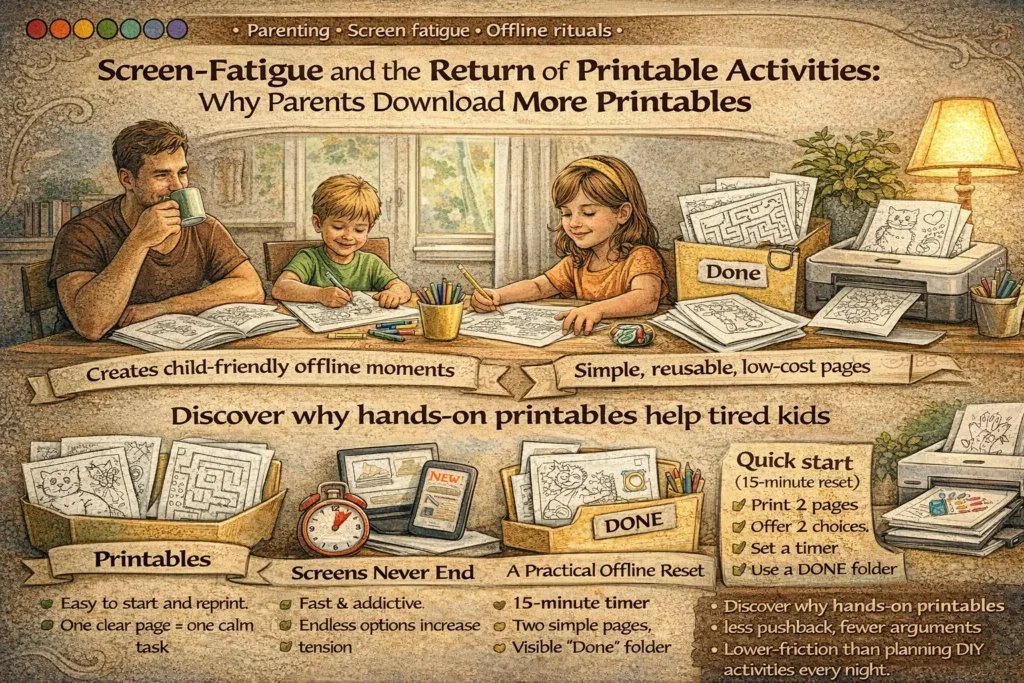
The “15-minute reset” routine
If you want printable activities to function as true screen-free activities,
attach them to a repeatable moment. A short routine usually works better than random good intentions.
- Minute 0–1: Clear one small surface. Put out only the tools you are willing to manage.
- Minute 1–2: Offer two page choices, not ten. Too many options recreate decision fatigue.
- Minute 2–12: Start a timer. Let the timer provide the structure instead of repeated adult reminders.
- Minute 12–14: Ask one warm question: “Show me one part you like.”
- Minute 14–15: Put the page in a DONE tray, folder, or clip. Completion should stay visible.
| Moment | What the child does | What the adult does | What it builds |
|---|---|---|---|
| 0–2 min | Chooses one page and tools | Offers two choices and sets the timer | Predictability + autonomy |
| 2–12 min | Works quietly | Stays nearby without over-directing | Sustained attention |
| 12–14 min | Shares one favorite detail | Asks one short question | Connection without pressure |
| 14–15 min | Files the page away | Closes the moment calmly | Closure + routine memory |
The deeper value of this reset is not artistic output.
It is the emotional architecture: a clear beginning, a manageable middle, and a visible end.
Screens often blur those boundaries. A simple printable routine can help restore them.
What to print when attention is already low
Not every printable works equally well in a fatigued moment.
The best page is not the most “creative.”
It is the one a child can begin without confusion.
That usually means one clear task, moderate white space, and a finish that feels reachable.
For ages 3–5
- Bold coloring pages with large shapes and simple outlines.
- Trace-and-color sheets that combine movement and easy success.
- Find-and-color prompts with just a few targets.
- Short cut-and-paste pages only if the scissors step is tiny and realistic.
For ages 6–8
- Mazes, word searches, and spot-the-difference for children who want more challenge.
- Color-by-number pages when structure helps focus.
- Theme packs that reduce novelty overload: animals, vehicles, seasons, simple characters.
- One-rule challenge pages such as “use only cool colors” or “circle three hidden details first.”
Save it for later. The best transition printable feels obvious.
How parents choose the right page: age, theme, and complexity
“Easy” is not one fixed category.
A page can be too hard and create friction, or too easy and feel boring.
The sweet spot is slightly challenging but still doable without adult rescue.
| Decision point | Choose this when… | Avoid this when… | Best result |
|---|---|---|---|
| Simple coloring page | The child is tired, dysregulated, or resisting transitions | They are seeking a bigger challenge | Fast start and calmer mood |
| Logic-lite printable | The child needs a focus target, not just open coloring | Attention is already too fragmented | More engagement for school-age kids |
| Theme-based page | A strong interest helps motivation | The theme becomes a negotiation battle | Quicker buy-in |
| Multi-step craft printable | You have time, attention, and willingness for setup | You need a low-mess weekday reset | Weekend or planned project use |
This is one reason parents often end up downloading more printables over time.
Once they find a few pages that fit their child’s age, energy level, and attention style,
they start building a small library of reliable yeses.
The value is not endless variety. The value is knowing which pages actually work in real moments.
A mini printable rotation system that stays realistic
Printable overload is real.
If everything is available, nothing feels manageable.
A small rotation system usually works better than a giant folder of good intentions.
- Ready now: 2–4 pages already printed and visible.
- Next up: 6–10 pages clipped in a folder for later.
- Done tray: finished pages stay visible for a few days.
- Retire: pages that create friction get removed without guilt.
This system also makes printables more sustainable.
You do not need to print huge stacks.
Keep a small active set, refresh when needed, and notice what actually gets finished.
The pages children repeat voluntarily are often the most useful ones.
after school, while dinner starts, before bath, or in the last calm block before bed.
Routine reduces negotiation.
How to keep it sustainable and organized
Printable activities work best when the system around them stays light.
If printing turns into clutter, guilt, or another management burden, families abandon it quickly.
The answer is not a perfect storage solution. It is a small, repeatable one.
- Print in small batches instead of downloading fifty pages at once.
- Group by function, not only by theme: calm pages, quick wins, challenge pages, bedtime pages.
- Store tools with the pages so the activity starts fast.
- Notice completion patterns: which pages get started, finished, or abandoned.
- Reprint favorites without apologizing for repetition. Familiarity often lowers friction.
In many families, that is the real reason printables return.
They are not flashy, but they are dependable.
And when attention is frayed, dependable often beats exciting.
FAQ
What are printable activities for kids and why can they help with screen fatigue?
Printable activities are ready-to-use pages such as coloring sheets, mazes, tracing pages, matching tasks, and simple puzzles.
They can help because they create a contained offline task with a clear beginning and end.
That makes them useful when a child needs a calmer transition after screens.
Why do parents download more printables instead of planning bigger offline activities?
Because printables reduce setup, decisions, and mess.
A parent does not have to invent the activity from zero.
The page already provides structure, which makes it easier to start on busy weekdays.
What is the “15-minute reset” routine?
It is a short printable-based ritual: offer two choices, set a timer, let the child work quietly, ask one warm question, and file the page away.
The purpose is not performance. The purpose is regulation, transition, and a more predictable family rhythm.
Which printables usually work best for ages 3–5?
Bold coloring pages, trace-and-color sheets, and very simple find-and-color prompts usually work best.
Large shapes and obvious tasks are often more helpful than dense detail during tired moments.
Which printables usually work best for ages 6–8?
Slightly more structured pages often work well: mazes, word searches, spot-the-difference, and simple color-by-number sheets.
They give attention a stronger target without requiring a full project setup.
How do we keep printable activities from becoming clutter?
Keep only a small active rotation: a few pages ready now, a few pages next, and a visible DONE tray.
Print in small batches and reprint what children actually use instead of storing huge stacks.
Are printables supposed to replace screens completely?
No. They work best as one practical offline tool inside a broader family rhythm.
The goal is not perfection. The goal is to create healthier screen-free moments that support rest, play, connection, and calmer transitions.