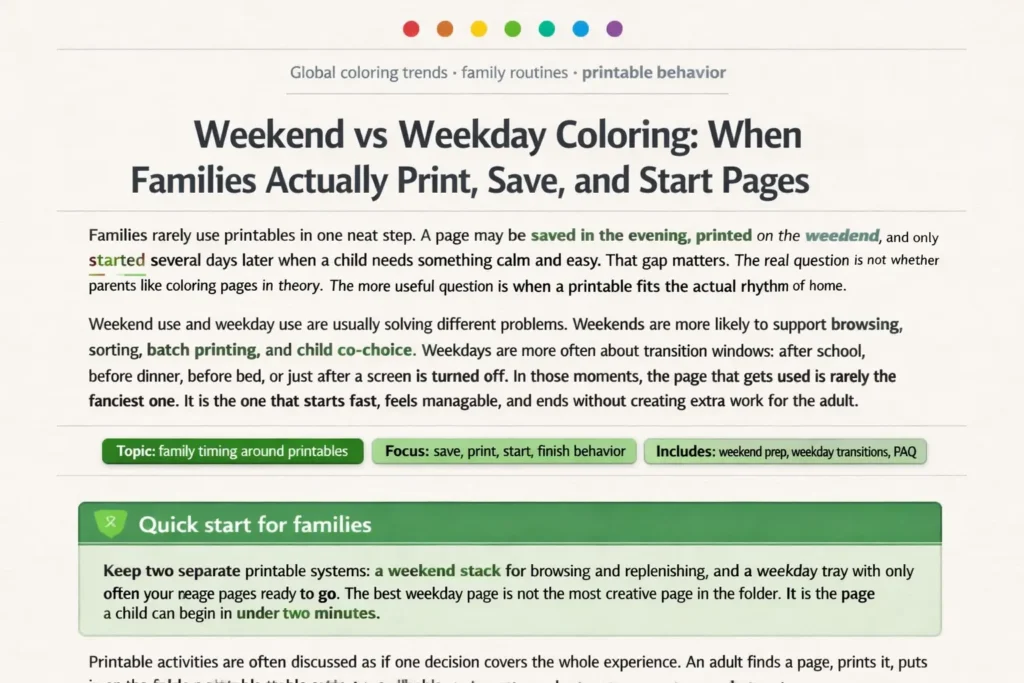
Families rarely use printables in one neat step. A page may be saved in the evening, printed on the weekend, and only started several days later when a child needs something calm and easy. That gap matters. The real question is not whether parents like coloring pages in theory. The more useful question is when a printable fits the actual rhythm of home.
Weekend use and weekday use are usually solving different problems. Weekends are more likely to support browsing, sorting, batch printing, and child co-choice. Weekdays are more often about transition windows: after school, before dinner, before bed, or just after a screen is turned off. In those moments, the page that gets used is rarely the fanciest one. It is the one that starts fast, feels manageable, and ends without creating extra work for the adult.
Focus: save, print, start, finish behavior
Includes: weekend prep, weekday transitions, FAQ
Tone: practical, analytical, family-centered
Why timing matters more than enthusiasm
Printable activities are often discussed as if one decision covers the whole experience. An adult finds a page, prints it, puts it on the table, and the child happily starts. Real household use is usually more fragmented than that. Saving, printing, starting, and finishing often happen in different parts of the week and under completely different emotional conditions.
That is why the same printable can feel helpful on one day and useless on another. A page that looks appealing during relaxed evening browsing may still fail three days later if the child is tired, the pencils are in another room, and dinner is already underway. Interest is only one part of the story. The other part is whether the activity arrives at the right moment with low enough friction.
It is also worth being careful with the evidence. There is no large public dataset that tracks the exact moment families save a coloring page, print it, and begin it. What we do have are adjacent signals that point in the same direction: time-use patterns, family media guidance, and child-development guidance around routines and transitions. Taken together, they support a simple conclusion most parents already recognize from daily life: weekdays leave less room for setup and decision-making, while weekends usually leave more room for preparation.
That distinction changes what a printable is for. On a weekday, it often functions as a low-demand transition tool. On a weekend, it is more likely to be part of browsing, choosing, planning, and stocking up for later. Once that difference is clear, a lot of “why didn’t this page get used?” questions become easier to answer.
The useful model is not download to use. It is save, print, start, finish.
A page is not successful because it was downloaded. It is successful because it was actually used without turning into another small household problem. The most useful way to think about printable behavior is to separate four moments that often get blurred together.
Many printable collections are unintentionally built for the save moment because beautiful pages are easy to collect. Real family life, especially on weekdays, rewards something else: pages that are easy to launch. That is where repeat use is often won or lost.
What weekend behavior is usually good for
Weekend printable behavior is less about urgency and more about preparation. Families are often not trying to solve an immediate after-school or before-dinner problem. That makes different kinds of decisions possible. Adults can browse more widely, compare difficulty levels, think in small sets rather than one-offs, and print a few backup pages for later in the week.
This is where a child’s input can also become more useful. On a calmer day, a child can help choose themes or point to a few pages that feel interesting. That later familiarity matters. A page often feels easier to start on Wednesday if it was already seen and accepted on Saturday.
Weekend time is also more forgiving of small household tasks like sorting pages by age, difficulty, or purpose. That sorting may look minor, but it removes friction later. A page that is already labeled in effect as “easy now” is far more likely to be used in a real weekday moment than a page buried in a large unsorted pile.
- Browsing with a little more patience and less urgency.
- Batch printing for the next few days instead of one emergency page.
- Sorting pages into easy, moderate, and adult-help-needed groups.
- Letting children help choose before the weekday rush returns.
The main weekend mistake is not under-preparing. It is over-preparing without structure. A thick mixed pile can feel productive when it comes out of the printer, but it often becomes clutter fast. A small, visible, sorted stack usually works better than a giant folder that has to be searched all over again later.
Why weekdays are about transitions, not “free time”
Weekday printable use usually happens inside a transition rather than inside a long empty afternoon. A child may be coming home from school, moving toward dinner, winding down before bed, waiting during a sibling activity, or shifting out of device time. In those moments, the printable is not competing with “nothing.” It is competing with fatigue, speed, habit, hunger, and adult decision load.
That is why routines matter so much. Family guidance around media use and child routines repeatedly emphasizes predictable structure, screen-free windows, and calmer transitions rather than expecting every difficult moment to be solved through discipline alone. A printable tends to work best when it is attached to a recognizable part of the day instead of appearing randomly whenever an adult gets desperate.
The most useful weekday rule is simple: the activity should reduce friction, not create it. A child who has just come home tired is rarely asking for a catalog of twenty great options. That child usually does better with one or two visible choices that already feel safe and doable.
When pages are most likely to actually get started
| Daily window | What the child often needs | Best printable format | Why it tends to work |
|---|---|---|---|
| After school / arrival home | A soft landing and lower verbal demand | Simple coloring page, large-shape page, easy find-and-color | It helps bridge the shift from outside stimulation to home rhythm |
| Before dinner | Containment while adults are multitasking | One-page quiet task with minimal tools | Short scope and visible boundaries keep it manageable |
| Before bedtime | Predictable slowing down | Gentle coloring page, calm-theme page, trace-and-color | It fits wind-down routines and lowers activation |
| Rainy day / sick day backup | An easy start when energy is uneven | Ready-to-go stack with age-sorted pages | No search step is needed in the live moment |
The point is not that children only color at these times. The point is that real family use often happens in recognizable windows. Once adults see that pattern clearly, it becomes easier to choose the right page for the right moment.
Why some saved pages never become used pages
A saved page still has to survive several layers of friction. It has to be visible. It has to be easy to print. It has to be near the tools. It has to feel doable for the child’s current energy level, not only for the child on a better day. And it has to ask for less effort than the easiest alternative, which is often a screen.
When parents say they have lots of printables but rarely use them, the problem is often not low interest. It is a broken path between intention and access. The page exists, but not in the right form at the right time.
- Too many choices create delay instead of relief.
- Hidden storage makes the pages disappear from memory.
- Beautiful but overly detailed pages feel hard to enter in tired moments.
- High setup raises the adult’s workload at exactly the wrong time.
- No repeatable routine slot means the activity stays a nice idea rather than a habit.
That is why the strongest fix is usually practical, not motivational. Families often do not need more printable options. They need fewer steps between “this could help” and “this is happening now.”
A family system that usually holds up better
The most durable printable habit is usually not constant creativity. It is modest preparation on the weekend and simple repetition during the week. That pattern makes coloring feel available without turning it into another household project.
Start by shortlisting pages by rhythm rather than only by theme. Choose a few calm pages, a few quick pages, and one or two backup options. Print a small stack, not a giant one. Sort it into simple groups such as “easy now,” “needs help,” and “later.” Keep the crayons or pencils in the same place as the pages instead of in another room.
During the week, offer only a very small choice set. Two pages are usually enough. More than that often recreates the decision fatigue the printable was supposed to reduce. A visible done habit also helps. A tray, folder, or clip area gives the child a finish point and quietly tells the adult that the activity really landed.
FAQ
Do families usually use printables more on weekends or weekdays?
Usually they do different things on different days. Weekends are more useful for browsing, printing, and preparing. Weekdays are where many pages either succeed or fail because that is when they have to work inside real transitions.
Why do so many downloaded pages never get used?
Because saving a page is easy, but starting it later may not be. The page may be hidden, unprinted, too detailed, too hard for the child’s current state, or simply not attached to any predictable part of the day.
What is the best weekday printable format?
Usually a one-page activity with bold shapes, minimal setup, and an obvious first move. On weekdays, the best page is often the clearest page, not the most elaborate one.
When are children most likely to actually begin a page?
Often during transition windows such as after school, before dinner, before bedtime, or during a rainy-day pause. These are the moments when a low-friction offline activity can fit naturally into the day.
Should parents keep a large library of pages ready?
Usually not in one big mixed stack. A smaller sorted set works better. Families tend to do more with a modest, visible, organized group of pages than with a large pile that must be searched again every time.
What is the best family system for repeat use?
A simple pattern usually works best: save and print on the weekend, keep a few easy pages visible during the week, store tools nearby, and use a clear done place so the activity has a visible ending.