School connectedness rarely grows from one assembly, one slogan on a wall, or one week of special programming. In real schools, students decide whether they have a place through repeated daily signals: how they enter the room, how adults respond when they are late or overloaded, whether participation always requires speed and talk, and whether there is any calm way to join before full social confidence arrives. That is why low-prep creative routines deserve more attention than they usually get.
Coloring is not a magic fix. It does not replace strong teaching, safe relationships, good behavior support, or mental-health care. It can, however, provide one quiet entry point into school life when a student needs to arrive gradually rather than all at once. A manageable page, a familiar basket of pencils, a shared table, and a short predictable opening can lower the social cost of participation. In many schools, that matters during quiet entry, after recess, in after-school care, or in a counseling room where direct conversation would be too much too early.
Focus: repeated low-pressure experiences
Includes: settings, scenario table, school model, FAQ
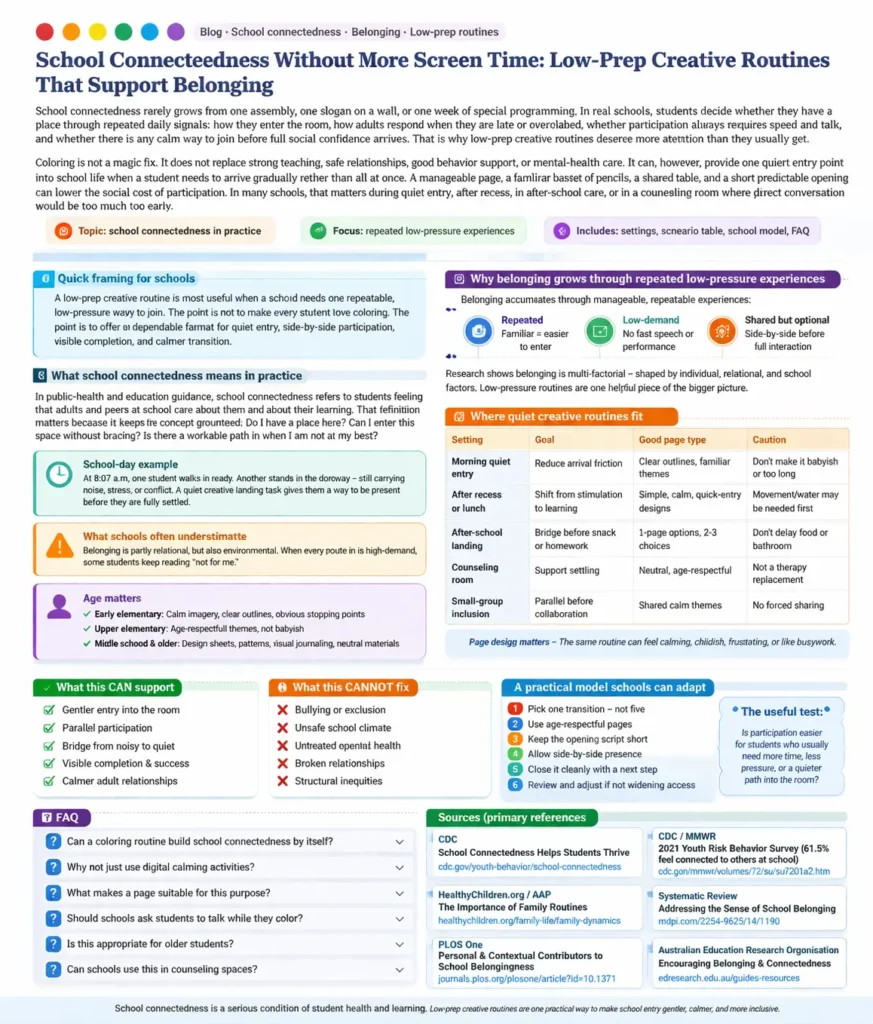
A low-prep creative routine is most useful when a school needs one repeatable, low-pressure way to join. The point is not to make every student love coloring. The point is to offer a dependable format for quiet entry, side-by-side participation, visible completion, and calmer transition.
What school connectedness means in practice
In public-health and education guidance, school connectedness refers to students feeling that adults and peers at school care about them and about their learning. That definition matters because it keeps the concept grounded. Connectedness is not the same thing as school spirit, event attendance, or liking a mascot. It is the student’s day-to-day reading of the environment: Do I have a place here? Can I enter this space without bracing? Is there a workable path in when I am not at my best?
That practical reading of school life is easy to miss because schools naturally notice the visible students first: the student who raises a hand, joins a club, greets everyone, or volunteers. But belonging does not begin only through visible confidence. For many children it begins much earlier and much more quietly. It starts when a student who comes in dysregulated is not treated as a disruption first. It starts when a shy child can sit at a table and do something next to others without being pushed to perform sociability on command. It starts when an older student who is tired, embarrassed, or socially cautious can still participate without having to explain themselves before they are ready.
At 8:07 a.m., one student comes in talking, drops a backpack, and is instantly ready for the room. Another stands in the doorway, still carrying the hallway with them: noise, movement, conflict from the bus, or the simple strain of switching from home to school. If the only acceptable entry is immediate talk, immediate eye contact, and immediate academic readiness, the second student starts the day behind. A quiet creative landing task does not solve everything, but it gives that student a way to be present before they are fully settled.
This is one reason connectedness matters so much. CDC guidance describes school connectedness as protective for health and learning, and analysis of the 2021 Youth Risk Behavior Survey reported that 61.5% of U.S. high school students felt connected to others at school. Students reporting higher connectedness also showed lower prevalence of poor mental health and lower prevalence of missing school because of feeling unsafe. The useful takeaway for schools is not that one quiet activity causes these outcomes. It is that connectedness is a serious condition of student wellbeing, and daily routines either support it or quietly erode it.
Belonging is partly relational, but it is also environmental. Students notice whether participation always requires speed, visibility, speaking, improvisation, or social boldness. When every route in is high-demand, some students keep reading the environment as “not for me,” even if adults say they are welcome.
- Early elementary: calm imagery, clear outlines, and obvious stopping points help children enter without too many decisions.
- Upper elementary: the routine still works, but pages need to feel age-respectful rather than babyish. Familiar themes are better than decorative clutter.
- Middle school and older students: the same low-pressure principle can work through design sheets, pattern pages, visual journaling starters, or advisory-table materials that feel neutral and not childish.
Why belonging grows through repeated low-pressure experiences
Students usually do not decide that they belong because of one big emotional moment. More often, belonging accumulates through repeated experiences that are manageable enough to repeat. A child comes in late and still has a place to land. A student who does not want to speak can still join without standing outside the activity. A socially cautious child can sit near peers and participate in parallel. A student who has come back from lunch overstimulated can re-enter the room through something concrete instead of through immediate correction or public sharing.
That is where low-pressure experiences matter. They lower the cost of entry. They also change the meaning of participation. Instead of participation meaning “talk now, perform now, explain now,” it can mean “sit down, choose a page, start somewhere, be near the group, and let the day catch up to you.” In a school context, that is not a small distinction. It creates a more realistic threshold for students who are capable of joining but not instantly ready to do so in a high-demand format.
Repeated routines matter just as much as calm ones. A one-off creative station can be pleasant, but it does not become legible fast enough to help under pressure. Repetition teaches the room. Students learn where the materials are, how long the activity lasts, whether they are expected to talk, what the transition out will be, and whether the adult tone stays steady. Over time, that predictability becomes part of the climate. The student is not only doing an activity; the student is learning that this environment has a reliable doorway.
- Repeated: students can enter without guesswork because the routine is familiar.
- Low-demand: the task does not require fast speech, originality, or emotional disclosure.
- Shared but not forced: students can be near others, use the same materials, and participate in parallel before fuller interaction is asked of them.
Research on school belonging supports this broader logic. Recent reviews describe belonging as multi-factorial and shaped by individual, relational, and organizational factors rather than by one isolated intervention. That is exactly why quiet creative routines are worth framing carefully. They are not “the answer” to school belonging. They are one practical participation structure inside the wider ecology of school climate. The strongest claim here is also the most honest one: when the environment offers more than one acceptable way to join, more students can read that environment as theirs.
Where quiet creative routines fit
Quiet creative routines work best when they are attached to an actual transition point rather than dropped into the day at random. Schools do not need another decorative activity. They need tools that reduce friction exactly where friction already exists.
Quiet entry
This is the most obvious use. Some students arrive chatty and ready; others arrive late, flat, embarrassed, overstimulated, or still carrying home stress into the room. A short table routine gives the second group something structured to do before attendance, morning meeting, or academic work. For younger classes, that may be one or two simple page options already laid out. For older students, it may look more like pattern work, a visual check-in card, or a small creative table task that does not feel juvenile.
After recess or lunch
This window is often mishandled because adults understandably want immediate re-regulation. But many students do not move cleanly from a noisy, social, body-heavy setting to seated academic control. A short creative bridge can make the first minutes after recess less about correction and more about transition. The routine should remain brief and calm; if the group clearly needs movement first, paper should not be forced as the first move.
After-school programs
After-school is not just extra time. It is another transition point with its own overload: mixed ages, snack logistics, tired students, late buses, family pickups, and uneven energy. A short landing activity works well here because it gives children a way to arrive before homework, group games, or open-choice time. It is especially useful for children who are not ready to talk but are not ready to be left in unstructured social space either.
Counseling room or wellbeing space
In a counseling or reset space, the value is not the page itself but the lower verbal load. Some students can regulate side by side long before they can process face to face. A page with calm imagery and no performance pressure can support settling without turning the encounter into silence that feels empty or interrogative talk that feels too fast.
Small-group inclusion
There are also moments when the goal is neither therapy nor transition but gentle participation. A small-group routine can help students be part of a table before they are ready for direct collaboration. This matters for students who are new to the school, English learners still finding language comfort, children who are shy, and students who have had recent peer friction. Sometimes parallel participation is the first workable form of social inclusion.
Short, clear, calm, and age-respectful. It should not feel babyish, random, therapeutic in name only, or like extra work disguised as self-care. The best pages in this slot usually have familiar themes, visible borders, moderate open space, and obvious stopping points. Very intricate pages, novelty-heavy designs, or anything that looks like another assignment can raise the cost of entry again.
| Setting | Goal | Good page type | Caution |
|---|---|---|---|
| Morning quiet entry | Reduce arrival friction and provide one calm first success. | Clear outlines, familiar themes, medium open space, obvious stopping points. | Do not make it feel babyish or stretch it too long. Older students notice tone very quickly. |
| After recess or lunch | Help the room shift from stimulation back to seated learning. | Simple pages, limited detail, calm imagery, quick-entry designs. | Some groups need movement or water first. Paper should not replace obvious physical needs. |
| After-school landing | Offer a nonverbal bridge before snack, homework, or group activities. | One-page options, easy choice between two or three pages, no full packs. | Do not use coloring to delay food, bathroom, or decompression after transport. |
| Counseling or reset room | Support settling, side-by-side presence, and low-demand engagement. | Neutral, nontriggering, age-respectful pages with no performance pressure. | Do not frame the page as therapy by itself or read it as diagnostic evidence. |
| Small-group inclusion routine | Allow parallel participation before direct collaboration. | Shared theme pages or variations from the same calm set. | Do not force conversation, peer sharing, or public explanation too early. |
Why low-prep matters in real schools
Many school ideas fail not because the idea is bad, but because the daily conditions are real. Teachers are managing attendance, late arrivals, transitions, behavior, supervision, and academic pacing. After-school staff are managing pickups, snack, mixed-age dynamics, parent questions, and staffing gaps. Counselors do not always have the time or conditions for a full processing conversation the moment a student walks in. Under those conditions, low-prep is not a minor convenience. It is the difference between a routine that survives Tuesday and one that lives only in planning documents.
Low-prep routines remove activation burden from adults as well as students. The pages are already there. Materials are already out. The opening line stays short. The time frame is visible. The transition out is known. That consistency matters because predictability is part of how routines become regulating rather than decorative. When adults do not have to reinvent the transition each time, students get a steadier entry experience.
Schools sometimes weaken the routine by over-explaining it. Students do not need a speech about why coloring is good for them. They need a calm, believable opening: “Start here while the room settles.” “Choose one page.” “Eight quiet minutes, then snack.” The more ordinary and dependable the routine feels, the more likely it is to support actual participation rather than symbolic programming.
Low-prep also makes adjustment easier. Schools can quickly change the slot, the page style, the length, or the adult script if the routine is not widening access. That matters because what works in a first-grade morning entry does not automatically work for an upper-elementary after-school group. Simple formats are not valuable because they are profound on their own. They are valuable because they are repeatable under pressure and adaptable without drama.
What this can support and what it cannot fix
Quiet creative routines can support belonging, but only within honest limits. Schools get into trouble when they ask a small activity to carry the weight of broader climate failures. A coloring table can make entry gentler. It cannot compensate for bullying, exclusion, inaccessible classrooms, chaotic transitions, punitive adult tone, or relationships students do not trust. It can support connection. It cannot substitute for it.
- Gentler entry into the room or program.
- Parallel participation without immediate social pressure.
- A more predictable bridge from stimulation to quieter activity.
- Visible completion and manageable success for students who need a smaller first step.
- A calmer opening for relationship-building with adults.
- Unsafe or exclusionary school climate.
- Bullying, harassment, or biased adult practice.
- Untreated mental-health conditions.
- Chronic overload created by unrealistic academic or behavioral demands.
- Belonging deficits rooted in broken relationships and structural inequities.
The language schools use here matters. The strongest and most credible claim is not “this activity builds belonging.” It is narrower: a well-placed, low-pressure creative routine can support the conditions in which belonging has a better chance to grow. That claim is modest, but it is also more defensible and more useful in practice.
A practical model schools can adapt
Schools do not need a complicated framework to start. They need one routine that is brief, age-respectful, repeatable, and attached to a real transition point. The model below is deliberately simple because simplicity is what makes the practice usable in everyday school conditions.
A routine is working when participation becomes easier for students who usually need more time, less pressure, or a quieter path into the room. It should not only work for the students who would have been fine anyway.
FAQ
Can a coloring routine build school connectedness by itself?
No. Connectedness is shaped by relationships, safety, adult practice, peer climate, and everyday school structures. A quiet creative routine can support the conditions in which belonging grows, especially by lowering the cost of entry, but it cannot replace a healthy school climate.
Why not just use digital calming activities?
Some schools do use digital tools, but screens add their own complications: device access, attention pull, transitions back off the screen, and the possibility that the “calming” activity becomes one more isolated digital experience. A paper-based routine can be quieter, more shared, easier to supervise, and easier to keep low-pressure.
What makes a page suitable for this purpose?
The best pages for transition slots usually have clear outlines, moderate open space, familiar imagery, and obvious stopping points. They should feel calm and manageable, not babyish, visually cluttered, or like extra academic work.
Should schools ask students to talk while they color?
Not as a default. The routine works best when conversation is optional. Adults can stay present, warm, and available, but forced discussion often raises the social demand too early and removes the very feature that makes the routine helpful.
Is this appropriate for older students?
Yes, but only when the materials respect age and context. Older students usually need more neutral, less childish visual options. The principle is the same; the design language has to change.
Can schools use this in counseling spaces?
Yes, as a low-demand settling tool or side-by-side entry activity. What it should not become is a stand-in for therapy or a pseudo-diagnostic reading of student artwork. The goal is to reduce verbal load and make the first minutes more workable.