In daily family life, printable activities still hold a real place. They do not replace books, open-ended play, or screen-based entertainment. They work because they fit a narrower slot: a short, low-prep, low-friction activity that helps a child settle, wait, or stay occupied without needing a device or a full shared reading session.
That distinction matters. This is not an anti-screen argument and not a claim that coloring pages are “better” than books. It is a practical argument: in many homes, printables survive because they are easy to start, easy to stop, and useful in those everyday moments when reading aloud is too demanding and screens feel like more input than a family wants.
Focus: ages 5–8 routine gaps
Includes: comparison table, data chart, FAQ
Angle: printables as a practical slot, not a replacement
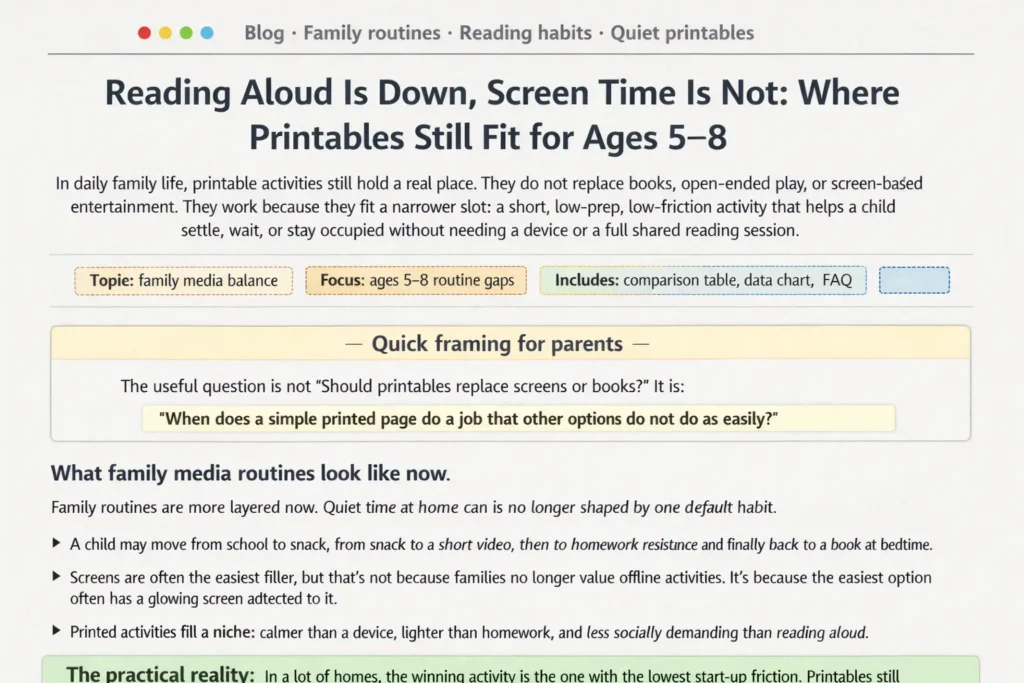
“When does a simple printed page do a job that other options do not do as easily?”
What family media routines look like now
Family routines are more layered than they used to be. Quiet time at home is no longer shaped by one default habit. A child may move from school to snack, from snack to a short video, from that video to homework resistance, and then back to a book at bedtime. Reading, screens, and printable activities do not compete in a simple winner-takes-all model. They serve different moments in the day.
For many households, screens have become the easiest automatic filler. They start fast, require little preparation, and can cover everything from waiting time to decompression to quiet occupation while adults are handling dinner, work messages, or another child. The modern routine problem is not that families no longer value offline activities. It is that the easiest activity now often has a glowing screen attached to it.
That leaves printed quiet activities in a specific niche. They tend to appear when a parent wants something calmer than a device, lighter than homework, and less socially demanding than shared reading. In that sense, printables are not replacing a lost golden-age ritual. They are filling a practical gap inside a mixed routine.
In a lot of homes, the winning activity is the one with the lowest start-up friction. Printables still matter because a page and a pencil ask for very little to begin.
Where daily reading routines have weakened
Reading aloud has not vanished. It has narrowed. In many families, it survives best at bedtime, where the sequence is familiar and the purpose is clear. What has weakened more often is the broader everyday reading habit around the edges of the day: the quick book after school, the casual read before dinner, the easy “let’s sit with a story for ten minutes” moment.
Part of the reason is structural. Reading aloud asks for adult attention, continuity, and enough shared energy to carry a child through a story. That is very different from handing over a device or putting out a simple activity sheet. When homes are busy, adults are tired, and transitions are crowded, reading becomes easier to postpone even when parents still value it.
Recent literacy data supports that picture. National Literacy Trust reported that 50.5% of parents said they had read with their child daily in 2024, down from 66.1% in 2019. HarperCollins reported that only 41% of children ages 0–4 were read to frequently in 2024, down from 64% in 2012, and only 36% of 5–7-year-olds were read to regularly at home. Those figures do not mean books no longer matter. They mean the routine around them is harder to sustain consistently.
A weaker daily reading routine does not automatically mean families care less about literacy. It often means that reading now has to compete with fatigue, time pressure, and easier default options.
Why low-prep printables still matter
Low-prep printables matter because they are operationally simple. They do not need charging, logging in, downloading, or content selection. They do not need a fully available adult. They do not ask the child to follow a plot, sustain listening, or stay inside a social exchange. A child can begin almost immediately, and that speed of entry is part of their real value.
This becomes especially useful in the messy middle of home life: after school, before dinner, between activities, or while a sibling needs something else. In those moments, “good enough to start right now” often beats “ideal in theory.” That is why printable pages continue to hold their ground even in homes with books, tablets, and toys already available.
Their strength is not depth. Their strength is how well they fit the moment. A coloring page or simple printable worksheet can create a small container for attention without making the child perform, narrate, or negotiate much. It gives structure without asking for a big emotional or cognitive ramp-up.
What printables do differently from screens and books
Screens, books, and printable pages are not interchangeable. They place different demands on a child and support different kinds of family moments.
| Activity type | What it does well | What it asks from the child | Best routine slot |
|---|---|---|---|
| Screens | Fast access, strong engagement, easy occupation | Handles stimulation and rapid input | Entertainment, downtime, occupied waiting |
| Books / reading aloud | Language, shared attention, story structure, closeness | Listening, staying with a narrative, shared focus | Bedtime, calm connection time, intentional literacy moments |
| Printables | Low-friction quiet task, visible boundaries, quick start | Light attention, simple motor engagement, low verbal effort | Transitions, short resets, between-task quiet time |
A book usually asks for relationship and attention. A screen usually offers stimulation and occupation. A printable usually offers containment.
Best use cases for ages 5–8
For ages 5–8, printable pages are most useful when the goal is not enrichment at all costs but a workable transition. That might sound modest, but it matches how real homes function. The activity does not need to be the highlight of the day. It needs to help the next 10 to 20 minutes go more smoothly.
After-school landing. A short printed activity can bridge the move from school structure to home rhythm without demanding a report about the day.
Before dinner. This is a classic “too little time for a full activity, too much time for nothing” slot. Printables fit well here.
Sibling asymmetry. When one child needs help and another needs an independent task, a printable can reduce friction without adding more noise.
Low-energy afternoons. When a child is too tired for reading but a parent does not want more digital input, a page can hold attention without overloading it.
Travel, waiting rooms, and pause points. A printable page works especially well where internet, sound, or shared reading conditions are poor.
What printables cannot replace
Printable pages cannot replace the language richness of being read to. They cannot replace the imaginative depth of story worlds, the give-and-take of conversation, or the open-ended problem-solving of free play. They also cannot do the job of a well-chosen shared digital activity when a family genuinely wants co-viewing or interactive learning.
Their role is narrower and more grounded. A printable is not the best answer to every routine problem. It is one useful answer to a specific family need: “We need a calm, simple activity that can start now and end cleanly.”
Simple data snapshot
The point is not that printables should “win” against books or screens. The point is that as shared reading becomes harder to maintain every day and screens remain easy to reach, printable activities keep a useful middle-ground role.
The practical takeaway
Families do not need every activity to do everything. They need a routine mix that works under real conditions. Books matter for language, connection, and reading culture. Screens matter because they are already built into modern life and can be used well or badly. Printables matter because they still solve one stubborn everyday problem: what to offer when a child needs something quiet, simple, and immediate.
That is why printable pages still fit. Not as a replacement for reading aloud. Not as a moral alternative to devices. But as a realistic, low-prep quiet activity that continues to earn its place in the daily life of families with children ages 5–8.
FAQ
Are printables better than books for ages 5–8?
No. They do different jobs. Books are stronger for language, story, and connection. Printables are stronger for short, low-friction quiet moments.
Do printables help reduce screen time?
Sometimes, yes, but that should not be the only goal. Their more useful role is offering a calm alternative in moments when a family wants something simple and offline.
Why do they work especially well after school or before dinner?
Because those are transition windows. A child often needs a task that starts fast, has clear edges, and does not require a lot of talking or shared focus.
Should printables replace reading aloud if the day is busy?
No. They can support the routine, but they should not become the only quiet activity. Shared reading still brings something unique that printables do not replace.
What kinds of printable pages work best?
Usually the best pages are simple, visually clear, and easy to finish. Overly dense or highly demanding printables can feel like extra work rather than a quiet reset.
What is the main reason printable activities still survive in modern routines?
They are easy to start. In family life, low-prep activities often last not because they are the richest option, but because they are the easiest workable option in the moment.