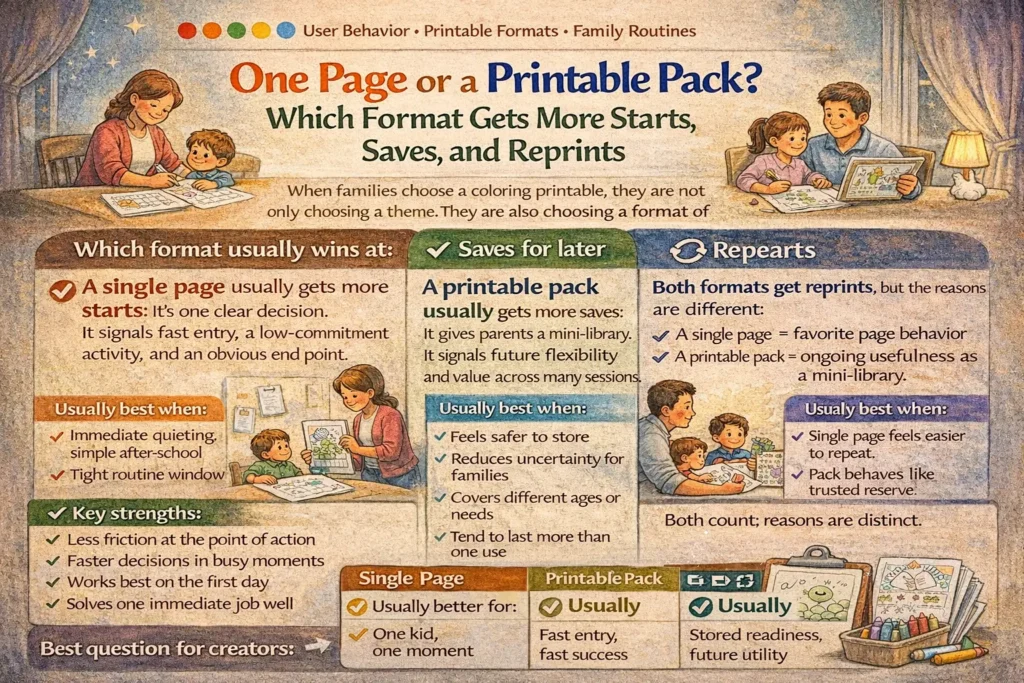
When families choose a coloring printable, they are not only choosing a theme. They are also choosing a
format of commitment. A single page suggests a fast start, a contained activity,
and a visible end. A printable pack suggests range, flexibility, and value across more than one moment. That
difference affects what users do next: whether they print now, save for later, reopen the file next week, or
return to the same page again.
This article is best read as a behavioral analysis, not as a published platform
benchmark. It does not claim that every single page outperforms every pack, or that every pack gets saved more than
every one-page file. Instead, it looks at a more useful question:
what kind of user behavior each format tends to support. That distinction matters,
because “start,” “save,” and “reprint” are not the same decision. They happen at different moments, under different
pressures, and for different reasons.
Main angle: behavior by format
Not a survey: evidence-aware editorial analysis
Why format matters before the coloring begins
Most families do not arrive at a printable library in a neutral, leisurely state. They arrive with a
job to solve.
A single page is usually stronger when the goal is immediate action. A pack is usually stronger
when the goal is future flexibility, stored value, or reuse across several moments.
Sometimes that job is immediate: keep a child occupied while dinner is cooking, bridge the first twenty minutes
after school, create a calm transition before bed, or set up an activity with almost no preparation. Sometimes
the job is broader: collect options for siblings, save backup pages for a rainy weekend, prepare material for a
classroom, or keep a few files ready at a grandparent’s house. A single page and a printable pack
can both be useful in those situations, but they solve them differently.
A single page reduces the number of choices at the point of action. There is one preview, one print decision,
and one clear activity boundary. A pack increases coverage, but it also introduces a second layer of thought:
which page first, whether to print all or some, whether to save before printing, whether one file must serve one
child or several, and whether the activity is for now or for later. That extra layer is not inherently bad. In
fact, it is exactly why packs can feel more valuable. But it changes the behavior that happens first.
Research on assortment size helps explain this pattern. Larger sets can feel attractive because they increase the
chance that something will match the user’s preference. At the same time, bigger choice sets can also slow down
action, especially when the user wants a quick, low-effort decision rather than a browse session. That tension is
exactly what printable libraries face. More choice can increase perceived usefulness, but it can also increase
friction at the start.
Starts, saves, and reprints are three different behaviors
One reason format debates become fuzzy is that people talk about engagement as if it were one thing. It is not.
A start is an action close to discovery. The user opens, prints, and actually begins the activity soon
after finding it. This behavior rewards low friction, fast confidence, and a clear sense that the activity is
manageable.
A save is a future-facing decision. The user is not necessarily ready to print right now, but sees
enough value to keep the file for later. This behavior rewards flexibility, coverage, and confidence that the
file will solve more than one future need.
A reprint happens after the format has already proved itself useful. Sometimes it means the exact same
page is used again. Sometimes it means the file is reopened because it has become a trusted mini-library.
The format that wins on immediate action is not always the format that wins on long-term utility. A file can be
excellent at getting saved and still weaker at getting started in the first minute.
Once those three behaviors are separated, the comparison becomes much clearer. A single page does not need to win
every metric to be valuable. A pack does not need to produce the fastest starts to be the better asset for return
visits and stored utility. The question is not “which format is best?” The question is best for what kind of
behavior.
Which format tends to get more starts?
For immediate starts, the single page usually has the advantage.
The reason is simple: the path from discovery to action is shorter. The user does not need to compare several
pages, choose an entry point, or decide whether to print selectively. One preview often gives enough information
to move forward. In homes where time and attention are limited, this matters more than people think. Parents often
say yes faster when they can quickly estimate setup, likely duration, and difficulty.
They reduce decision load. They make the task shape obvious. They create a visible finish line before the child
even begins. That combination supports fast yes decisions, especially in tight routine windows.
Packs invite browsing before action. The user may appreciate the value, scan the previews, imagine later uses,
or save first and decide later. The first behavior is often selection, not coloring.
This is particularly relevant in transition-heavy moments: after school, before dinner, while a parent is handling
another task, or when a child needs a low-friction quiet activity right now. In those conditions, more choice can
feel like more work. A single page often wins not because it is richer or better designed, but because it asks
less of the adult and less of the child at the moment of decision.
That does not make packs weak. It means they tend to perform best when the user has enough mental space to browse,
compare, or plan. A Sunday afternoon and a Wednesday 5:20 p.m. are not the same use case. Format performance
changes with that difference.
Which format tends to get more saves?
When the user is deciding whether a file is worth keeping for later,
packs often pull ahead.
A pack signals future readiness. It tells the user, “You do not need to know exactly what you’ll need next time.”
That matters in homes, classrooms, and shared family spaces where the next situation is uncertain. A parent may
not know which page a child will want tomorrow. A teacher may want different difficulty levels in one file. A
grandparent may simply want options ready without having to search again.
This is where variety has real practical value. People do not only save files because they love them. They also
save files because those files reduce future uncertainty. A pack often feels safer to store because it covers more
moods, more ages, or more moments. It behaves less like a single activity and more like a small reserve.
A single page can absolutely be saved too, but usually for a more specific reason. It tends to happen when the
page is clearly useful: a favorite animal, an easy design that worked before, a seasonal page for a known
occasion, or a page with the right level of complexity for one child. In those cases, the user is not saving
optionality. They are saving confidence.
Saving a single page often means, “This exact page is likely to work.” Saving a pack often means,
“Something in here will probably work.” Both are valid, but they reflect different kinds of trust.
Which format tends to get more reprints?
Reprints are the most nuanced behavior of the three, because repeat use takes more than initial interest.
It takes remembered fit.
Single-page reprints are usually driven by favorite-page behavior. The child already knows the page, the
complexity felt right, and the first experience was successful enough to repeat. Sometimes the repeat is emotional:
the page felt comforting, familiar, or confidence-building. Sometimes it is practical: the page is easy to finish,
appropriate for a routine, and works without negotiation.
Pack-driven reprints tend to work differently. Families often do not reprint the entire pack as one object. They
reopen it selectively: one page now, another next weekend, a third during a quiet-time routine, another when a
sibling wants something comparable. In that sense, a pack often functions as a reusable library, not as one
repeated page.
| Behavior signal | Single page tends to win when | Pack tends to win when | Why it happens |
|---|---|---|---|
| Immediate start | The user wants a fast yes and minimal decision work | The user has time to browse and select | Single pages shorten the path to action; packs add pre-start choice |
| Save for later | The page is highly specific and already feels useful | The user values flexibility across future moments | Specific confidence versus broader option value |
| Repeat printing | One sheet becomes a known favorite | The file is reused as a trusted mini-library | Repeated sameness versus selective return across sessions |
| Return value over time | The same routine calls for the same page again | The household wants one file to serve several needs | Routine repetition versus stored coverage |
This is also why retrieval matters. Reprints depend on whether users can remember what the file was for and access
it without friction. A single page may be easier to recall as “the dinosaur page he always finishes.” A pack may
be easier to retain as “the travel pack” or “the rainy-day set.” The format that wins on reprint is often the one
whose purpose is easiest to remember.
Where each format usually fits best in real family use
After-school decompression, waiting-room distraction, quick calm-down routines, fast setup before dinner,
one-child use, low-choice environments, and moments when an adult wants a clear activity with a clear end.
Weekend browsing, mixed-age siblings, classroom prep, travel folders, grandparent houses, printable reserves,
and situations where one download needs to serve several moods or several sessions.
Notice what the dividing line really is: not seriousness, not creativity level, not even age by itself. The real
divider is time horizon. A single page is excellent at collapsing the distance between discovery and use. A
pack is excellent at extending value across several future uses. Strong printable ecosystems usually need both,
because families move between those two states constantly.
How to make each format perform better
The goal is not more pages. The goal is less friction for the user state you are trying to serve.
If the asset is a single page
- Make the preview instantly readable. The user should understand the page in a glance.
- Signal difficulty honestly. Simple, medium, or detailed helps more than vague decorative labels.
- Keep the print path short. Fewer steps increase the chance of an actual start.
- Preserve a visible finish line. A doable page gets printed faster than a page that feels endless.
If the asset is a printable pack
- Give users a clear entry point. A “start here” page or suggested first page reduces hesitation.
- Show a small structured preview set. Orientation matters more than sheer page count.
- Group pages by mini-theme or effort level. That makes the pack feel guided instead of bulky.
- Normalize selective printing. Packs work better when users feel free to print only what they need now.
A common mistake: assuming that a bigger file automatically feels more valuable. In reality,
a well-structured five-page pack can outperform a loose twenty-page file if it helps the family decide faster,
remember the pack’s purpose, and come back to it with less friction.
This is where many libraries misread user value. They assume that a bigger file automatically feels better. In
reality, a well-structured five-page pack can outperform a loose twenty-page file if it helps the family decide
faster, remember the pack’s purpose, and come back to it with less friction. Pack value is not just quantity. It
is organized optionality.
So which format is better?
Neither format is better in the abstract. Each one is better at a
different behavioral job.
If the goal is a fast start, the single page usually has the edge. If the goal is saving for future use, the pack
often has the edge. If the goal is repeat use, the answer splits: single pages are often reprinted as favorites,
while packs are often reopened as reusable reserves. That is why the most useful comparison is not page against
pack as a winner-takes-all contest. It is page against pack as two different ways of reducing friction.
The best practical question is this: what problem is the user solving right now?
That question is more useful than asking which format is “better” in the abstract.
The best practical question is this: what problem is the user solving right now? If the answer is “I need a
quick success,” the single page is usually stronger. If the answer is “I want one file that can cover several
future moments,” the pack is usually stronger. A smart content library does not force one answer. It gives users a
fast-start option and a flexible option, then lets the context do the sorting.
FAQ
Do printable packs always get more saves than single pages?
Not always. Packs often have an advantage because they preserve future choice, but a single page can be saved
more often when it is obviously useful for a known child, routine, or season. Packs usually win on broader
optionality. Single pages usually win on specific confidence.
Why do single pages often start faster?
Because they shorten the decision path. One preview, one page, one clear boundary. When adults are managing
time, energy, or transitions, that reduction in choice can make the difference between “save for later” and
“print right now.”
Why do some packs get downloaded but not printed immediately?
Because packs often solve a future problem rather than a current one. Users save them as reserves for another
mood, another sibling, another classroom moment, or another weekend. That is delayed use, not failed use.
What usually causes reprints?
Reprints happen when the format has already proved its fit. For single pages, that often means the exact same
page became a favorite. For packs, it often means the file became a trusted library that users reopen
selectively across several sessions.
Should a printable library choose one format and focus only on that?
Usually no. Libraries serve both immediate-use moments and future-planning moments. Single pages and packs
support different user states, so the strongest libraries tend to offer both in a deliberate, organized way.