Not every coloring page belongs in the bedtime window. Some pages help by keeping the task
small,
predictable,
and low-pressure. Others can wake the brain back up: too many tiny details, too much choice,
too much excitement, or a strong “just five more minutes” feeling that keeps the child mentally switched on.
The better bedtime question is not “Should we color or not?” It is:
what kind of page helps this child shift toward sleep instead of pulling them into one more project?
Focus: page type + wind-down fit
Includes: 7–10 minute protocol, FAQ, sources
Best for: parents of kids 3–12
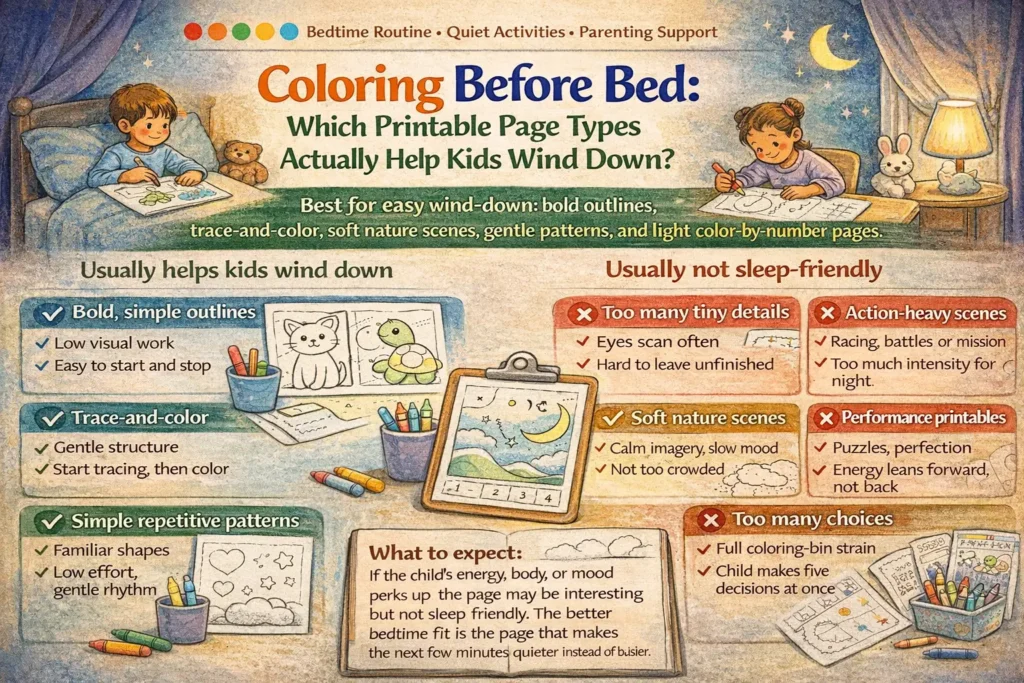
bold outlines, trace-and-color sheets, soft nature scenes, gentle repetitive patterns, and light color-by-number
pages with only a few sections. The pages that more often backfire are tiny-detail pages, competitive tasks,
puzzle-heavy sheets, highly stimulating characters, and “I need to finish this perfectly” printables.
Bedtime is different from after-school time. In the evening, the goal is not challenge, productivity,
or creative ambition. The goal is a softer landing. That changes what “good” looks like. A page can be excellent
in the afternoon and still be a poor fit at 7:45 p.m. if it demands too much visual scanning, too much
decision-making, or too much emotional energy.
A bedtime coloring page is also not magic. It does not replace a stable routine, a calm room, or enough sleep
opportunity. But it can work well as one short quiet step inside a predictable wind-down rhythm. In that role,
the most bedtime-friendly pages usually do three things: they reduce choice, lower arousal, and give the child
one manageable task with a visible stopping point before lights-out.
evening stimulation than for one exact printable category. So the page-type guidance below is best understood as
an applied fit framework: which page shapes are more likely to keep the bedtime window calm rather than busy.
Why page type matters more than many parents expect
Parents often search by topic: dinosaurs, unicorns, school, princesses, trucks, animals. Topic matters,
but before bed, task shape often matters even more. Two pages can feature the same character and create very
different effects. One page may offer four large shapes, a familiar face, and an easy stopping point. Another may
be packed with background clutter, tiny accessories, visual noise, and dozens of places where the child feels they
“should” keep going.
Bedtime-friendly pages usually have a clear beginning, a calm middle, and an easy end. They do not ask for much
planning. They do not create a strong “unfinished mission” feeling. They do not push performance. That is why pages
with moderate or high novelty can underperform at night even if the child loves them during the day.
Ask three quick questions before printing:
Is it simple enough to start easily?
Is it calm enough not to energize the room?
Is it easy enough to stop without frustration?
If the answer is “not really” to any of those, the page is often better for daytime than bedtime.
The printable page types that often help kids wind down
The best bedtime pages are not always the cutest or most impressive. They are the ones that make the next ten
minutes feel quieter instead of busier.
Often the safest bedtime starting point for younger kids and tired kids. Big shapes lower visual load.
Clear boundaries reduce decision fatigue. A child can color one area, then another, without feeling lost
or overwhelmed.
A trace-first structure gives the hands a quiet job before color choices even begin. This can work well for
children who settle through rhythm and repetition, as long as the page stays short and light rather than
school-like.
Moon, stars, clouds, trees, slow animals, a simple garden, light weather imagery. The helpful part is not
“nature” by itself, but softer scene pacing and more open visual space.
Large circles, waves, stripes, stars, hearts, clouds, and repeated shapes can create a more rhythmic,
less effortful experience. Repetition often helps when the scale stays generous; it tends to become activating
when the pattern turns intricate.
This can work for children who calm down through structure, but only if the page remains light:
a small number of sections, clear number zones, and no pressure to complete the whole thing.
If you are unsure, start with bold outlines first. They are often the easiest bedtime format to enter,
the easiest to modify, and the easiest to stop without drama.
What usually backfires before bed
Some pages do not fail because they are bad. They fail because bedtime asks for a different kind of success.
Tiny-detail pages, dense backgrounds, crowded wildlife scenes, or micro-patterns that make the eyes work hard
and tempt the child to keep correcting small areas.
Racing, battles, chasing, loud expressions, “mission” pages, or anything emotionally intense enough to lift
the room’s energy instead of lowering it.
Puzzle-style sheets, performance pages, school-feeling pages, or printables that create a “do it right”
mindset rather than a quiet end-of-day rhythm.
Printing five pages, setting out the full art bin, or offering so many options that bedtime becomes
another decision-making session.
happening. Engagement and calming are not the same thing. If the child becomes more alert, more verbal,
more perfectionistic, or more resistant to stopping, the page may be interesting but not sleep-friendly.
A comparison table parents can actually use
| Page type | Usually works best when | Why it may help at bedtime | Watch-outs |
|---|---|---|---|
| Bold simple outlines | The child is tired, easily frustrated, or resisting the transition | Low visual load, easy entry, easy stopping point | Can feel too young for some older kids if the theme feels childish |
| Trace-and-color | The child settles through hand rhythm and predictable steps | Adds structure without requiring much planning | Avoid correction-heavy, worksheet-like versions |
| Soft nature scenes | The child needs calmer imagery and less emotional charge | Gentler scene pacing, fewer urgent visual elements | Skip highly detailed forests, oceans, or crowded wildlife pages |
| Light color-by-number | The child likes rules and settles when choice is reduced | Clear structure can reduce bedtime indecision | Too many zones or too much perfectionism can wake the brain back up |
Practical takeaway: bedtime success often improves when parents treat page selection as a fit problem,
not a behavior problem.
The 7–10 minute bedtime coloring protocol
A bedtime page tends to work better when the routine around it stays small too. Long evening creative projects
often keep the mind active. A short repeatable pattern is usually a better fit.
- Minute 0–1: Dim the room a little and put out only one page and one simple tool set.
- Minute 1–2: Give a calm invitation: “You can color one part or the whole page. Either is enough.”
- Minute 2–7: Stay near, keep your voice low, and do not turn it into a lesson or long discussion.
- Minute 7–9: Name the close gently: “Let’s choose one last part.”
- Minute 9–10: Put the page in a bedtime folder or tray so the ending feels visible and complete.
The child does not need to decide whether to launch a full project. The activity feels contained from the start,
which lowers the chance that bedtime coloring turns into delay or negotiation.
Children often do better when the task has a clear finish signal. A bedtime folder, clipboard, or “done for today”
tray can reduce the urge to keep going and make stopping feel orderly rather than abrupt.
Age tweaks that keep bedtime coloring useful
Choose large shapes, familiar objects, simple animals, moon-and-stars pages, or easy bedtime-themed scenes.
Keep tool choice narrow: crayons or a few pencils, not the full art basket. At this age, the goal is
co-regulation and predictability more than artistic independence.
Add light structure: trace-and-color, easy number zones, low-detail room or nature scenes, simple paths,
and pages with one main visual focus. This age group often likes “just enough challenge,” but bedtime challenge
still needs to stay gentle.
Older kids may reject obviously little-kid pages, so the trick is not to increase intensity too much while
increasing dignity. Try cleaner pattern pages, calm animal art, soft seasonal themes, or large-section designs
that do not require finishing everything.
Ask: “Do you want an easy page tonight or a page with a little more to do?”
That gives the child some control without opening ten bedtime choices.
How to tell whether a page is helping or quietly hurting bedtime
Do not judge only by whether the child says they like the page. Judge by what happens to the room and the body
over the next ten minutes.
- Voice softens
- Pacing slows
- Body settles
- Less argument about the next bedtime step
- Stopping is easy enough
- More talking and bargaining
- More perfectionism
- Stronger refusal to stop
- More energy after finishing
- Requests for “just one more page” every night
A mixed result is also possible: the child enjoys the page but becomes upset at cleanup or insists on doing
another page immediately. In that case, the activity may not be a bad activity overall; it may simply be a poor
match for the bedtime slot.
When bedtime coloring is probably not the right tool that night
Skip coloring and go simpler if the child is already far past the calm window. A page is usually not the best
choice when the child is melting down, highly dysregulated, sick, overtired to the point of tears, or clearly
using the activity to delay sleep. On those nights, an even lower-demand routine may fit better than any printable.
who gets more awake every minute they stay with the page.
The goal is not to force coloring into the routine. The goal is to protect the wind-down effect. Sometimes the best
bedtime choice is one page. Sometimes it is no page at all.
If bedtime distress keeps repeating, sleep becomes harder for weeks rather than days, or the child’s daytime
functioning is clearly shrinking, the issue may be bigger than a printable fit problem. In that situation,
it is sensible to check in with a pediatrician or qualified child sleep professional.
FAQ
Is coloring before bed actually a good bedtime activity for kids?
It can be, if the page is simple, short, and low-pressure. Bedtime coloring works best as a quiet part of a
predictable routine, not as a big evening project. The wrong page can make a child more alert rather than calmer.
What type of coloring page is best right before sleep?
Bold simple outlines are often the safest first choice. Other good options can include light trace-and-color,
soft nature scenes, low-detail repeating patterns, and easy color-by-number pages with only a few sections.
What coloring pages should parents avoid at bedtime?
Usually avoid pages with tiny details, strong action scenes, puzzle-heavy tasks, too many choices, or anything
that makes the child feel they must keep going to finish it “properly.”
How long should bedtime coloring last?
About 7 to 10 minutes is often enough. The bedtime version should feel short, calm, and easy to end.
Longer sessions are more likely to shift from winding down into one more evening project.
Is color-by-number calming before bed?
Sometimes. It can help children who relax when structure is clear, but only if the page is light and easy.
Dense or perfectionistic color-by-number pages often become too mentally activating for bedtime.
Can bedtime coloring become a delay tactic?
Yes. If the child starts bargaining for extra pages, extra colors, or more finishing time every night,
the activity may be serving delay more than wind-down. Tightening the routine usually helps.
Should parents talk a lot while the child colors before bed?
Usually no. Bedtime coloring tends to work better with calm presence, short prompts, and a quieter room.
Too much discussion can raise energy again even when the page itself is a good fit.