Parents usually do not start by saying, “I’m watching small-muscle development.” They say, “My child grips the crayon so tightly,” “She gets tired fast,” “He colors everywhere except the page,” or “Tracing looks easier than coloring.” Those everyday observations are useful. Coloring is not a diagnosis, but it is a visible window into grip, pressure, control, and endurance. The goal is not perfect pages. The goal is to notice whether the hand is becoming more stable, more efficient, and less effortful over time.
Best for: parents, preschool, early years
Includes: checklist, tracker, FAQ
Keywords: pencil grip development, tracing vs coloring
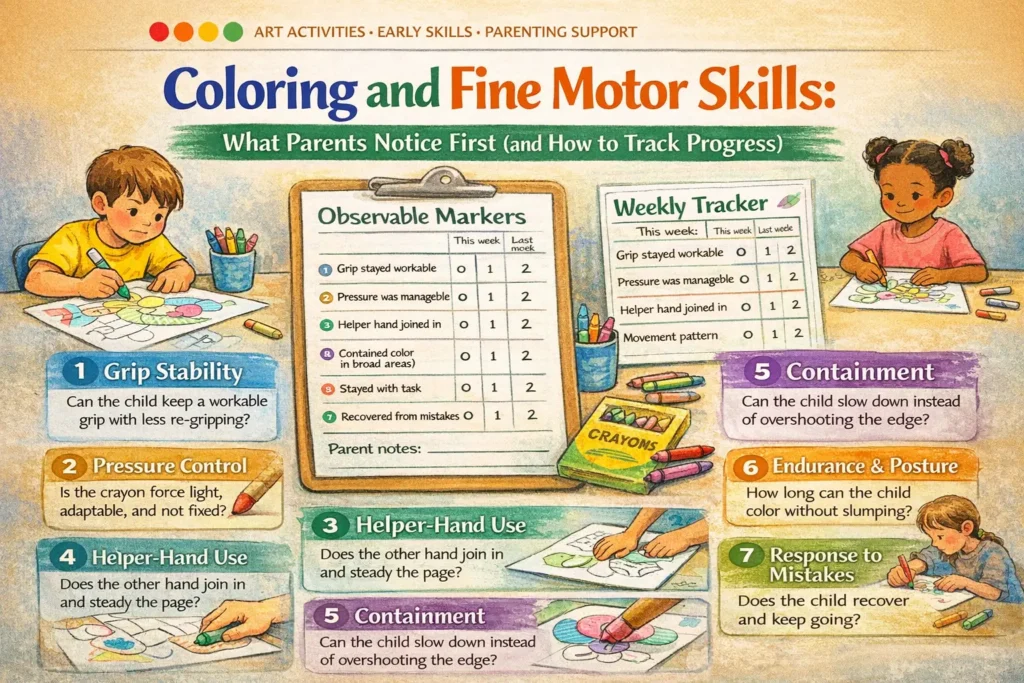
What fine motor skills are, in plain language
Fine motor skills are the small, controlled movements of the hands and fingers that help a child manage tools and everyday tasks. In daily life, that includes holding a crayon, turning a page, picking up a bead, fastening clothing, using utensils, rotating puzzle pieces, and making a line go where the child wants it to go. Coloring may look simple, but it asks the body to combine several systems at once: hand strength, finger isolation, wrist stability, body posture, visual attention, and the ability to guide movement with the eyes.
That is why two children can sit with the same coloring page and have very different experiences. One colors for ten minutes without thinking much about the hand. Another uses the whole arm, switches hands, presses hard enough to dent the page, or quits after two minutes because the task feels like work. The difference is not always motivation. Often, it is that the hand is still learning how to do the job more efficiently.
Coloring also overlaps with other early school-readiness tasks. A child who is working on pencil grip development is often also working on scissors, feeding tools, buttons, zippers, puzzles, stacking toys, and simple pre-writing lines. That does not mean coloring and handwriting are the same thing. It means they share several foundations: shoulder support, wrist position, finger control, bilateral coordination, and visual-motor timing.
Instead of asking, “Does this picture look good?” ask, “How did the hand manage the job?” That question gives better information than judging neatness alone.
Observable markers parents can actually track
If you want a data-friendly view, track what is visible and repeatable. These markers are more useful than vague impressions like “good coloring” or “bad grip.”
Watch whether the child can keep a workable grasp or keeps re-gripping every few seconds. A stable grip does not have to look identical to another child’s grip. The more useful question is whether it is functional: can the child move the tool with some control, keep going, and finish without obvious strain?
Some children barely leave a mark. Others press so hard that the paper dents or the crayon snaps. Pressure tells you how well the hand is grading force. What matters is not “light” versus “dark,” but whether force is adaptable instead of fixed.
The other hand should gradually begin helping by steadying the paper, turning it, or repositioning it. When the helper hand is absent, the page slides around and the task becomes harder than it needs to be.
Early coloring often comes from the shoulder and elbow. Over time, parents usually see more controlled wrist and finger movement, especially on smaller shapes. If the child still relies almost entirely on whole-arm motion for simple pages, smaller targets may feel much harder than expected.
“Staying in the lines” is not the best early goal, but containment still matters. A better question is whether the child can keep color mostly inside a broad area and slow down near an edge instead of overshooting it.
Notice how long the child can color before slumping, switching hands, shaking the hand out, or asking to stop. Endurance is one of the easiest markers to compare over time because it tends to show progress before neatness does.
Some children stop the moment they slip outside the area. Others press harder, scribble over the error, or abandon the page. A growing skill set often shows up as better recovery: the child keeps going, adjusts, and tolerates “good enough.”
Another useful marker is how much adult help the child needs. Is the adult constantly repositioning the paper, correcting the grasp, and restarting the task? Or can the child begin, continue, and finish with only light prompting?
Age guide: what may be typical, and what deserves a closer look
Age patterns help, but they should be used as guides, not pass-fail rules. Children develop unevenly. The more useful question is whether the child is becoming more functional for age, not whether every page looks advanced.
It is common to see large-arm movement, broad scribble-coloring, inconsistent pressure, and short sessions. Many children at this stage still need big shapes and quick success. Concern rises more when the child avoids hand tasks across settings or cannot manage even a brief supported attempt without distress.
Parents often begin seeing more controlled grasp patterns, better use of the helper hand, and broader containment. Pages do not need to look neat, but the hand should gradually look less effortful and more organized.
By this stage, many children show better pacing, more controlled directional changes, and more tolerance for tracing or smaller targets. A closer look may be useful if the child cannot comfortably access early classroom pencil tasks or avoids tabletop work consistently.
An awkward-looking grip is not automatically a problem if it is functional. A more meaningful concern is a grip or movement pattern that causes pain, breakdown, very fast fatigue, or difficulty across multiple daily tasks.
One uneven week does not define a child’s fine motor profile. Look for patterns that repeat across time, tasks, and settings.
Page types that train different subskills
Not all coloring pages ask the same thing from the hand. If a child struggles, the problem may be the match between the page and the current skill level. Broad shapes, repeated patterns, tracing paths, and detailed scenes place different demands on the hand.
| Page type | Best for | What parents may notice | Good prompt |
|---|---|---|---|
| Big open shapes | Pressure control, early grip, first endurance | Less frustration, easier success, fewer tears in the paper | “Fill this big space any way you want.” |
| Repeated patterns | Rhythm, pacing, staying with the task | More consistency from shape to shape | “Let’s do three, then pause.” |
| Mazes and paths | Direction changes, stopping, visual tracking | Better slowing down near corners and turns | “Slow hand, tiny turns.” |
| Tracing lines | Route following, start-stop control, pre-writing patterns | Whether the hand can follow a target instead of only filling space | “Let the crayon ride on the road.” |
| Dot-to-dot or guided shapes | Planning, sequence, connecting points | Less impulsive movement, more visual checking | “Find the next stop before you move.” |
| Detailed scenes | Precision, mature control, longer endurance | Grip breakdown or fatigue appears faster | “Pick only two small parts today.” |
Usually stronger for route-following, directional control, stopping, and pre-writing strokes. It shows how well the hand can follow a target instead of filling a space freely.
Usually stronger for pressure, fill control, pacing, endurance, and containment. It often reveals more about effort level and tolerance for staying with the task.
Weekly tracking sheet and realistic expectations
Parents get the clearest picture when they track the same child on a similar task across several weeks. Use similar page difficulty, similar tools, and a similar time of day. That reduces noise. Tracking once or twice a week is usually enough. Daily tracking often captures mood, sleep, hunger, novelty, and cooperation more than true skill change.
| Marker | This week | Last week | Parent notes |
|---|---|---|---|
| Grip stayed workable | 0 / 1 / 2 | 0 / 1 / 2 | Did the child keep re-gripping or settle into one hold? |
| Pressure was manageable | 0 / 1 / 2 | 0 / 1 / 2 | Too light, too hard, or flexible on purpose? |
| Helper hand joined in | 0 / 1 / 2 | 0 / 1 / 2 | Did the other hand hold or turn the page? |
| Contained color in broad areas | 0 / 1 / 2 | 0 / 1 / 2 | Mostly inside large shapes, even if not neat? |
| Stayed with task | 0 / 1 / 2 | 0 / 1 / 2 | How long before fatigue, refusal, or posture breakdown? |
| Recovered from mistakes | 0 / 1 / 2 | 0 / 1 / 2 | Did the child continue after slipping outside the area? |
| Needed less adult support | 0 / 1 / 2 | 0 / 1 / 2 | Less prompting, resetting, or hand-over-hand help? |
A child may improve grip but still press too hard. Another may last longer but still struggle with smaller areas. Improvement in one marker counts because fine motor development is usually uneven, not all-at-once.
Instead of asking, “Why isn’t everything fixed?” ask, “Which part of the job is easier than it was three weeks ago?” That question tracks growth more honestly.
What can distort the picture before you assume there is a problem
Fine motor observation is not only about watching the child. It is also about watching the setup. Coloring can look worse when the tool is too thin, the page is too detailed, the table height is awkward, or the child is tired and already running low on attention.
Chunky crayons, shorter tools, and broader strokes are often easier for early hands than long thin pencils.
A crowded scene can create more frustration than a broad simple page, even when the child’s current skill level is otherwise adequate.
If feet are dangling or the table is too high, the hand usually has to work harder and fatigue appears faster.
Fatigue, hunger, stress, or sensory overload can temporarily reduce fine motor efficiency even when the underlying skill is present.
When to ask an OT or pediatrician about it
This article is educational and observation-based. It does not diagnose a delay, disorder, or medical condition. If concerns are persistent, affect daily function, or show up across settings, discuss them with your child’s pediatrician or an occupational therapist.
Ask sooner if the same difficulty appears not only in coloring, but also with feeding tools, buttons, scissors, puzzles, dressing, blocks, and early classroom pencil tasks.
Frequent pain, strong avoidance, or very fast fatigue deserves a closer look, especially if the child regularly refuses hand tasks.
Ask if there is little or no movement across several weeks, even when the task has been simplified and the setup is reasonable.
Regression matters more than one messy page. If a child loses a skill that was previously manageable, it is worth discussing.
If teachers, caregivers, and parents are all noticing similar patterns, that usually deserves more attention than a home-only issue.
Ask if the child cannot comfortably access early classroom tasks that involve tracing, cutting, pencil use, or tabletop participation.
A useful rule is this: coloring should be one clue, not the whole case. If the child struggles only in coloring but manages other hand tasks well, the issue may be page match, setup, interest, or frustration tolerance. If similar concerns appear across daily hand use, professional input becomes more reasonable.
FAQ
Does good coloring mean a child is ready for handwriting?
Not by itself. Coloring supports several foundations for writing, but handwriting also requires letter learning, directionality, spacing, and classroom-task stamina. A child may color comfortably and still need help with writing-specific skills.
Is tracing better than coloring for fine motor development?
They build different parts of the job. Tracing is often better for route-following and pre-writing control. Coloring is often better for pressure, area coverage, pacing, and endurance. Many children benefit from both when the level matches their current skill.
Should I correct pencil grip every time I see an awkward hold?
Not every time. Constant correction can increase tension and reduce willingness to practice. Focus first on function: can the child control the tool, continue without major fatigue, and complete a manageable task? If grip clearly blocks performance, use gentle cues or a better-sized tool rather than turning the session into constant correction.
How long should a preschool coloring session be?
Often 5 to 10 minutes is enough for useful practice. End before the hand fully falls apart. Very long sessions can blur the picture because you start measuring fatigue more than control.
What if my child presses extremely hard?
Track it first instead of trying to fix everything at once. Very hard pressure may reflect force-grading difficulty, excitement, speed, or a search for stability. Try broader pages, shorter tools, and a calmer pace. If hard pressure shows up across writing and other tasks and causes frequent fatigue or pain, raise it with an OT or pediatrician.
Do left-handed children need different expectations?
The core expectations are the same: functional grip, workable control, and reasonable endurance. The hand position may look different, and paper angle often matters more. Focus on comfort and function, not on forcing the page to match a right-handed model.
What is the best sign that progress is really happening?
The clearest signs are usually practical ones: the child lasts longer, re-grips less, uses less force, tolerates mistakes better, and needs less adult help. Those changes often appear before noticeably neater pages.