Parents and teachers often begin with the wrong question. They ask which format is best. The more useful question is which format keeps a child engaged
for the goal of that session. Color-by-number, free coloring, and drawing do not ask the brain to do the same job. One gives more structure,
one gives more choice inside boundaries, and one asks the child to generate the whole plan. That is why the answer changes with age, stress level, confidence, interest, and setting.
Best for: parents, teachers, media
Includes: 3-session comparison protocol
Bonus: mini scoring rubric
If a child resists being told exactly what to do, free coloring often lasts longer because it keeps ownership.
If a child already has a strong idea and wants to invent, drawing can hold deep attention—but only when blank-page demands do not overload working memory, confidence, or patience.
In other words, attention is not only about interest. It is also about task load. A child may love drawing and still leave it quickly if idea generation, planning, composition,
correction, and self-evaluation all happen at once. Another child may call color-by-number “too rule-based” and still stay with it longer because the next step is always visible.
For adults looking at attention span activities, kids focus activities, or a classroom comparison, that difference matters more than broad claims about which activity is “more creative.”
Attention often lasts longer when the child can spend energy on doing the task, not first on figuring out what the task is.
This article takes a practical and evidence-aware approach. It does not try to crown one format as universally superior. Instead, it compares what each format demands,
shows who often benefits from more structure, gives a simple comparison protocol for home or school, and explains how to report the result responsibly without turning one short session
into a fixed judgment about a child’s ability or personality.
Three formats, three different kinds of attention
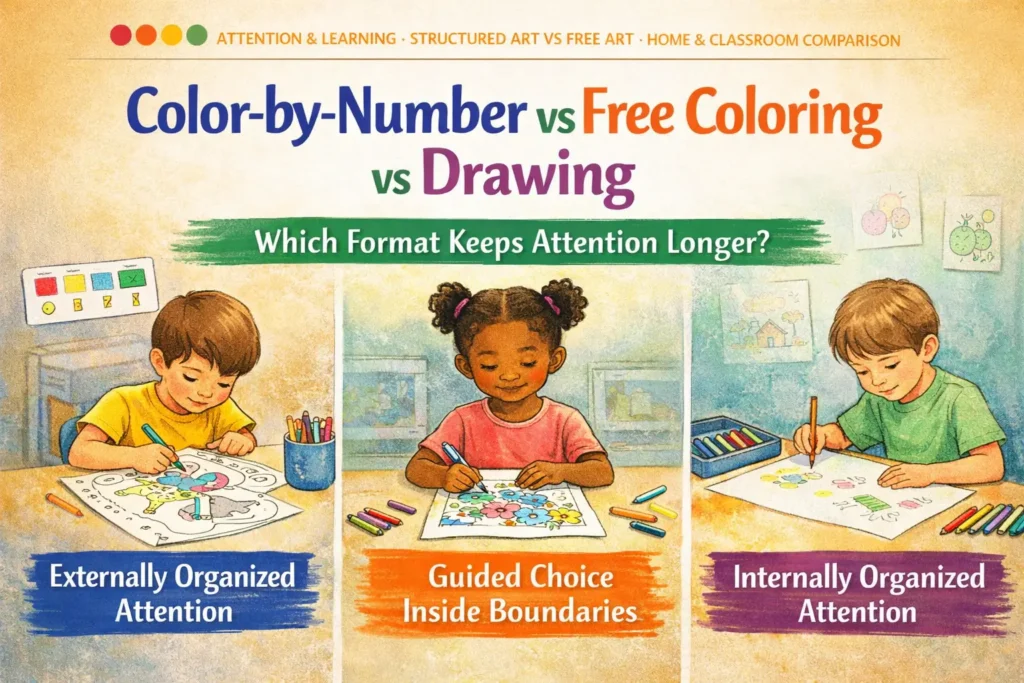
Color-by-number is the most externally organized of the three formats. The page already carries much of the plan. The child’s job is to match, scan, switch tools,
and complete a visible sequence. That can lower working-memory demand because the child does not have to invent the next step from scratch. For many children,
this creates a steady rhythm: find, match, color, continue.
Free coloring usually sits in the middle. It gives more ownership than color-by-number, but the outlines still provide containment. The child has to choose colors,
decide where to begin, and manage a page with fewer rules, but the page is not completely open. For many children, this becomes the most balanced format:
enough freedom to feel personal, enough structure to keep the task from dissolving.
Drawing is the most open-ended option. The child must generate the idea, plan space, form shapes, revise, and remember the goal. That does not make drawing “better.”
It makes it more self-directed. For some children, this is exactly why attention deepens. For others, it creates the fastest drop-off because the blank page requires
too many decisions before momentum begins.
The question is not whether structured art beats free art or whether free art is automatically more meaningful. The real comparison is where the effort sits.
In one format, the page carries more of the plan. In another, the child carries more of the plan. Attention changes accordingly.
What each format demands (working memory, planning, creativity)
Developmental research on executive function, task structure, and drawing suggests that open-ended activities often place heavier demands on working memory, inhibition,
flexibility, and self-directed planning. That does not mean open-ended tasks are a problem. It means they are asking for more internal organization. Structured tasks,
meanwhile, can reduce initiation barriers and help some children maintain selective attention because the next step is visually obvious. The practical conclusion is not
“structure is better” or “freedom is better.” It is that different formats support different kinds of attention.
| Format | What attention goes to | What usually helps | Common friction point |
|---|---|---|---|
| Color-by-number | Matching a code, finding small areas, switching tools, completing a sequence | Predictability, visible progress, lower idea-generation load | Tiny spaces, too many number shifts, perfectionism about “doing it right” |
| Free coloring | Choosing colors, deciding order, managing freedom inside outlines | Moderate structure, familiar themes, ownership without a blank page | Choice overload, drift, weak sense of completion |
| Drawing | Generating an idea, planning space, forming shapes, revising, remembering the goal | Strong intrinsic interest, confidence, time, tolerance for trial and error | Blank-page hesitation, self-criticism, high working-memory demand |
Seen this way, color-by-number is not “less creative” in any simplistic sense. It is more externally organized. Free coloring sits between structure and freedom.
Drawing is the most open-ended and can produce the deepest engagement when the child already arrives with an idea or a story. But it can also produce the quickest drop-off
when the child must build the whole task internally before the page even starts to feel rewarding.
Who benefits from structure—and when age changes the answer
Structure usually helps when attention is fragile, not when a child lacks ability. That distinction matters. A structured page can support children who are still building stamina,
children who hesitate when choices are too broad, and children whose ideas are stronger than their current ability to organize those ideas on paper. In noisy or busy environments,
structure can also help because it provides a visible next step when the room itself is distracting.
Children who get stuck on blank pages, ask “What do I do now?” repeatedly, or leave tasks soon after the first difficult decision often stay with color-by-number longer.
The format lowers initiation barriers and makes progress easy to see. It can also suit children who enjoy matching, order, and finishing one small zone at a time.
Free coloring often fits children who need some structure but dislike rigid direction. These children may enjoy choosing colors, personalizing a familiar page, and working at a calmer pace.
For many children, this becomes the best middle ground between structured art vs free art: enough guidance to reduce drift, enough freedom to preserve ownership.
Drawing may keep attention longest when the child already has an idea, a character, a story, or a strong visual interest. It often suits children who narrate, role-play,
invent scenes, or want to explain something in pictures. But when drawing holds attention, it is often because topic interest is carrying a large part of the cognitive load.
What you are seeing is a match between task design and current regulation, not a fixed label.
Age lens
Age matters because self-direction changes over time. Preschoolers are often still building initiation, persistence, and tolerance for ambiguity. Many benefit from bold structure,
fewer choices, and shorter completion loops. Early elementary children often do well with mixed formats, especially when the theme is familiar. Older children may care less about the format itself
and more about topic ownership, perceived competence, and whether the task feels meaningful.
- Ages 3–5: more likely to benefit from visible structure, clear stopping points, and shorter paths to “I did it.”
- Ages 6–8: often ready for mixed formats; free coloring may become the most stable middle option.
- Ages 9+: topic ownership and confidence can outweigh format structure; drawing may hold deep attention when the subject matters.
Simple comparison protocol (3 sessions, same time)
If you want a useful answer at home or in class, compare the three formats fairly. Do not test one on a calm weekend morning, one after a long school day,
and one in a noisy room, then treat the result as objective. Keep the conditions as equal as possible so you are comparing the formats, not the circumstances.
A 12–15 minute window is a practical comparison length for most home and classroom trials.
| Session | Format | Keep constant | Watch for |
|---|---|---|---|
| 1 | Color-by-number | 12–15 min, same tools, same adult role | Steady pace, repeated checking, detail frustration, completion drive |
| 2 | Free coloring | Same length, same seat, similar theme complexity | Ease of starting, drift, color-choice load, calmer pace |
| 3 | Drawing | Same time block, same prompts, same expectation level | Idea flow, planning pauses, self-correction, blank-page hesitation |
During the session, avoid turning yourself into a coach. The goal is not to help the child perform equally well in all three formats. The goal is to observe where attention holds more naturally.
Neutral prompts work best: “You can start anywhere,” “You still have time,” or “Tell me when you feel done.” Avoid rescuing one format more than another.
Mini scoring rubric: focus, frustration, enjoyment
Use a simple 1–5 rubric immediately after each session. Keep it quick. If you over-measure, the activity starts to feel like a test and the result becomes less natural.
| Score | Focus | Frustration | Enjoyment |
|---|---|---|---|
| 1 | Hard to start or left quickly; frequent disengagement | Frequent complaints, visible tension, repeated stopping | Mostly avoidance, little visible pleasure |
| 3 | Stayed with it in parts, but needed pauses or redirection | Some hard moments, but still manageable | Mixed response; some interest, some fatigue |
| 5 | Steady engagement; easy return after small pauses | Low visible strain; challenges did not derail the task | Clear pride, interest, or willingness to continue |
Use a short factual note such as “Started fast, stayed steady, annoyed by tiny spaces,” “Loved choosing colors, slowed after 9 minutes,” or
“Had a strong drawing idea, but paused often to fix mistakes.” Short observations are usually more useful than big interpretations.
What adults often misread
A child can be silent and still mentally checked out. Real engagement usually shows in returning to the task, persisting after small obstacles,
and staying connected to the goal without constant prompting.
A child may stay longer because they are absorbed, but they may also stay longer because they are perfectionistic, hesitant to stop, or waiting for adult approval.
Duration is useful data, but it is not the only data.
Some frustration is part of meaningful engagement. The practical question is whether frustration remains manageable or pushes the child completely out of the task.
A child who finishes rapidly may be focused, but they may also be rushing to escape the task. Looking only at speed can hide whether the child was genuinely engaged or simply eager to be done.
Reporting results responsibly
Once you compare the sessions, report what you saw with caution. One of the biggest mistakes in home observation and classroom comparison is turning a small pattern into a large conclusion.
A child may focus longer in color-by-number on a tired day and longer in drawing next week when the topic is dinosaurs, racing cars, or space. That does not make the first result false.
It means attention is situational and shaped by both the task and the context.
One session shows a moment. A useful pattern appears only when the same trend returns under similar conditions.
- Compare the child to themselves, not to peers. Another student’s calm drawing stamina tells you nothing about this child’s best-fit format.
- Separate compliance from engagement. A child can look “good” while investing very little mentally in the task.
- Report context. Time of day, noise level, adult support, and topic interest all influence the result.
- Note novelty. Sometimes the apparent winner is simply the newest format.
- Use functional language. Say “held attention longer under these conditions,” not “this child can’t handle drawing.”
Less responsible wording: “Free coloring is their level,” or “Drawing is too hard for them.”
For parent communication, teacher notes, or quote-friendly media use, the most defensible conclusion is usually this:
structure can support attention without replacing creativity, and freedom can support ownership without always supporting persistence.
The best format is not the one that looks most impressive from across the room. It is the one that keeps the child engaged, regulated, and willing to return tomorrow.
FAQ
Is color-by-number always better for attention?
No. It often helps when a child needs more visible structure, but some children lose interest because the format feels too controlled, too detailed, or less personal.
Better attention depends on fit, not hierarchy.
Does free coloring build creativity better than color-by-number?
Free coloring usually gives more room for choice, but that does not automatically make it better. A child may express more when the task feels manageable.
Structure can support creative confidence rather than block it.
Is drawing too hard for short attention spans?
Not always. Drawing can hold very deep attention when the child has a strong idea and enough confidence. It becomes harder when blank-page planning overloads the child
before the drawing really begins.
How long should the comparison sessions be?
A 12–15 minute session is a useful starting point for most children. It is long enough to show whether attention settles, but short enough to reduce fatigue as the main variable.
Should adults help during the test?
Adults should stay calm, available, and warm, but prompts should remain neutral and similar across all three sessions. Too much help in one format makes the comparison unreliable.
Can teachers use this as a classroom comparison?
Yes, if the goal is observation rather than labeling. Keep time, seating, tools, and adult support as similar as possible, and describe the outcome as a classroom pattern
under those conditions, not as a permanent trait of the child.
What counts as “better attention”?
Better attention usually means easier starting, steadier persistence, lower frustration, and willingness to continue or return. Quiet behavior alone is not enough evidence.