Calm corner ideas have moved well beyond counseling offices. Parents build them beside bookshelves, teachers create them inside busy classrooms,
and school teams use them as one small part of a wider regulation plan. The strongest versions are not decorative “Pinterest corners” and not mini
time-out zones. They are predictable recovery spaces where a child can downshift without shame. Coloring fits especially
well because it is low-demand, familiar, quiet, and repeatable. A page gives the hands and eyes one manageable job when the rest of the moment feels too big.
Also covers: calm down corner printables
Includes: rules poster text + materials checklist
Best for: parents, teachers, school admins
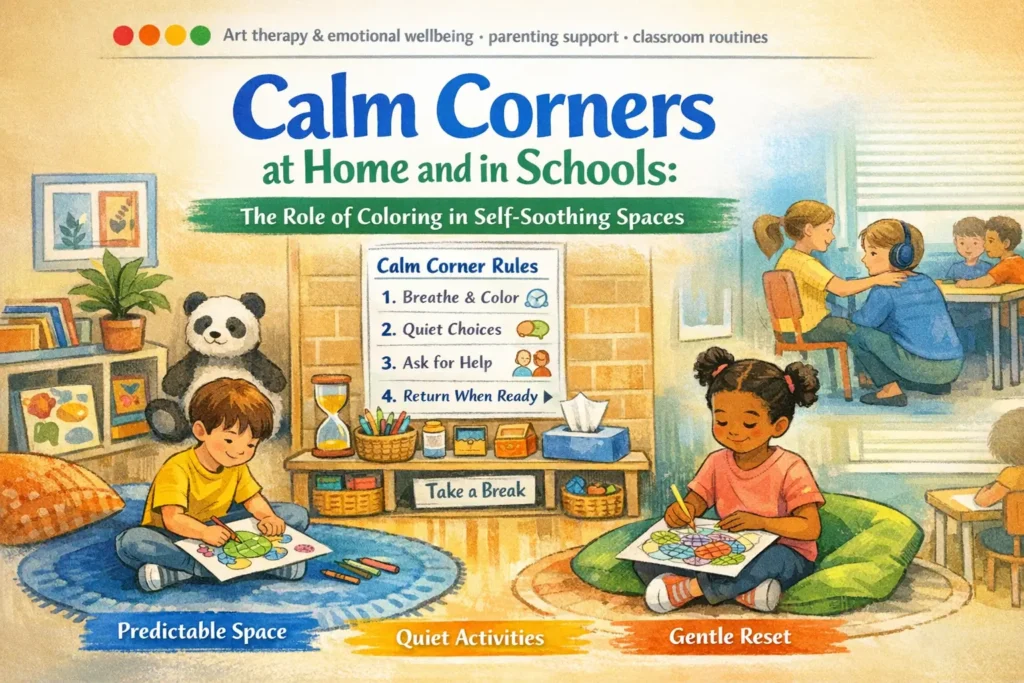
Teach the space before a hard moment, keep visits short, and treat it as a reset tool—not a consequence. The adult’s calm tone matters as much as the materials.
What a calm corner is—and what it is not
A calm corner is a small, pre-taught space designed to help a child reduce stress, regain control, and return to daily life with less friction.
At home, it may sit in the living room, a bedroom corner, or a hallway niche. In school, it may be part of the classroom calm space, a library nook,
or a student-support room. The key feature is not the furniture. It is the message behind it: “You are not in trouble. You are allowed to regulate.”
That distinction matters. A regulation corner is not punishment. It is not exile, public humiliation, or a place where adults send children only after conflict.
When a child experiences the space as “the spot I go when I am bad,” the entire system weakens. The best calm corners are introduced during neutral moments,
practiced before they are needed, and linked to everyday skills such as pausing, choosing, breathing, coloring, and returning.
It also helps to be precise about the goal. For many children, especially preschoolers and younger elementary students, a calm corner does not begin with
fully independent self-soothing. It begins with co-regulation: an adult helps lower the temperature through tone, presence, predictability,
and simple choices. Over time, repeated calm experiences in that space can support more independent self-regulation. In other words, the corner is not a magic
place where the child suddenly “does it alone.” It is a structured environment where adult support and child practice meet.
- You are safe. Big feelings are manageable here.
- You are not being sent away. You are being supported.
- You have one job. Breathe, color, squeeze, sit, or reset.
- You can come back. The goal is rejoining, not disappearing.
A strong setup is usually simple. The child should not have to decode ten instructions, perform emotional insight on command, or choose from twenty tools.
The space works because it reduces demand: fewer decisions, less noise, one calm activity at a time, simple language, and a visible beginning-middle-end.
In real life, that can regulate more effectively than a long emotional conversation delivered too early.
Why coloring fits so well in self-soothing spaces
Among self soothing tools for kids, coloring works especially well because it asks very little at the exact moment when a child has less capacity.
It does not require advanced language. It does not demand eye contact. It does not force a child to explain feelings before the body is ready.
A coloring page gives structure without pressure: pick a page, pick a color, fill one area, continue or stop. That sequence is small enough to feel possible.
Coloring also helps because it is predictable. The paper stays still. The outlines do not argue back. The task is quiet and concrete.
For many children, especially in overstimulating moments, that predictability lowers arousal faster than open-ended problem-solving.
A printable page can act like a soft track for attention: the eyes follow shape, the hand repeats motion, and the nervous system gets a break from social complexity.
Another strength is that coloring scales easily. A preschooler can scribble inside one large circle. A first or second grader can use feelings pages,
weather pages, or school-themed printables. Older children often do better with patterns, mandalas, room designs, lettering, or low-pressure sketch pages
that do not feel babyish. That makes calm down corner printables one of the easiest tools to adapt across ages without turning the area into a toy bin.
| Feature | Why it helps | Home use | School use |
|---|---|---|---|
| Low demand | No long explanation is needed to begin. | Useful after transitions, sibling conflict, bedtime friction. | Useful after recess, noise, peer stress, or redirection. |
| Predictable | The task has a clear shape and steady pace. | Helps slow down fast evenings. | Supports a quicker return to instruction. |
| Quiet | Reduces verbal load and social pressure. | Works even when the adult is nearby but not overtalking. | Fits a classroom calm space without disrupting others. |
| Visible completion | Finishing one section creates a sense of progress. | Good for children who need closure after a hard moment. | Makes transitions back to work more concrete. |
It works best when the adult first lowers the pressure and then offers the page.
This is also why coloring is often better than forcing conversation too early. A dysregulated child may not yet be able to describe the problem,
choose a coping strategy, or tolerate correction. Coloring lets the body settle first. After that, words usually come more easily—if they are still needed.
Setup list: materials, rules, timing
The most effective calm corner ideas are visually clear and materially restrained. Children regulate better when the space looks usable, not crowded.
A corner with too many sensory items, too many choices, or too much novelty can become another source of activation. Think
small basket, clear rules, predictable steps, not “store display.”
- Core items: small basket, clipboard or lap board, 6–10 coloring pages, crayons or colored pencils, timer, tissues, and a simple feelings card.
- Helpful printables: calm down corner printables, breathing cards, choice cards, “first regulate, then return” visual steps, and low-detail coloring sheets.
- Optional supports: squeeze ball, soft stuffed animal, weighted lap pad if already familiar, noise-reducing headphones, or a small sand timer.
- For classrooms: duplicate sets, wipeable tools, a return-to-work card, and a quiet location visible to staff.
- Avoid: loud fidgets, reward charts, glitter, piles of toys, competitive games, or anything that turns the corner into entertainment instead of regulation.
- Place it near adult support, not in isolation.
- Keep it out of the main traffic path.
- Teach it when the child is calm. Do not introduce it for the first time during a meltdown.
- Default visit length: about 5–12 minutes for most children.
- Use one activity at a time. Coloring plus three other tools usually becomes clutter.
- Plan the exit. The space should end with a simple return cue, not endless lingering.
| Age / profile | Best coloring fit | Adult role | Avoid |
|---|---|---|---|
| Ages 3–5 | Large shapes, familiar objects, 1–2 page choices, thick crayons. | Stay close, use very short phrases, co-regulate first. | Open-ended questioning, too many tools, long stays. |
| Ages 6–8 | Feelings pages, classroom scenes, simple patterns, visual routines. | Offer two choices, prompt briefly, support re-entry. | Turning the corner into extra work or behavior lecture. |
| Ages 9+ | Pattern pages, lettering, low-pressure sketching, more private designs. | Respect autonomy, avoid babyish framing, keep language neutral. | Juvenile printables, public attention, forced sharing. |
| Sensory-sensitive / neurodivergent children | Known paper texture, familiar tools, lower visual clutter, predictable page types. | Check sensory load first: noise, light, seating, transitions. | Assuming coloring alone will work if the environment is still overwhelming. |
1. This space is for calming, not punishment.
2. One calm activity at a time.
3. Quiet voices, safe hands, gentle bodies.
4. Choose a page, a tool, and a place to start.
5. If your body still feels too big, ask for help.
6. When you are steadier, return to home or class.
7. We use this space with respect—for ourselves and for others.
In practice, “less but better” is usually the winning rule. One sturdy calm corner with reliable materials beats a beautiful one that adults forget to reset.
School administrators should also pay attention to staff consistency. If one teacher treats the regulation corner as support and another uses it as discipline,
children stop trusting the space.
Scripts for introducing the space to kids
The way adults introduce a regulation corner often determines whether it feels safe or punitive. The first explanation should be calm, short, and concrete.
Avoid therapy-heavy language, lectures, or emotional interrogation. A child does not need a speech. A child needs a usable frame.
“This is our calm corner. It is not where you go because you are bad. It is where you go when your body needs help getting smaller again.
You can color, breathe, sit with your stuffed animal, or ask me to stay near you.”
“This classroom calm space is for resetting, not for getting in trouble. If your body feels fast, noisy, tight, or overwhelmed,
you may use one quiet tool here and return when you are ready to learn.”
“I’m going to help you get smaller first. Let’s go to the calm corner. You do not have to talk yet. Pick one page and one color.”
“You do not have to like this space. It is just a short reset zone. You can choose a page, sit quietly, or use one tool until your body is more workable.”
Avoid lines like “Go calm down right now,” “You can come out when you behave,” or “Tell me exactly why you did this.”
Those phrases increase pressure. Regulation usually improves when adults lower words, lower speed, and lower demand.
For younger children, practice matters as much as explanation. Rehearse the routine during neutral moments: walk to the corner, choose a printable,
color one shape, put it back, and leave. That rehearsal turns the space into a known path instead of an emergency-only zone.
Measuring success: fewer escalations, quicker recovery
A calm corner should not be judged by whether the child looks perfectly peaceful inside it. The better question is whether the space helps the child recover
more efficiently over time. Strong results usually look practical rather than dramatic: fewer explosive moments, earlier self-use, less adult talking needed,
and a smoother return to normal routines.
| Indicator | What to track | Healthy change | Red flag |
|---|---|---|---|
| Escalations | How often the child moves from upset to explosive. | Hard moments happen less often or peak less intensely. | Corner use becomes another battleground. |
| Recovery time | Minutes needed to rejoin home or class. | Return happens faster and with less prompting. | The child stays stuck there longer and longer. |
| Independence | Whether the child starts asking for the space before breaking down. | More early self-initiation. | The child only goes when forced. |
| Return to function | Can the child go back to play, work, or routine? | Return is steadier and less fragile. | The corner becomes escape from all demands. |
- The child experiences the space as shame or exclusion.
- The corner is used only after punishment language.
- Peers treat it like a spectacle or a joke.
- There are too many materials and the child gets more activated.
- No adult follows through on the return routine.
- The child starts using the corner mainly to avoid every demand rather than to recover and rejoin.
That last point matters. A regulation corner should reduce overload, not quietly become a permanent escape hatch. If a child repeatedly uses it to avoid
normal expectations, the answer is not to remove the space entirely. The answer is to refine the routine: shorten visits, clarify the exit step,
reduce adult commentary, and check whether the child needs more support outside the corner as well.
For school admins, success measurement should stay realistic. Track patterns across weeks, not one day. For parents, a simple notebook is enough:
date, trigger, tool used, time to recover, and whether the child returned more smoothly. If the space regularly reduces friction, it is doing its job.
FAQ
At what age can a child use a calm corner?
Even preschoolers can use one if the setup is simple. Younger children need fewer choices, larger-print coloring pages, and more adult co-regulation. Older children and tweens usually do better when the space feels respectful and not babyish.
Should a calm corner ever be used as punishment?
No. The moment it becomes a consequence space, trust drops. A regulation corner works best when it is framed as support, taught ahead of time, and paired with a clear return routine.
Why use coloring instead of just talking things through?
Because many children cannot process a long conversation while dysregulated. Coloring lowers verbal demand and gives the body something concrete to do first. Talking usually works better after the child is steadier.
How long should a calm-corner visit last?
For many children, 5–12 minutes is enough. The goal is not to disappear into the corner but to recover enough to return. If the child needs much longer every time, the setup or the wider support plan may need revision.
What are the best calm down corner printables?
The best printables are low-demand and visually clear: simple coloring pages, feelings faces, breathing prompts, “choose one tool” cards, and short visual step charts. Avoid worksheets that feel like extra schoolwork during distress.
Can a classroom calm space work for the whole class?
Yes, if expectations are taught clearly and the space is supervised consistently. Children should know what it is for, how many tools can be used at once, and how to transition back to learning without drama.
What if a child refuses to use the calm corner?
Do not force it as a power struggle. Re-teach it during a calm moment, simplify the setup, reduce language, and check whether the child experiences the area as shame, too public, too babyish, or too demanding.