Time-to-Calm: A Simple “Before/After” Mood Check Experiment With Coloring
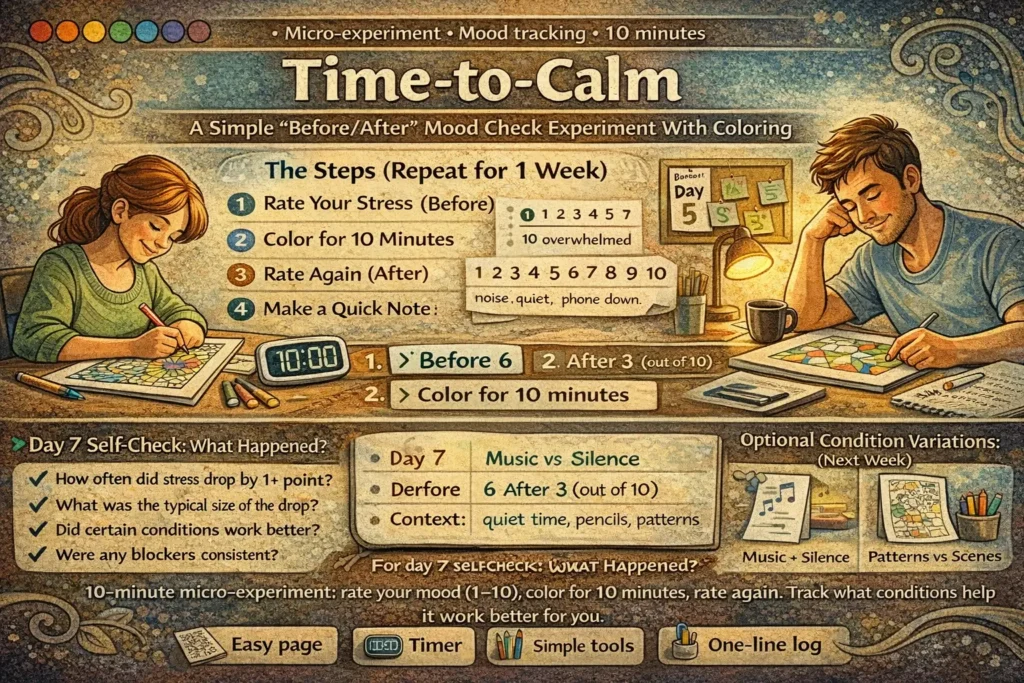
This guide gives you a replicable, non-clinical coloring stress relief experiment: rate your stress (1–10), color for 10 minutes, rate again, and repeat for one week. The goal is simple and practical—find out whether coloring acts as a quick relaxation test for you, and which conditions make it work best (quiet vs. noise, music vs. silence, patterns vs. scenes).
What you’re measuring (and what you’re not)
You’re measuring a small, repeatable shift: how your stress level changes before vs. after a short coloring session. You’re not trying to prove a universal effect, and you’re not trying to “win” a calming score. The point of mood tracking is to see what happens in your real context—sleep, noise, deadlines, family life, and all.
A 1–10 rating is intentionally low-tech. In research and practice, simple subjective ratings are used because they’re fast and can be repeated consistently. The tradeoff is that they’re influenced by expectations and context. That’s not a flaw—it’s part of what you’re testing. If coloring helps mainly when you’re in a quiet corner, that’s a useful finding. If it helps more with simple patterns than detailed scenes, that’s also useful. Either way, you end up with a clearer, more realistic mindful coloring routine.
A 1–2 point drop that happens repeatedly across the week is often more useful than one dramatic “perfect” day.
“Only works when I’m not multitasking” or “works better with patterns” is actionable and improves how you use the habit.
That coloring “always” works, or that it “should” work the same for everyone. Individual response and context vary.
The method (1–10 stress rating before/after, 10 minutes)
To keep the experiment replicable, hold three things constant: your rating scale, the 10-minute timer, and one short context note. Everything else is optional.
What you need
- One coloring page you can start without friction.
- Tools that feel smooth and easy (pencils, markers, gel pens—your choice).
- A timer set to 10 minutes.
- A place to log your before/after numbers (Notes app, journal, paper—anything).
Protocol (about 12 minutes total)
- Baseline (60 seconds). Pause. Take one slow breath. Rate your stress (1–10).
- Intention (10 seconds). Pick one: “reset,” “unclench,” “transition,” or “focus.”
- Color for 10 minutes. If you drift, return gently to the page. You don’t need to “finish” anything.
- After-rating (30 seconds). Rate stress again (1–10) within 30 seconds of the timer ending.
- One-line note (30 seconds). Example: “noise,” “quiet,” “late coffee,” “kids nearby,” “music,” “phone in hand,” “pattern,” “scene.”
If you want to reduce “rating noise,” keep the timing consistent: one slow breath before the first rating, and the second rating immediately after the 10 minutes ends. Small timing differences can change how your body feels, especially on busy days.
Tracking for a week
One session can be pleasant. A week tells you whether coloring produces a repeatable shift—and under what conditions. Aim for seven sessions. If you miss a day, continue the next day; this is about noticing patterns, not perfection.
Pick an “anchor” that fits real life
Consistency doesn’t require the same clock time. It can be the same moment in your routine: after you close your laptop, after dinner, after school pickup, or before bed. If your schedule is chaotic, use a trigger anchor instead: “when I notice I’m tense,” “when I’m about to doomscroll,” or “when my patience is running low.”
A simple weekly review
- Count the drops: On how many days did your stress drop by 1 point or more?
- Notice the typical size: Are your drops usually 1 point, 2 points, or more?
- Compare contexts: Do drops cluster on quiet days, phone-away days, or certain page types?
- Respect no-change days: They often reveal blockers like multitasking, noise, or an active stressor still in progress.
For parents: co-regulation without turning it into a test
If you do this alongside a child, keep it light. The goal isn’t “better numbers”—it’s a predictable settling ritual: a timer, a shared quiet moment, and a gentle transition. Some kids like ratings (“stormy → calmer”), others don’t. If ratings create pressure, skip them and focus on the routine.
How to interpret results (placebo, expectation, context)
A before/after change can be meaningful and still have multiple causes. Interpreting responsibly keeps your conclusions accurate and useful.
Placebo and expectation: not “fake,” just part of the mechanism
If you expect coloring to calm you, your nervous system may settle faster. That doesn’t invalidate the result. In everyday habits, expectation is often part of what makes a routine effective. The experiment asks a realistic question: Does it reliably help me shift state in my day-to-day context?
Context is not a side note—it’s often the main driver
A 10-minute pause might help because it creates a boundary: you step away from the stressor, narrow your attention, and give your body a sensory focus. If your phone is buzzing, the room is loud, or you’re mid-conflict, the “after” number may not move. That’s still data. Over a week, your one-line notes often reveal which conditions support a calm shift.
Regression to the mean: why high-stress days may drop anyway
When you start very stressed, your score may fall partly because intense states naturally cool down over time—especially when you stop feeding the stressor. Your experiment becomes more informative when you look at medium-stress days too (for example, starting at 4–6). If coloring helps there as well, your signal is stronger.
Research on mandala coloring and broader art-making tasks suggests stress/anxiety-related benefits can appear in controlled settings, but results vary by task type and context. Your one-week log is a practical way to identify what’s true for you.
Variations (music/no music, patterns vs scenes)
Keep the experiment clean: change only one variable at a time, while keeping the timer and rating scale the same.
Variation 1: Music vs. silence
Alternate conditions across sessions. For example, use music for three sessions and silence for three sessions (in any order), keeping everything else the same. Music can help some people enter flow; for others, it increases stimulation. Your notes should capture whether music supports settling or adds mental activity.
Variation 2: Patterns vs. scenes
Compare two page styles across the week. Patterns often reduce decision fatigue and lower perfection pressure because they’re repetitive and predictable. Scenes can be absorbing, but they can also activate “doing it right” thinking. Neither is better universally—your results tell you which one produces a steadier before/after shift.