Social Anxiety and Group Coloring: Why It Helps Some People (and Stresses Others)
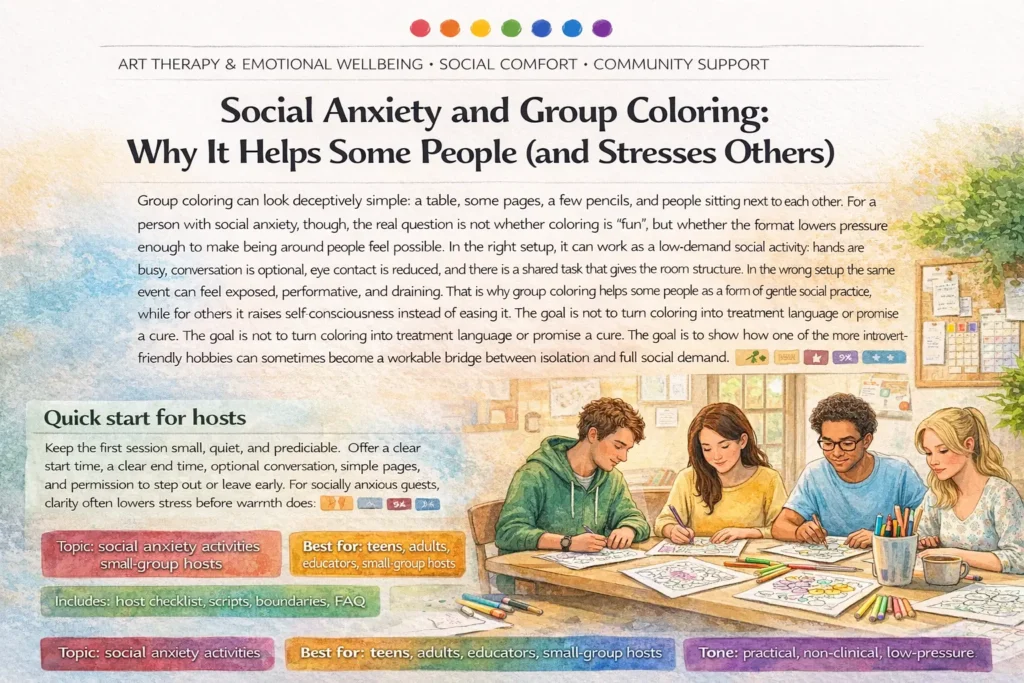
Group coloring can look deceptively simple: a table, some pages, a few pencils, and people sitting next to each other. For a person with social anxiety, though, the real question is not whether coloring is “fun,” but whether the format lowers pressure enough to make being around people feel possible. In the right setup, it can work as a low-demand social activity: hands are busy, conversation is optional, eye contact is reduced, and there is a shared task that gives the room structure. In the wrong setup, the same event can feel exposed, performative, and draining. That is why group coloring helps some people as a form of gentle social practice, while for others it raises self-consciousness instead of easing it.
This guide is for teens, adults, educators, librarians, and community organizers who want a more realistic answer than “art is always calming.” It explains why side-by-side participation often feels easier than direct socializing, how to host a safer community art night, which boundaries matter, and what to do when group coloring increases anxiety instead of softening it. The goal is not to turn coloring into treatment language or promise a cure. The goal is to show how one of the more introvert-friendly hobbies can sometimes become a workable bridge between isolation and full social demand.
Why “side-by-side” reduces social pressure
Many people with social anxiety are not afraid of human contact in a vague, general way. They are afraid of what happens inside interaction: being watched, sounding foolish, not knowing when to speak, being judged for silence, having to make eye contact for too long, or getting stuck in a conversation they cannot leave gracefully. A good side-by-side activity changes that equation. Attention is distributed between the person, the page, the table, and the shared environment. That matters because it reduces the feeling that all attention is landing on one face, one voice, one social performance.
Coloring also gives the body something concrete to do. That is not a small detail. When hands are moving, there is a task rhythm: choose a pencil, fill a shape, switch colors, pause, continue. For some people, that reduces the intensity of social self-monitoring because the brain is not handling only one social problem at once. There is a visual anchor and a motor anchor. Instead of “I am being perceived,” the experience can shift toward “I am doing one manageable thing while other people happen to be here.”
Another reason side-by-side formats can help is that they make silence easier to tolerate. In a normal conversation-based gathering, silence can feel loaded. At a coloring table, silence often reads as concentration rather than social failure. That difference matters more than it may seem. People who would never choose a discussion circle may tolerate a quiet table for forty minutes because the silence is not empty; it has a clear social purpose.
There is a shared focal point, not a spotlight. Eye contact can happen briefly rather than continuously. People can join the room before they join the conversation. The task has a beginning, middle, and end. And there is no strong demand to be witty, fast, relaxed, or socially “on.”
Loud music, crowded tables, forced introductions, comments on people’s work, jokes about artistic talent, icebreakers that require disclosure, or an unspoken expectation that everyone should mingle. Once coloring becomes a test of sociability, the pressure returns.
Group coloring can be a supportive, lower-demand way to practice being around people. It is not the same thing as psychotherapy, not a diagnostic tool, and not a substitute for evidence-based care when anxiety is severe, persistent, or clearly impairing school, work, relationships, or daily functioning.
This is why group coloring can sometimes function as a form of gentle exposure in plain language: not formal treatment, not a substitute for therapy, but a lower-stakes way to practice being near people without jumping straight into high-demand social performance. The difference matters. A useful session does not demand confidence first. It gives the person enough structure that confidence becomes slightly less necessary.
How to structure a safe group session
A safe session is not built from decoration. It is built from predictability. People with social anxiety usually do better when the room answers four questions early: What happens first? Do I have to talk? How long does this last? What if I need a break? When those questions stay unclear, anticipatory anxiety rises before the activity even starts.
Start small. A first session usually works better as a 3-to-8 person gathering than as a busy public drop-in. Use a room with enough space between chairs, comfortable lighting, a calm entry point, and easy access to the door. Put materials out before people arrive so nobody has to ask where things are. Offer a narrow selection: a few page types, a few pencil or marker sets, maybe one simple choice between larger shapes and more detailed pages. Too many options can create social friction because anxious people often experience choice as visibility: “I’m taking too long, choosing wrong, or already doing this badly.”
The opening should be brief and practical. A long introduction can be more stressful than the activity itself. One or two sentences are enough: “Welcome. You can color quietly, chat if you want, or just settle in. No one has to share their page.” That lowers ambiguity before anyone has to earn permission to be quiet.
| Host checklist | What to do | What to avoid | Why it matters |
|---|---|---|---|
| Group size | Keep it small for the first round; leave extra chair space. | Packed seating or a crowded drop-in table. | Crowding increases scanning, comparison, and exit stress. |
| Arrival | Let people come in quietly and start without ceremony. | Mandatory introductions at the door. | It reduces first-minute social exposure. |
| Conversation | Make talking optional from the start. | Icebreakers or “tell us about yourself” rounds. | Optional speech protects nervous participants from shutdown. |
| Materials | Offer simple pages, clear outlines, and familiar tools. | Overly complex pages or too many material choices. | It lowers decision load and performance worry. |
| Timing | State the session length up front and keep it reliable. | Open-ended time with no clear closing point. | Predictable endings make attendance feel safer. |
| Exit options | Normalize breaks, stepping out, and early departure. | Drawing attention to leaving early. | Freedom to exit often makes staying more possible. |
A small session often works well with a simple rhythm: five minutes to arrive and choose materials, thirty to forty minutes of coloring, ten minutes of optional conversation, and a calm close. Not every group needs a sharing moment. In many cases, the safer option is to end with a simple thank-you and optional clean-up, not a forced reflection round.
Optional conversation rules and boundaries
Boundaries do not make a group colder. They make it more usable. For socially anxious participants, the difference between a supportive session and a stressful one is often not the activity itself but the social rules around it. Clear rules reduce guessing, and reducing guessing is one of the fastest ways to lower tension.
Talking is optional. Silence is normal. Nobody has to explain their page. No critique unless someone explicitly asks for feedback. No teasing about being “bad at art.” No pressure to stay after the activity ends. No public call-outs for “being too quiet.”
Keep voices low, avoid commenting on personal appearance, do not read meaning into someone’s color choices, and do not turn the table into a therapy circle unless that was clearly stated beforehand and facilitated appropriately.
One useful distinction is this: conversation can be available without becoming the assignment. Some guests will warm up halfway through and start chatting. Others will color quietly the whole time and still leave feeling that the session “worked.” Both outcomes count. Hosts often undermine good sessions by treating speech as the proof of success. For many anxious people, success is simpler: they came, stayed, did the activity, and left without feeling crushed by self-consciousness.
“No one has to explain their page.”
“Feel free to step out for a minute and come back.”
“Quiet participation counts fully here.”
This point matters in schools, libraries, youth programs, and community spaces. A session meant to support emotional comfort should not accidentally reward only the most verbally confident people in the room. When quiet participation is respected, group coloring becomes one of the more realistic low-pressure social activities available to mixed personalities and mixed nervous-system needs.
If it increases anxiety: alternatives
Group coloring is not automatically regulating. Some people become more anxious when others can see their page, hear their silence, or sit close enough to observe their pace. Others are fine with the room but not with the “shared task” feeling; they worry about looking childish, slow, awkward, visibly tense, or out of place. These reactions do not mean the person failed the activity. They mean the social load was still too high for that format.
When that happens, the best response is not “push through at all costs.” It is to reduce demand while preserving dignity. A person may do better with parallel solo coloring in the same room as one trusted person, a brief drop-in instead of a full session, sitting at the edge of the room, wearing headphones during the activity if the setting allows it, or attending a session where people arrive and leave quietly without introductions. Others may prefer digital coloring, tracing, collage, sticker-by-number, or a small repetitive art task that feels less exposed than a visible page on a shared table.
One-to-one coloring with a trusted friend. Quiet library art tables. Bring-your-own-page sessions with no sharing. Arrive-late and leave-early attendance. Solo coloring before joining the group. A “silent first 20 minutes” format. Small repetitive art instead of open creativity.
The person cannot start, keeps scanning the room, feels trapped, becomes shaky or flooded, apologizes repeatedly, hides the page, leaves with strong shame, or spends more time recovering from the event than benefiting from it. At that point, a smaller, quieter, more private version is usually smarter than increasing social demand too quickly.
There is also a line where a hobby format should not be asked to do clinical work. If social fear is intense, broad, persistent, and clearly reducing school attendance, work participation, relationships, or day-to-day function, a structured evidence-based treatment route matters more than trying to solve everything with a craft night. In that situation, community activities can still play a supporting role, but they should not carry the whole burden.
FAQ
Is group coloring good for social anxiety?
Sometimes. It can help when the session is quiet, optional, structured, and easy to leave. It can feel harder when the room is crowded, the rules are unclear, or talking and sharing are treated as proof of success.
Why does side-by-side activity feel easier than direct conversation?
Because the task absorbs part of the attention. People are not relying only on eye contact, small talk, and social timing. The page gives the body and mind something steady to do.
Should hosts make everyone introduce themselves?
Usually no, especially not in the first minutes. Mandatory introductions can create exactly the kind of performance pressure that prevents anxious guests from settling.
What group size is usually best?
A small first session is usually best. Around 3 to 8 people is often more manageable than a busy drop-in format.
Do people need to talk about what they colored?
No. Optional reflection can be offered, but forced explanation often increases self-consciousness and can make the room feel evaluative rather than supportive.
Can group coloring replace therapy?
No. It can be supportive and socially easier for some people, but it is not a substitute for treatment when anxiety is severe or impairing daily life.
What is the best alternative if a full group feels too intense?
Try a smaller version first: one trusted person, a short drop-in, quiet solo coloring near others, or a silent-format session with clear exit options.
Sources (primary references)
Useful for the article’s framing of social anxiety as fear in situations involving possible scrutiny, judgment, or evaluation, and for the distinction between supportive coping activities and actual treatment.
Supports the article’s careful line between lower-pressure participation and structured mental health care, and reinforces the importance of adapting communication and environments to the person’s participation needs.
Helpful for broad public-health framing: social anxiety can affect participation, school, work, and everyday life, and may show up as avoidance, distress, and strong fear of social situations.
Relevant for the article’s cautious position that complementary and creative approaches may help some people cope with anxiety or stressful situations, without overstating them as primary treatment.
Useful background for the article’s plain-language discussion of exposure as a structured therapeutic concept, and for the distinction between supportive participation and formal psychotherapy.
Supports the article’s point that evidence-based care for significant social anxiety is structured and specific, rather than something that should be replaced by a casual hobby setting.
Expert Commentary: Social Safety Usually Comes Before Social Confidence
Why anxious people often struggle before the session even begins
One of the biggest misunderstandings about social anxiety is that observers usually focus on what happens in the room, while the anxious person is already having a full stress response before arrival. The pressure often starts with anticipation: What if I do not know where to sit? What if people look more comfortable than I do? What if I am the only quiet one? What if I freeze, leave early, or look rude? This is why predictability matters so much. When hosts assume that a warm vibe is enough, they miss the fact that socially anxious people are often not looking for warmth first. They are looking for orientation. They need to know what the room expects from them, how visible they will be, whether silence is acceptable, and how to leave without humiliation if the experience becomes too much.
What often happens during the activity
During a group session, anxiety does not always look dramatic. It often looks quiet. A participant may keep scanning the room, delay choosing a page, apologize for trivial things, hide their work, laugh at themselves before anyone else can judge them, or stay so focused on not doing the wrong thing that they cannot enjoy the activity at all. That is why the room matters as much as the art. A well-run table lowers unnecessary decision points, lowers performance pressure, and lowers the amount of spontaneous social responding the person has to do. The goal is not to make the person instantly comfortable. The goal is to make the task socially survivable enough that the nervous system does not spend the whole session in defense.
What hosts should pay attention to after the session
The after-effect matters just as much as the event itself. Some people appear composed in the moment and then go home into heavy rumination: replaying what they said, how they looked, whether they seemed strange, whether their silence was noticed, whether leaving early “meant something.” That post-event shame spiral is important. A useful session is not just one that looks calm from the outside. It is one that the person can leave without feeling emotionally punished for attending. That is a more honest measure of whether the format was supportive.
What good support actually looks like
Good support is not pushing harder. It is adjusting demand without removing dignity. Sometimes that means a smaller group, a shorter stay, no introductions, a seat near the edge, a silent first block, or permission to participate without explaining anything. People often worry that this is “accommodating avoidance.” In reality, smart pacing often does the opposite. It creates a version of participation the person can actually return to. Sustainable social confidence is usually built through tolerable experiences repeated over time, not through one overwhelming experience that the person survives but never wants to repeat.
The most important line not to cross
It is also important not to romanticize every quiet creative space as therapeutic. Group coloring can be supportive. It can reduce social demand. It can help some people practice being near others with less pressure. But it should not be asked to carry clinical responsibility it does not have. When fear of judgment is severe, persistent, and life-limiting, the person deserves more than a nice room and a polite activity. They deserve structured, evidence-based care. Used thoughtfully, group coloring can sit beside that bigger picture as one helpful bridge. Used carelessly, it becomes another place where the person is visible, tense, and misunderstood.