Sensory Regulation Through Coloring (For Sensitive Kids and Overwhelmed Adults)
Coloring can be a surprisingly effective set of sensory regulation activities when it’s designed around the nervous system: predictable pages, the right tools, supportive pressure, and clear environmental boundaries. This expert guide explains how texture, pressure, tool choice, and limited options reduce overload—and how to turn coloring into a repeatable sensory overload coping routine for sensory-sensitive kids, educators, and overwhelmed adults.
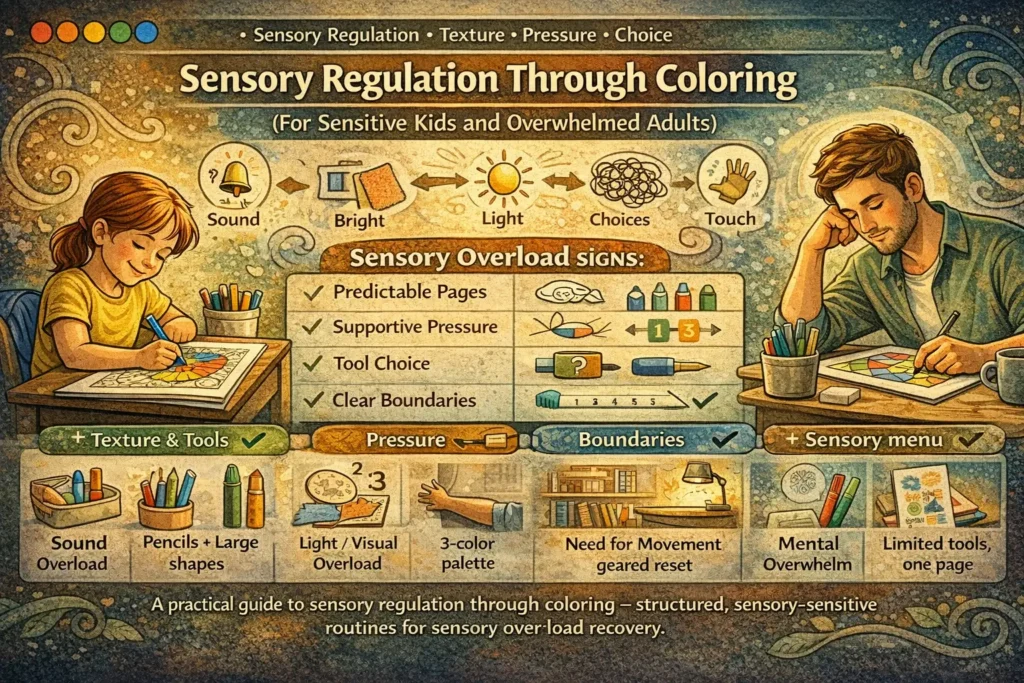
Sensory overload signs and why predictable tasks help
Sensory overload is not a character flaw. It’s the brain and body hitting a threshold: too much input, too little control. Kids may melt down, bolt, or refuse textures. Adults may become irritable, foggy, shut down, or feel “on edge” for hours.
- Sound: covering ears, panic in busy rooms, snapping at small noises.
- Light/visual load: squinting, zoning out, headaches, “my eyes are tired.”
- Touch/texture: avoiding seams, sticky hands, certain papers/tools, sudden “don’t touch me.”
- Body/movement: restlessness, rocking, crashing, chewing, repetitive fidgeting.
- After-effects: exhaustion, tearfulness, “I can’t do this,” rigid thinking.
Predictable tasks help because they reduce surprise and decision load. Coloring is built on repeatable steps: pick a color, make strokes, fill a shape, stop. When the page is structured (large shapes, repeating patterns), the brain can settle into a rhythm. For many people, this is exactly what overload needs: structure + choice + a clear endpoint.
Tool selection (crayons vs pencils vs markers)
Tools change the sensory experience. Crayons add friction and grounding feedback. Pencils support slow control. Markers reduce effort but can be visually “loud.” For fine motor sensory needs, tool resistance can make the hand feel more organized. For sensory sensitivity, smell, squeak, and mess can trigger overload.
| Tool | Sensory feel | Best for | Watch-outs |
|---|---|---|---|
| Thick crayons | More “drag” + pressure feedback; slower strokes | Grounding input; big shapes; building hand endurance | Wax smell; broken tips can frustrate |
| Colored pencils | Quiet, predictable resistance; layerable | Slow pacing; shading; pressure control practice | Scratchy feel; tip fatigue for small hands |
| Markers | Low resistance; fast coverage; bright color | Low-energy days; quick success; large areas | Smell; bleed-through; streak “mistakes” |
| Gel pens | Smooth glide; crisp lines | Repeating patterns; adults who like neat rituals | Ink skipping; too-stimulating neon sets |
Texture tuning (small changes that matter)
- Paper feel: smoother paper reduces scratchiness; slightly heavier paper can feel more stable under firm pressure.
- Grip feel: thicker barrels or a soft grip can reduce finger strain and “sharp” tactile feedback.
- Hand cleanliness: for sticky-sensitivity, keep a dry cloth nearby; avoid markers if smell or wet ink spikes stress.
- Sound sensitivity: some pencils “scratch”; try smoother leads or switch to crayons for quieter feedback.
Pressure and pacing (slow strokes, “pressure scale”)
Many people regulate through deep pressure and proprioception—the body’s sense of force and position. Coloring can provide that input gently through the hands. When pressure becomes extreme, it’s often a signal the body needs “bigger-muscle” input.
A practical “pressure scale” (1–5)
- 1: feather-touch (warm-up, high touch sensitivity)
- 2: light (quiet, low strain)
- 3: medium (steady “sweet spot”)
- 4: firm (grounding, stronger feedback)
- 5: power (brief only; redirect if paper creases/tears)
Heavy work alternatives (fast reset before returning)
- Wall pushes: slow push for 10 counts × 3.
- Chair push-ups: lift hips slightly, hold 3 seconds × 5.
- Hand squeeze: stress ball or rolled sock, 10 slow squeezes.
Pacing: slow strokes change the body
Use “one shape at a time” pacing: outline, fill, pause. Adults can pair it with breath (inhale while outlining, exhale while filling). This builds a reliable calming activity that feels concrete, not abstract.
- 30 seconds: choose 3 colors only.
- 60 seconds: fill one large shape at pressure “3.”
- 30 seconds: add one small detail at pressure “2,” then stop and notice shoulders/jaw/breath.
- Stop + simplify: switch to a page with large shapes; reduce to 2–3 colors; move to pressure “2.”
- Reset input: do 60 seconds of heavy work (wall pushes or chair push-ups), then return for only 1–2 minutes.
- Change one variable: if it still spikes stress, change just one thing next time (tool OR lighting OR seating), not everything.
Setting boundaries (sound, light, seating)
Coloring is most regulating when the environment is not fighting the nervous system. Small boundary changes can reduce spikes in stress and improve follow-through.
Quick boundary checklist
- Sound: move away from TV/kitchen traffic; consider steady low noise if it helps.
- Light: reduce glare; aim a lamp at the page; clear visual clutter.
- Seating: feet supported; elbows comfortable; take micro-breaks (shake hands, relax grip).
Adult-friendly uses (realistic, time-limited)
- Workday overload: 2 minutes between meetings: repeating pattern + pencils + 3-color palette.
- After social load: low light + large shapes + “one section only” rule.
- Transition support: set a timer for 3–5 minutes; stop on purpose even if unfinished (predictable ending).
Sensory-friendly page types (large shapes, repeating patterns)
Page design can lower or raise sensory load. Start with pages that reduce precision demands and create predictable visual structure.
- Large shapes: easier start, fewer boundaries, less perfection stress.
- Repeating patterns: rhythmic, soothing, less “what do I do next?”
- Clear sections: supports pacing and a clean stopping point.
- Thicker outlines: less visual searching, steadier hand placement.
For textured coloring, add texture in small steps (slightly heavier paper, a soft grip, thicker crayon) and watch the body response. If touch sensitivity rises, return to smoother materials and simpler pages. The goal is a “workable” level of input—not maximum intensity.
A sensory menu (5 options) for common triggers
A sensory menu is a short list of ready-made choices that reduce decision fatigue during overload. Pick the option that matches the trigger.
Setup: pencils + large shapes + minimal talking.
First step: 10 slow strokes, pause, repeat.
Setup: dimmer light + uncluttered table + 3-color palette.
First step: color one section only; leave blank space on purpose.
Setup: smooth paper + thicker tools + optional grip.
First step: pressure “2–3,” slow pace, avoid strong-smell markers.
Setup: 60-second reset (wall pushes), then firm crayon coloring.
First step: color big areas for 2 minutes, stop before fatigue.
Setup: put out 3 tools only; one pre-chosen page.
First step: “start line”: color one shape only.
The long-term goal is skill: people learn which tools calm, which textures irritate, and which pacing keeps them steady—so regulation becomes more self-directed. Coloring should not be framed as a treatment or cure; its value is helping the nervous system enter a workable state during transitions and recovery from overstimulation.
Sources
-
CDC — Treatment and Intervention for Autism Spectrum Disorder
Outlines supports including occupational therapy; useful for framing sensory strategies as supports rather than cures.
-
AOTA (AJOT) — Sensory Integration Approaches for Children and Youth
Professional perspective on sensory integration approaches and sensory-based interventions in OT practice.
-
NHS Lothian — Deep pressure to help prevent sensory overload (PDF)
Practical guidance on deep pressure strategies, with safety framing and signs to monitor.
-
National Autistic Society — Sensory processing
Clear explanation of sensory differences and everyday accommodations (environment, predictability, pacing).
-
DCHFT NHS — Sensory strategies for older children and adolescents (PDF)
Highlights overload signs and practical environmental adjustments (noise/light), supporting the boundary checklist.
FAQ
What are quick sensory regulation activities when someone feels overloaded?
Start with predictable, low-demand input: choose 2–3 colors, color one large shape for 60–120 seconds at a medium pressure level, then pause. If tension rises, do a 60-second “heavy work” reset (wall pushes or chair push-ups) and return for a shorter round. The goal is to enter a workable state, not to finish a page.
How can coloring help with sensory overload coping for sensitive kids and overwhelmed adults?
Coloring supports regulation when it is structured and time-limited. Clear boundaries on the page reduce decision fatigue, repetitive strokes create a calming rhythm, and controlled choice (few tools/colors) increases a sense of safety and control. It can be used as a transition tool before learning, homework, or task switching.
Which tools are best for sensory-sensitive coloring: crayons, pencils, or markers?
It depends on the trigger. Thick crayons provide more friction and grounding feedback for people who benefit from stronger hand input. Colored pencils support slow pacing and pressure control. Markers reduce effort and can work on low-energy days but may be visually intense, smelly, or messy. A helpful rule is to offer two options, not a full set.
What is a pressure scale and how do you use it during coloring?
A pressure scale (1–5) helps people notice and adjust force. 1 is feather-touch, 3 is steady medium pressure, and 5 is power pressure that should be brief. Practice changing pressure by one step at a time (for example from 4 to 3) instead of asking someone to stop pressing completely. If paper creases or tears, pause for a reset and return at a lighter level.
What are heavy work alternatives if coloring pressure becomes extreme?
Use short proprioceptive activities before returning to coloring: wall pushes (10-count push × 3), chair push-ups (hold 3 seconds × 5), or slow hand squeezes with a stress ball (10 reps). These inputs can reduce agitation and help the body settle into a more regulated range.
What page types are most sensory-friendly for regulation?
Start with pages that reduce precision demands and visual searching: large shapes, repeating patterns, clear sections, and thicker outlines. These designs support pacing and provide predictable stopping points. If touch sensitivity is high, choose smoother paper and avoid highly textured surfaces.
What should you do if coloring makes sensory overload worse?
Stop and simplify. Switch to a page with large shapes, reduce to 2–3 colors, and drop to lighter pressure. Do a 60-second reset (wall pushes or chair push-ups), then try 1–2 minutes only. Next time, change just one variable (tool OR lighting OR seating) so you can identify what helps.
From a clinical psychology perspective, sensory overload is often less about “willpower” and more about the nervous system losing a sense of control. Structured coloring can help because it is predictable, time-limited, and low-stakes. The clear boundaries of a page provide an external structure: one shape begins, one shape ends. That reduces cognitive overload and supports steadier attention without requiring intense self-control.
Importantly, coloring should not be framed as a treatment or cure. Its value is helping the nervous system enter a workable state, especially during transitions (starting homework, calming after overstimulation, or shifting tasks). When people feel overwhelmed, “too many choices” can become another stressor. Limiting tools and options is not restrictive—it is protective.
- Keep sessions short and predictable: brief, repeatable routines often regulate better than long sessions.
- Limit choices: too many colors or tools can increase distraction rather than reduce it.
- Emphasize process, not outcome: focus on starting, staying, and stopping—rather than finishing a perfect page.
- Watch for escalation cues: if pressure becomes extreme or frustration rises, pause and switch to a simpler page or a softer tool.
- Use a reset when needed: a 60-second heavy-work break can bring the body back into a range where coloring feels good again.
Over time, the most helpful message is: “Your body’s signals matter, and we respond with skills, not shame.” That mindset builds self-awareness and makes coloring a sustainable coping routine for both kids and adults.