Re-Coloring the Same Page Again: When Repetition Feels Safer Than Novelty
My child keeps picking the same page — should I worry? Almost certainly not. Here is what is actually happening in the nervous system, how to tell healthy repetition from a broader stress signal, and what not to do in either case.
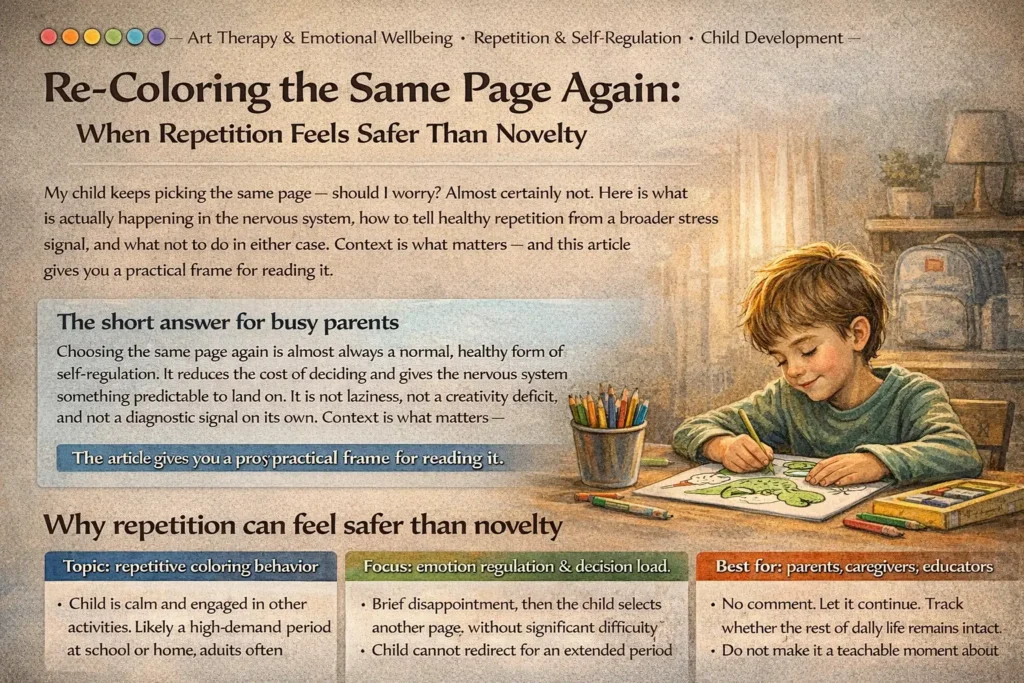
Choosing the same page again is almost always a normal, healthy form of self-regulation. It reduces the cost of deciding and gives the nervous system something predictable to land on. It is not laziness, not a creativity deficit, and not a diagnostic signal on its own. Context is what matters — and this article gives you a practical frame for reading it.
Why repetition can feel safer than novelty
When a child opens a coloring book and reaches straight for a page they have already finished once, twice, or a dozen times before, adults often notice — and often intervene. The redirect is usually gentle: “Pick a different one. You already did that one.” Sometimes it is less gentle than that.
But from the child’s perspective, something specific is happening that the adult’s prompt misreads entirely. That familiar page carries a known shape, a known outcome, and zero evaluation cost. The brain does not have to calculate whether this will go well. It already knows. For a child who has spent hours managing unpredictability — at school, in social settings, or inside a nervous system that finds novelty genuinely costly — that is not a small thing.
The mechanism is reasonably well supported. Sweller’s cognitive load theory (Learning and Instruction, 1994) established that familiar tasks require significantly less working memory capacity before the task even begins. More directly relevant: Carleton’s work on intolerance of uncertainty (Journal of Anxiety Disorders, 2016) shows that for individuals with lower tolerance for the unknown, familiarity functions as an active stress-reduction strategy — not a passive default. The known page is the shortcut the nervous system found on its own, and it works.
The preference for familiar stimuli under cognitive and emotional load is not a children-only phenomenon. It appears across development and is documented in both neurotypical populations and in children experiencing elevated situational stress. It is not a trait — it is a state response.
Familiar pages reduce decision load — and that reduction is real
Choosing a coloring page looks trivial. It is not. Even a small stack of five pages requires the child to evaluate visual complexity, personal interest, likelihood of success, and mood fit — before the pencil touches paper. Each of those is a small executive function draw. When the child is already tired or emotionally depleted, those draws compound. Baumeister’s research on ego depletion (Journal of Personality and Social Psychology, 1998) established that self-regulatory capacity is a finite resource. By 3pm, many children have spent a large portion of it.
A familiar page eliminates almost all of that pre-task cost. The decision is already made. This is functionally similar to other low-demand anchors that children and adults use under load: the same route home, the same playlist on a hard commute, the same bedtime book in the same reading order. The content is not the point. The eliminated uncertainty is.
In practice, reaching for the same page can look identical across children while serving quite different regulatory needs. Understanding which situation applies changes what, if anything, to do about it.
A child who has spent six hours managing school arrives home with depleted executive resources. The familiar page asks nothing new of a system that has nothing left to give. This is the most common picture, and it resolves on its own as the child’s reserves rebuild across the afternoon. The appropriate adult response is to not interrupt it.
A new school year, a house move, a friendship disruption, the arrival of a sibling — all of these elevate baseline uncertainty. Research on predictability and stress suggests that when the broader environment becomes less navigable, individuals increase their use of predictable sub-environments. The familiar page becomes a small domain of certainty inside a period when most things feel variable. This pattern typically loosens as the transition resolves, without direct adult intervention.
A child with a higher baseline intolerance for uncertainty (Dugas et al., Behaviour Research and Therapy, 1997) may show the same page preference not only during hard weeks but consistently across many contexts. The behavioral surface is identical to the first two profiles — but the driver is different. This child is not recovering from a specific load; they are managing a chronic one. That distinction matters for what comes next: patience and gradual expansion work for the first two; broader professional support may be relevant for the third.
These profiles are not always easy to distinguish in real life. The most practical question is not which category applies but whether the pattern is time-limited and context-bound, or whether it is stable and expanding into other domains.
Repetition is not the same as emotional rigidity
In clinical contexts, rigidity involves marked distress when a routine is interrupted, an inability to shift even when clearly motivated, and a pattern that narrows progressively over time. Re-coloring a favorite page has almost none of those features in typical cases. Most children who prefer a specific page also engage freely with other activities, show no significant distress when the page is unavailable, and shift naturally as mood and context shift.
The word repetition often carries a clinical shadow in parenting conversations, and it is worth naming that shadow directly: repetitive behavior is one feature — among many — of several developmental profiles. It is also a feature of being a tired seven-year-old in October. One data point does not support clinical inference. Context, flexibility, distress level, and the full developmental picture are all necessary before the word “rigidity” belongs in the conversation.
Healthy preference vs. rigidity: what the difference looks like in practice
A practical orientation tool — not a diagnostic checklist.
When the favorite page is not available
Brief disappointment; child adjusts, picks another page, moves on without significant disruption
Prolonged, disproportionate distress; the activity loses all value; child cannot redirect for an extended period
Pattern over weeks and months
Favorite pages shift over time; the child naturally expands the repertoire as the stressor resolves
The acceptable range narrows steadily — fewer pages, fewer activities, fewer tolerated contexts over months
Connection to broader stress level
Repetition increases during harder periods and relaxes when the overall load lightens — tracks with context
Repetition is constant regardless of context, or escalates without an identifiable stressor
Variation within the repeated activity
Child tries different colors, pressure, sequences — active creative exploration within a safe container
Child insists on reproducing the exact same result each time; any variation causes distress rather than interest
When re-coloring supports regulation — what it actually provides
For most children in most circumstances, returning to a known page is an active regulatory move. The activity provides sensory input — pencil pressure, wrist movement, the visual boundary of the outline — without requiring new cognitive negotiation. The hands are busy. The mind can process what the day left behind without any social performance demand attached.
AAP guidance on emotion regulation consistently notes that children arriving home from school are not in a free recovery state — they are carrying the residue of hours of sustained behavioral effort. An activity that demands nothing new from the executive system, produces a visible result, and has a clear stopping point serves a measurable function in that window. The familiar page does all three.
- Removed evaluation cost: the outcome is already known; the pre-task decision load is effectively zero
- Sensory rhythm: repeated bounded motor movements can lower physiological arousal — documented in occupational therapy research on fine motor regulation
- Non-verbal processing space: the hands are occupied, which allows emotional processing without the demand to articulate anything
- Low performance risk: the child already knows this page; there is no possibility of failing it in a new way
- Visible completion: finishing something familiar provides a small, uncomplicated sense of done — meaningful for children who have experienced ambiguous or unresolved situations during the day
Healthy repetition, possible stress signal, best adult response
The table below is not a screening tool. It is a practical orientation for adults who want to read the full picture without over-reading a single behavior.
| What you observe | Healthy repetition | Possible stress signal | Best adult response |
|---|---|---|---|
| Same page every session for one to two weeks | Child is calm and engaged in other activities. Likely a high-demand period at school or home. | Coloring is the only activity that feels accessible — other usual activities have dropped away too. | No comment. Let it continue. Track whether the rest of daily life remains intact. |
| Visible upset when the favorite page is missing | Brief disappointment, then the child selects another page without significant difficulty within a few minutes. | Sustained distress that prevents engagement with anything else; upset disproportionate to the situation. | Acknowledge the preference without judgment. Offer a similar page nearby. Do not make it a teachable moment about flexibility. |
| Child colors the same page with different color choices each time | Active creative exploration within a safe structure — the most functional version of this pattern. | Not a stress signal. | Notice it warmly if the child shares. Do not frame it as “look, you tried something different” — they are not trying to break a pattern; they are using the familiar frame creatively. |
| Repetition increases sharply after a life event | Normal regulatory response to elevated uncertainty: new school, sibling arrival, house move, friendship loss. | If accompanied by sleep changes, appetite shifts, or social withdrawal, the broader picture warrants attention. | Do not reduce access to the familiar page. Increase predictability across the broader environment. |
| Pattern stable for months, across many contexts | Possible if the child is temperamentally lower-tolerance for uncertainty but developing normally across other domains. | If the range of acceptable activities, foods, and social situations has been narrowing — not just stable — over the same period. | Describe the full picture to the child’s pediatrician or school counselor — not the coloring behavior specifically, but the pattern across domains. |
| Child insists the adult also use the same page | Social extension of a safe activity. Child is co-regulating with a trusted adult — this is relationally healthy. | If any variation in the shared routine causes significant distress, consider what the child is asking for beyond the page itself. | Join when possible. The shared familiar activity carries relational weight well beyond the coloring itself. |
When adults should pause and look closer
The repetition itself is almost never the problem. But it can be the most visible surface of something worth tracking — not diagnosing, not fixing immediately, but observing with more care over time.
The practical question is not “why does my child pick the same page?” — it is “what does the rest of the picture look like, and has that changed?” The page preference is one data point. Its value depends entirely on what surrounds it.
- The range of tolerated activities, foods, or social situations has been narrowing over several weeks — not holding steady, actively shrinking
- Distress at any deviation from routine is high and consistent across multiple areas of life, not only at the coloring table
- Sleep, appetite, or peer engagement have changed at the same time the repetition increased
- The child cannot self-soothe in any way other than this single repeated activity — the regulatory toolkit has narrowed to a single tool
- The child expresses fear or active avoidance about trying anything new across multiple contexts — not just coloring pages
If several of these are present together and sustained over weeks, the appropriate step is a conversation with the child’s pediatrician or school counselor, framed around the full behavioral picture. The page preference is where you noticed something; the full pattern is what a professional needs to see.
Instead of “Why does my child keep choosing the same page?”, try: “What has my child’s week looked like, and is this what I would expect a nervous system under that load to reach for?” That reframe almost always produces a more accurate reading than the behavioral surface alone.
Gentle ways to widen choice without shame
The goal is not to end the repetition. The goal is to keep the child’s range open over time, without making the familiar page a source of adult pressure. That requires patience and indirection. Direct redirection — “pick something new” — adds a social demand cost to an activity whose primary value is low demand. It does not address the underlying reason for the preference; it adds friction to it.
Do not make the familiar page unavailable in order to force variety. Removing a regulation tool without replacing it teaches the child that their self-soothing preferences will be managed and overridden by adults. That message is rarely what the adult intends. It is often what the child receives.
What this does not mean
A few points worth stating plainly, because the interpretation of children’s repetitive behavior can drift toward over-reading very quickly.
Repetitive behavior is one feature of several developmental profiles. It is also a feature of being a tired child on a difficult week. A single behavioral pattern in isolation cannot support a clinical reading. If a full assessment ever becomes relevant, it belongs with a qualified professional who can see the whole child — not at the coloring table.
Many children who return to the same page produce their most exploratory color work there, precisely because the structural decision is already made and all available cognitive resource goes to creative choices. The container repeats; the creative act inside it often does not.
A direct instruction to vary the choice does not address why the child is reaching for the familiar page. It adds social performance pressure to an activity whose primary function is the absence of such pressure. The behavior will reappear — possibly with more tension attached to it than before.
All three of those experiences can involve repetition. So can being a typically developing child who had a hard month. One data point does not support clinical inference in any of those directions. Adults who jump to those readings without a full picture often generate more anxiety — in themselves and in the child — than the behavior ever warranted.
FAQ
My child has picked the same page every day for two weeks. Is this a problem?
Two weeks on its own is not a threshold for concern. The more useful question is whether the rest of your child’s life looks roughly normal — activities, sleep, social engagement, appetite. If yes, the repetition is almost certainly functioning as a low-cost regulation anchor during a specific period, and it will shift when the load does. If other things are also changing, that broader picture — not the page count — is what is worth tracking.
Should I try to introduce variety?
Gently, yes — but through addition, not replacement. Place a similar page alongside the familiar one without comment or expectation. Do not make variety the point of the session. If the child is not ready, the new page will sit untouched — and that is fine. The option remains available for when the regulatory load is lighter.
What if the repetition continues for several months?
A sustained page preference, while the rest of development continues normally, is not by itself alarming. The more useful observation is directional: is the child’s overall range of acceptable activities and situations expanding, holding steady, or shrinking? Gradual contraction across domains is worth a conversation with a professional. A continued page preference within an otherwise developing child is almost always benign.
My child gets noticeably upset when the specific page is missing. Is that a red flag?
Brief upset when something expected is absent is a normal disappointment response. What matters is intensity, duration, and proportion. If the child recovers within a few minutes and can redirect to something else, that is within normal range. If the upset is prolonged, disproportionate, and prevents access to any alternative, that is worth observing in the context of the child’s overall flexibility and stress level — not as an isolated incident.
Does re-coloring the same page count as a creative activity?
Yes — and sometimes more genuinely creative than choosing a new page. When the structural decision is already made, all available attention goes to color choice, pressure, sequence, and expression. Many children produce their most interesting color combinations on pages they know well, because the cognitive overhead of the task itself is not competing with the creative decisions.
Is this more common in certain children?
Children with a lower baseline tolerance for uncertainty — a well-documented individual difference, not a diagnosis — reach for familiar activities more consistently. So do children in high-demand periods: new school year, stressful social dynamics, family transitions. The behavior appears across a wide range of profiles. Many adults show the same pattern: the same book, the same playlist, the same walk, when emotionally spent. The developmental version is not categorically different.
When should I speak to someone about it?
When the page preference is one part of a broader narrowing: fewer tolerated foods, fewer comfortable activities, increasing distress about any change, a visible shift in mood or sleep over weeks. In that case, the appropriate conversation is with your child’s pediatrician or school counselor — framed around the full picture, not the coloring behavior specifically. The page is where you noticed something; the pattern across domains is what the professional needs to hear about.
Sources (primary references)
Used here to support the point that familiar tasks reduce working memory load before the task begins — directly relevant to why a known page lowers the cognitive entry cost of an activity under stress.
Used here for the core mechanism: for individuals with lower tolerance for uncertainty, familiar environments can function as an active stress-reduction strategy — not a passive preference. Cited for the three-profile distinction (tired / transitioning / chronically anxious).
Cited for the post-school depletion framing: self-control and executive decision-making can feel depleted after sustained demand. By the afternoon, many children have used a large portion of that resource managing school demands.
Used here to support the distinction between acute situational repetition and a more chronic pattern: intolerance of uncertainty is a stable individual difference linked to greater reliance on predictable routines across contexts.
Expert Commentary: What Twelve Years of Working With Children in Transition Taught Me About the Same Page
The misread I see most often
In over a decade of working with children through school transitions, family stress, and social difficulty, the most consistent misread I see from well-meaning adults is this: they treat the familiar page as evidence of a problem, when in most cases it is evidence of a solution — one the child found without being taught it.
Children do not have the developmental vocabulary to say “I am running low on regulatory capacity and I need a low-demand anchor right now.” They pick the cat page again. Or the same mandala for the fourth time. Or the single dinosaur in the corner of a larger scene. The behavior is communicating something that the words are not yet there to express. The adult’s first job is to read it correctly before deciding whether to do anything at all.
Three children I have worked with this month — and what was actually different
I want to make the three-profile distinction concrete, because in practice they look nearly identical from the outside and feel very different from the inside.
The first child is eight, three weeks into a new school year. She colors the same forest scene every afternoon after school. She is tired; her peer group is reforming after the summer; she is managing a new classroom structure and a teacher whose style is quite different from last year’s. By October, the page will shift on its own. What I am watching is whether she stays connected to the rest of daily life — which she does. There is nothing to do here except not interrupt the one thing that is working.
The second child is six, recently moved across the country, and consistently reaches for an animal page he brought from the old house. That page is doing a clear job: it is an object that traveled with him, is visually identical to what he remembers, and asks nothing new of him in a context where almost everything else is new. This is healthy repetition in a transition. What I watch for is whether his range slowly begins to expand as the new environment becomes familiar — which it almost always does over two to four months, without adult intervention.
The third child is nine, temperamentally high in intolerance of uncertainty, and has shown a narrowing preference pattern not only at the coloring table but in food, in the route to school, in clothing, and in seating at the dinner table. This child is not tired or transitioning. The regulatory system is working very hard to manage baseline unpredictability, and the coloring preference is one piece of a broader picture. That is the child whose family I gently direct toward a developmental or clinical conversation — not because of the page, but because of the pattern the page is part of.
What adults do that actually helps — and what does not
For the first two profiles, the most useful adult response is nothing. Literally: no comment, no praise for eventually choosing something different, no gentle redirect. The moment the familiar page becomes the subject of adult attention, it acquires social performance weight it did not have before. The child now has to manage the adult’s reaction alongside the activity. That is exactly the opposite of what the page is for.
Gradual expansion — a similar page nearby, an adult quietly engaging with something new without invitation, acceptance of partial contact with unfamiliar material — works because it reduces novelty cost without adding social pressure. The child does not have to perform openness. They can touch the corner of the new page and go back. That is enough. That is, in my clinical experience, exactly how the range widens: through small, unpressured contacts over time, not through clean switches.
What does not help: removing the familiar page to force variety, directly challenging the repetition, or framing the preference as something the child needs to overcome. All of those strategies increase the regulatory load the page was managing. None of them address why the child was reaching for it in the first place.