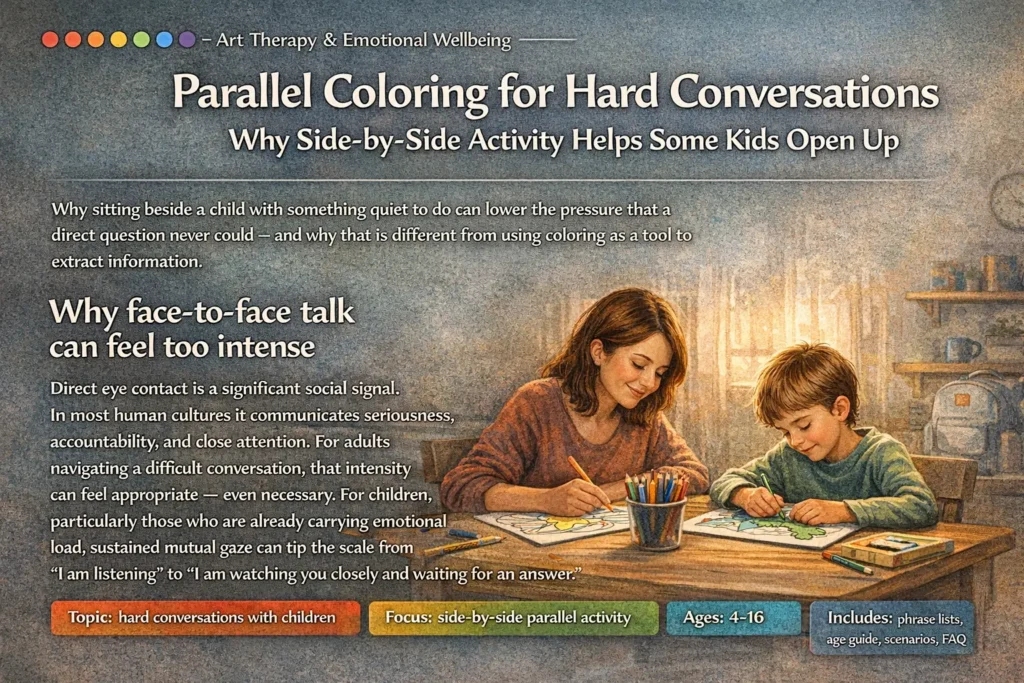
Parallel Coloring for Hard Conversations: Why Side-by-Side Activity Helps Some Kids Open Up
Why sitting beside a child with something quiet to do can lower the pressure that a direct question never could — and why that is different from using coloring as a tool to extract information.
You ask a simple question — “How was school?” — and the answer is nothing. Not a shrug, not a sentence. Just a wall. The child looks away, says “fine” in a tone that means anything but, or quietly leaves the room. You try again, softer this time. The wall gets thicker. This is not a failure of your relationship. For many children, a direct question from a trusted adult feels less like an invitation and more like a spotlight: bright, sudden, and hard to escape.
There is a long-standing observation in family therapy and school counseling: some children talk more freely when their hands are busy and no one is looking directly at them. This is sometimes called side-by-side or parallel activity — two people doing the same quiet thing, sitting close but not face-to-face, with no stated agenda. Coloring is one of the most accessible versions of this format. It asks almost nothing of the child except to begin. It asks no questions. It fills the silence without pressure. And sometimes — not always, not on demand — that absence of pressure creates enough room for something real to come out.
Why face-to-face talk can feel too intense
Direct eye contact is a significant social signal. In most human cultures it communicates seriousness, accountability, and close attention. For adults navigating a difficult conversation, that intensity can feel appropriate — even necessary. For children, particularly those who are already carrying emotional load, sustained mutual gaze can tip the scale from “I am listening” to “I am watching you closely and waiting for an answer.”
The effect is not simply social discomfort. A 2006 review of stress and self-disclosure in children published in developmental psychology literature found that perceived evaluative contexts — situations where a child believes their response is being judged — produce measurable increases in cortisol and reduce the fluency of emotional language. [1] The child is not being stubborn. In a very real sense, they are running low on the cognitive and emotional bandwidth that candid self-disclosure requires, at exactly the moment the adult wants more of it.
Several features of direct conversation make this worse:
- Sustained eye contact requires ongoing social regulation on top of the emotional processing the child is already doing.
- Question-and-answer structure creates turn-taking pressure that is hard to manage when a child does not yet have words for what they feel.
- The adult’s undivided attention — however loving — signals that a response is expected, raising the stakes of every pause.
- An unoccupied setting (sitting across a table, on a couch) removes all neutral focal points and leaves the child’s inner state as the primary object of the interaction.
The American Academy of Pediatrics notes in its child communication guidance that children — especially those under 12 — are more likely to disclose difficult feelings in the context of activity than in structured conversation. [2] This is not a character flaw. It reflects the developmental reality that for many children, language access and physical occupation co-regulate each other.
When a child shuts down during a direct question, it rarely means they have nothing to say or do not trust the adult. More often the format of the conversation has outpaced their current processing capacity. Changing the format — not pressing harder — is usually the more effective response.
Side-by-side activity changes the pressure
When two people sit together doing the same quiet thing, the social geometry of the interaction shifts. Neither person is the object of the other’s full attention. There is a shared focal point — the page, the colors, the table — and that focal point absorbs some of the pressure that would otherwise land entirely on the child. The adult is present but not hovering. The child is not required to perform emotional accessibility.
This structure connects to what developmental researchers describe as co-regulation: the process by which a calmer, regulated adult nervous system actively supports the regulation of a less-settled child. [3] The rhythmic, low-demand nature of coloring gives attention a simple focal point instead of leaving it free to scan for threat cues — Is this a test? Am I in trouble? Will I say it wrong? — freeing up a different quality of thinking. The shared silence becomes companionable rather than expectant.
Shared silence in a joint activity is not the same as the silence of a question still waiting for its answer. The first is restful. The second is pressure with a pause in it.
For coloring specifically, there are additional features worth noting. The page has clear visual boundaries, which makes the activity feel manageable. The task is self-evident, so no one has to explain or negotiate it. The outcome is not evaluated — there is no right way to color a page. This combination of low stakes, no performance, and predictable structure gives the nervous system something to rest against. In that rest, words sometimes find their own way out.
Coloring is a container, not an interrogation tool
The most important thing to hold onto: coloring alongside a child is not a method for getting them to tell you what happened. The moment it becomes that, something essential changes — and children are often acutely sensitive to that shift, even when they cannot name it.
If the adult sits down with the internal goal of using this time to get the child to open up, that goal tends to leak through in small but readable ways: the particular timing of silences, the questions chosen, the way attention orbits back to the difficult topic. Children read these cues. What was a resting place becomes a setup.
The activity creates an opening. What fills that opening — if anything — belongs entirely to the child.
— Core principle of side-by-side presence in family therapy and school counseling practiceThis means the adult’s job during parallel coloring is, in an important sense, to genuinely color. Not to wait with practiced patience. Not to return to the difficult topic at regular intervals. The activity functions as a container precisely because it is real — because the adult is actually present in the task, not primarily present as a concealed interviewer.
Research on child disclosure patterns consistently shows that instrumental framing — where the child understands that an adult is using an activity to reach a conversational goal — reliably reduces spontaneous disclosure. [1] The container works when it is honest. It stops working when it is a technique in disguise.
If you find yourself mentally tracking how many minutes have passed since you last asked a question, you have already left the container. Come back to the page. The conversation will find its own time, or it will not — and either outcome is valid.
Helpful phrases and phrases that shut things down
The language an adult uses during side-by-side activity makes an outsized difference. A few well-placed sentences can keep the space open. A few poorly-timed ones can close it faster than direct questioning ever did.
- “I’m just going to color with you for a bit.”
- “No rush. I’m here.”
- “You don’t have to talk about anything.”
- “This page looked interesting to me.”
- “I had a hard moment today too, actually.”
- “Mm.” (soft, non-leading acknowledgment)
- “That sounds like a lot.” (after anything the child says)
- “We can just sit.”
- “You can tell me more whenever — or not.”
What these have in common: they remove the requirement to respond, reduce evaluative tone, and signal genuine presence without expectation.
- “You can tell me anything — you know that.”
- “I noticed you seemed upset. What was that about?”
- “We need to talk about what happened.”
- “Just tell me. I promise I won’t be mad.”
- “Why won’t you talk to me?”
- “You always shut down like this.”
- “I’m trying to help you, but you have to let me.”
- “Is it about school? Is it about a friend?”
- “I know something is wrong.”
- “You’ll feel better if you just say it.”
What these have in common: they signal that a disclosure is expected, introduce pressure or guilt, or frame the child’s silence as a problem requiring immediate resolution.
How this looks at different ages
The same principle — side-by-side presence reduces conversational pressure — applies across childhood, but the practical form changes significantly depending on the child’s developmental stage. What works well with a five-year-old is often the wrong format for a twelve-year-old.
| Age range | What tends to work | Why it fits this stage | What to avoid |
|---|---|---|---|
| Ages 4–6 | Coloring or drawing side by side, simple sensory play (playdough, water). No conversational agenda needed. | Young children do not separate activity time from talk time. They narrate freely during almost any task. The adult’s main job is to be present and receptive, not to ask questions. | Structured “feelings check-ins,” complex questions, asking them to name an emotion they cannot yet locate. |
| Ages 7–11 | Coloring, LEGO, card games with low competitive pressure, simple cooking tasks. Eye contact avoidance is especially useful here. | School-age children are acutely aware of being observed and evaluated. Shared activity provides legitimate gaze redirection — neither person needs to look at the other. | Anything that feels like a formal check-in, face-to-face seating, questions that require emotional vocabulary they may not have. |
| Ages 12–16 | Walking, driving, cooking together, playing a video game side by side. Movement and environmental change often work better than static seated activity. | Tweens and early teens are more sensitive to anything that feels scripted or therapeutic. Activity needs to feel genuinely incidental, not deliberately set up. | Explicitly framing the activity as “a chance to talk,” any format where the teen can tell the adult is waiting for them to say something. |
Some twelve-year-olds color freely and talk during it. Some six-year-olds need movement before anything else. These age ranges describe general developmental patterns, not fixed categories. Pay attention to what your specific child does — the pattern matters more than the number.
Three practical scenarios
Abstract principles are easier to apply when they are grounded in recognizable situations. The following scenarios are drawn from the kind of cases that come up regularly in school counseling and family therapy practice.
A child comes home visibly withdrawn. She goes straight to her room. You know from another parent that something difficult happened at lunch. She will not answer direct questions.
What parallel coloring offers here: Sit nearby and begin a page of your own. Say nothing about what happened. After several minutes, a low-key comment about the colors or the page you are working on can signal that the space is warm and not dangerous. If she says anything — even something unrelated — receive it without pivoting to the topic. The conversation, if it comes, usually comes sideways: “She said something mean” arrives much more easily after ten minutes of coloring than in response to “What happened with your friend today?”
What to watch for: If she joins you, she is not shutting you out. She is co-regulating with your presence. That is valuable in itself, regardless of whether she speaks.
A child has been resistant to school for several days. He has been irritable, vague about why, and shuts down when parents ask directly. There is no single obvious incident.
What parallel coloring offers here: School-related anxiety often has no single clear cause — it is cumulative, and the child may genuinely not know how to name it. Side-by-side activity reduces the pressure to produce an explanation. Sitting beside him with coloring materials, without any mention of school, gives him a regulated space where fragments may emerge: “The classroom is too loud.” “I don’t know what to do at lunch.” These are not confessions — they are small windows. Respond to each one simply and without urgency.
What to watch for: Persistent school avoidance with somatic complaints (stomachache, headache with no physical cause) warrants a conversation with the school counselor or pediatrician, regardless of what comes out during coloring sessions. [2]
A child has had a significant emotional outburst — tearful, loud, possibly including some physical expression. It has passed. She is now quiet but still raw.
What parallel coloring offers here: The post-meltdown window is not the right time for discussion, explanation, or repair conversation. The nervous system needs time to come fully back online before language-based processing is useful. [3] Sitting near the child with a low-demand activity, saying almost nothing, and not making the episode the subject of the interaction gives the body what it needs: time, proximity, and no new demands. Repair conversations and discussion of what happened work better when introduced 20–40 minutes later, or sometimes the following day.
What to watch for: A child who is still very activated (rapid breathing, tense body, avoidance of eye contact) is not ready for any conversation. Stay near, stay quiet, keep the coloring available but not required.
Signs a child is not ready to talk yet
Reading the child’s state during a parallel activity session is more useful than any particular phrase or technique. Children communicate readiness — or its absence — through posture, rhythm, and small behavioral signals.
Turned slightly away from you, tight shoulders, pressing hard with the pencil, coloring fast without looking up. These usually indicate the nervous system is still at capacity and the window has not yet opened.
You make a low-key comment and get no response, or a flat “yeah.” The child is not in conversational mode. This is information, not a rebuff. Stay present, stay quiet, keep coloring.
The child pivots immediately to something entirely different — a question about dinner, a remark about the page. They may want the contact without the processing. That is a valid need. Follow their lead.
A child who gets up within a few minutes is not rejecting the relationship. They may need a different kind of decompression — movement, solitude, a snack. This is information, not failure.
Many children process difficult experiences with a meaningful delay. They come back two days later, in the car, at bedtime. The container you created during the quiet coloring session remains available even when nothing was placed in it that afternoon.
When a different format works better than coloring
Coloring is not the right tool for every child or every moment. Understanding when to use a different format is as practically important as understanding when coloring helps.
| What you notice in the child | A format that often fits better | Why this tends to work |
|---|---|---|
| High motor energy, cannot settle | Walking side by side, backyard time, short movement burst first | Some children must discharge physical activation before seated regulation is possible. Coloring before movement can increase frustration rather than reduce it. |
| Sensory overload, covering ears, looking withdrawn | Silence first, lower lights, reduce input, then presence without activity | The nervous system needs less input, not more. Adding an activity — even a quiet one — can extend overload. Sit near without initiating anything. |
| Tween or teen, finds coloring childish | Walking, driving, cooking, a video game played in parallel, building something | The mechanism is identical — side-by-side, low-gaze, low-demand — but the format needs to feel age-appropriate. Coloring that the child finds demeaning will create resistance, not safety. |
| Child is hungry, pale, or immediately dysregulated at arrival | Snack and water first, no conversation, no activity yet | Basic physiological need is still driving the behavior. Introducing coloring before the first edge of hunger comes down is premature. |
| Child has autistic traits or sensory processing differences | Varies significantly by child; may prefer parallel building, tactile materials, or no shared activity at all — just co-presence | Sensory and processing profiles differ widely. For some children, the visual complexity of a coloring page is itself a source of demand. Observe what the child gravitates toward and work with that rather than importing a format. |
What this does not mean
When a bigger concern needs outside support
Side-by-side coloring is appropriate for the the ordinary emotional ups and downs of childhood: a hard week, a conflict with a friend, sadness a child cannot yet name. It is not designed for situations that require professional attention, and should not be expected to address them.
The following signs suggest that a conversation with a pediatrician, school counselor, or mental health professional is the more appropriate next step:
- The child has been persistently withdrawn or sad across multiple weeks, not just a difficult day or two.
- Eating, sleeping, or daily functioning has changed significantly without obvious explanation.
- You have reason to believe the child has experienced or witnessed something frightening, harmful, or traumatic.
- The child has made any statements — however indirect — about not wanting to be here, hurting themselves, or wishing things would stop.
- Distress is escalating rather than following the natural rhythm of regulation and recovery.
- The child is avoiding school persistently and this is accompanied by physical complaints with no medical cause.
FAQ
Does this only work with coloring, or can it be any quiet activity?
Any side-by-side activity with similar properties can work: free drawing, a simple puzzle, a card game with low competitive pressure, building with LEGO, or walking side by side. The key features are that both people are occupied, neither is looking directly at the other for extended periods, and the activity has no evaluative outcome. Coloring is often cited because it is widely accessible, requires no particular skill, and has a very low barrier to entry — you simply begin. For tweens and teens, walking and driving tend to work better than seated craft activities, which can feel age-inappropriate.
How long should I stay beside the child before moving on?
There is no target duration, and the framing of “giving up” is worth examining. If the activity has value as shared presence — not as a means to a disclosure — then any time you spend is worthwhile regardless of whether the child speaks. Ten to fifteen minutes is enough for many sessions. If the child leaves earlier, let them go without commentary. The absence of a deadline is part of what makes the space feel genuinely low-pressure.
My child knows I want them to talk. Is this approach still useful?
Possibly — but it requires a genuine shift in the adult’s internal agenda, not just in their language. If a child has experienced previous coloring sessions as veiled interrogations, they will arrive with their guard up regardless of what the adult does differently this time. Rebuilding the association takes repetition: several sessions where genuinely nothing is asked and nothing is expected. Over time, the child’s nervous system learns that this format is safe. That recalibration takes longer the more the pattern was previously established.
What if the child starts to say something difficult and then stops mid-sentence?
Keep coloring. A soft “Mm” or a brief natural pause, and then returning to your page, signals that you heard them and are not alarmed — which is often more useful than turning to face them and asking them to continue. Many children test the emotional temperature with a small, incomplete disclosure before deciding whether to say more. A calm, undramatic response to the first fragment typically opens more space than a full-attention pivot does. If they do not continue, do not prompt. Let the fragment stand.
Does this work differently for younger children versus tweens and teens?
Yes, significantly. Children under 7 often do not separate activity time from talk time at all — they narrate freely during almost anything, so coloring works well simply as a calm shared setting with no conversational agenda needed. School-age children (7–11) are more socially aware and more likely to benefit specifically from the absence of eye contact. Tweens and early teens often respond better to walking, driving, or building — activities where conversation feels incidental rather than set up. The underlying mechanism is the same; the format needs to fit the developmental stage.
Is it OK to share something of my own while coloring?
Yes — with one condition. The sharing needs to be genuine, not strategic. A real brief disclosure (“I had a moment today where I felt left out and I couldn’t quite shake it”) normalizes emotional experience and models the fact that feelings are expressible without causing catastrophe. A strategic disclosure designed to prompt reciprocation — “I felt sad today… did you feel sad?” — will usually be recognized as a prompt and will close the space rather than open it. Children are more attuned to adult intent than adults often realize.
What if my child never talks during coloring — ever?
Some children process more through action than through language, and the experience of being quietly beside a trusted adult has real value that does not require words to be valid. Other children talk in completely different contexts — in the car, at bedtime, during a walk. If coloring does not produce conversation for your child, that is useful information about their communication style, not a verdict on your relationship. Pay attention to when and where they are most likely to speak, and build from that pattern rather than importing a format that does not fit them.
Sources (primary references)
Expert Commentary: Why Children Sometimes Talk More Easily When Their Hands Are Busy — and What Adults Get Wrong About It
What direct questions actually ask of a child
When an adult asks “What’s wrong?” or “What happened today?”, they are doing something that feels naturally helpful. But consider what the question actually requires. The child needs to locate an internal state, find language for it, assess whether the language is accurate, decide whether to share it, deliver it to the adult, and simultaneously monitor the adult’s face for their reaction. That is a significant cognitive and emotional task — and it is asked at exactly the moment when the child is most likely to be at capacity.
What I observe consistently in clinical work and school settings is that children who are described as “refusing to talk” are not usually withholding. They are overloaded. The format — face-to-face, question-and-answer, full adult attention — is demanding more processing than is available. Change the format and the same child often produces language within minutes, without being asked anything at all.
What side-by-side activity changes at the level of regulation
The shift that happens during parallel activity is not primarily social — it is physiological. A low-demand, familiar activity occupies just enough of the attentional system to prevent the anxious self-monitoring that makes disclosure hard. The rhythmic aspect of coloring specifically — repetitive, predictable movement with no decision points — has a mild regulatory effect on arousal. This is not the same as therapy. It is closer to what we know about why people talk more freely while walking than while sitting across from each other: the body in motion or occupation gives the vigilance system something else to do.
The important practical implication is that the adult genuinely needs to be occupied too. A parent who sits down with a coloring page but is visibly waiting — body turned slightly toward the child, hand barely moving, eyes periodically checking — is not offering a neutral space. They are offering a watching space with coloring as props. Children read this. The adult’s genuine engagement in the activity is not incidental to the approach. It is the approach.
A note on children with anxiety, selective mutism, and autistic traits
For children with social anxiety or selective mutism, side-by-side activity with very low communicative demand can be genuinely useful — but it is worth being aware that even small conversational bids from the adult may feel like a test. The threshold for what feels “low pressure” is lower for these children than it is for a child who is simply having a hard week. In practice this often means the adult needs to say even less, move even more slowly, and hold the absence of conversation for longer before anything opens up.
For children with autistic traits, the sensory properties of the activity matter as much as the social format. A coloring page that is visually complex or uses materials with textures the child finds uncomfortable is not a neutral container — it is a source of demand. In these cases, it helps to let the child choose the activity or material entirely, and to follow their lead on whether any shared presence is wanted at all.
The hardest part for most adults
In my experience working with families, the genuinely difficult part of this approach is not the technique — it is the adult’s relationship to outcome. Most parents sit down with their child because they are concerned and they want to know what is happening. That concern is appropriate and loving. But if the adult cannot genuinely release the need for the child to speak, the container is not real. The child will feel the tension between the stated message (“no pressure”) and the actual message (“I am waiting for you to give me something”).
The most useful reframe I offer to parents is this: the goal of this session is not information — it is presence. A child who sits beside you for fifteen minutes, says nothing, and leaves slightly calmer than when they arrived has had a good session. That is a real outcome. If language comes eventually — today, tomorrow, next week — it will come because the child has learned that this space is genuinely safe. You cannot build that in one session by asking the right question. You build it by not asking questions repeatedly, until the child has enough experience to believe the offer is real.