Mindful Coloring vs Meditation: Similarities, Differences, Best Use Cases
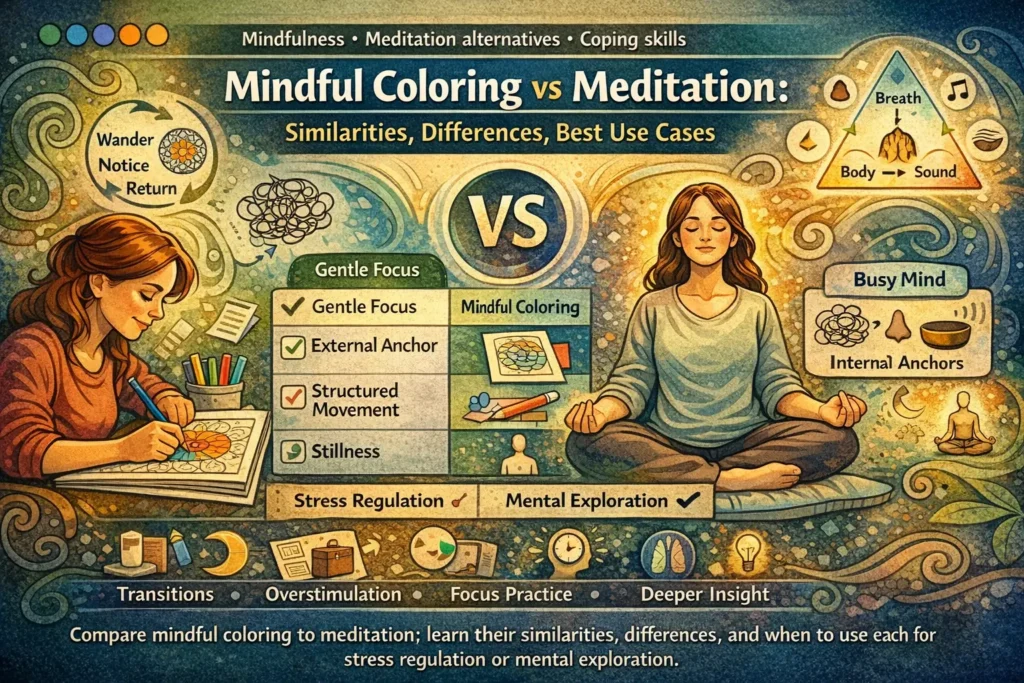
Mindful coloring and meditation train the same core skill: noticing where attention goes and returning on purpose. Both can support everyday stress regulation and focus—without promising a cure. The difference is practical: meditation usually relies on internal anchors (breath, body, sound), while coloring offers an external anchor (the page), which may feel easier for many beginners.
What mindful coloring is (and isn’t)
Mindful coloring is coloring with attention as the point. The page becomes a steady target: edges, shapes, and repeated motion. You’re practicing “wander → notice → return,” again and again.
Mindful coloring isn’t the same as distraction. It’s a structured way to narrow attention and slow pace, which many people find calming. It also isn’t a clinical treatment. Think of it as a portable self-regulation routine that may help your nervous system feel more workable.
- Not a talent contest: the outcome doesn’t define the practice.
- Not a “blank mind” goal: thoughts are expected; returning is the skill.
- Not always relaxing: if perfectionism spikes, simplify the page and reduce choices.
If you like repetition, start with mandala pages. If tiny details increase tension, choose bigger shapes (a typical “stress relief coloring” style). The best page is the one that helps you stay present without gripping your muscles.
Best use cases (quick, practical)
- Transitions: work → rest, commute → home, screen time → sleep.
- Before a demanding task: a difficult email, a meeting, or focused study.
- After overstimulation: noisy environments, busy days, emotional conversations.
- When you feel “too wired” to sit still: gentle movement can make attention feel more accessible.
Meditation vs coloring: how attention works in each
Beginner meditation often trains either focused attention (return to one anchor) or open monitoring (notice whatever arises). Mindful coloring is usually focused attention, with the page as an anchor and movement as built-in support.
| Feature | Meditation | Mindful coloring | Best when… |
|---|---|---|---|
| Main anchor | Breath, body sensations, sound, mantra | Visual boundary + hand movement (optionally breath) | You need simplicity (breath) or structure (page) |
| Body demand | Often stillness | Gentle movement | Stillness feels frustrating or restless |
| Feedback | Internal notice-and-return | Internal + visible page feedback | You benefit from concrete, immediate cues |
| Common trap | “I can’t stop thinking” | “I must do it perfectly” | You pick the method that softens your trap |
Who may prefer coloring (at least at first)
Different nervous systems prefer different entry points. Many adults choose coloring because it can lower the barrier to starting while still being a legitimate mindfulness practice.
- Restless mind or body: light movement may help attention settle without forcing stillness.
- Beginners who need structure: the page can reduce ambiguity and decision overload.
- People who ruminate with eyes closed: an external anchor may feel safer and more grounding.
- High stress days: coloring can be easier than “doing nothing,” especially when time-limited.
Meditation can be a better fit when you want a practice that needs no materials, travels anywhere, and deepens observation over time. You don’t have to choose one forever—many people do best with a small menu.
3 guided protocols: breath + color, body scan + color, gratitude color
Read one script once, then color quietly for 5–15 minutes. Each script is designed to take about 60–90 seconds.
Protocol 1: Breath + Color (60–90 seconds)
Protocol 2: Body Scan + Color (60–90 seconds)
Protocol 3: Gratitude Color (60–90 seconds)
If choices feel overwhelming, limit the palette to 2–4 colors. Fewer decisions often makes mindfulness easier.
What results to realistically expect
Realistic results are modest but meaningful: steadier attention, slightly lower stress reactivity, and better “pause” skills. If you want bigger change, think in weeks and months, not one session.
- In the moment: a slower pace, calmer breathing, fewer impulsive switches.
- Over weeks: improved ability to return after distraction and interrupt spirals earlier.
- Over months: a more flexible relationship with thoughts (less “I must believe this thought”).
A simple rule: choose the practice you will actually repeat. Consistency usually beats intensity. Many people rotate: a short meditation in the morning, mindful coloring in the evening, and a one-minute breathing pause during the day.
FAQ
Is mindful coloring a real mindfulness practice?
Yes—when you use it to notice distraction and return to an anchor (a line, a shape, or the sensation of your hand) rather than chasing perfection.
How long should I color mindfully?
Start with 5–10 minutes. Short, predictable sessions are often easier to repeat than long sessions.
What if my mind won’t stop thinking during meditation?
That’s normal. The skill is noticing “thinking” and returning. If it feels too hard today, try mindful coloring first, then do 60 seconds of breath focus.
Can I combine breathing + coloring?
Yes. Try a gentle rhythm: inhale—pause—exhale—color. If tracking breath feels stressful, keep breath natural and use the page as the main anchor.
Does mindful coloring help anxiety?
For many people it can support everyday stress regulation, but it isn’t a cure and doesn’t replace individualized mental health care.
Are mandalas better than simple pages?
Mandalas offer repetition and symmetry; simple pages can reduce decision fatigue. Choose what helps you stay present without tension.
When is meditation the better choice?
When you want a materials-free practice, or when you’re ready for deeper observation of thoughts and feelings over time.
Mindful Coloring vs Meditation: A Licensed Psychologist’s Perspective
Educational use only. This commentary does not create a psychologist–client relationship and does not replace individualized mental health care.
In clinical work, many adults don’t resist mindfulness itself—they resist the friction of starting. Early meditation can feel “too quiet,” especially when stress has trained the mind to scan for problems. Mindful coloring offers an external scaffold: a boundary to follow, repetitive motion, and visible feedback that you are staying with one activity. For many people, that structure may reduce decision fatigue and make it easier to enter a workable focus state.
It also helps to be honest about evidence: mindfulness meditation has a broader research base than coloring. Coloring is best viewed as a supportive self-regulation practice—useful for routine and transitions—rather than a clinical intervention. The most practical question is: “Which method helps me regulate today, and what skill do I want to build over time?”
A safe, effective way to use coloring
- Short and predictable: 7–12 minutes is often enough to downshift.
- Limit choices: 2–4 colors can be easier than a large palette.
- Process over outcome: success is starting, staying, and stopping—on purpose.
- Use for transitions: before sleep, after overstimulation, or before demanding work.
One clinical hint is to watch for avoidance. If you only color to escape emotions, add a tiny dose of observation: after coloring, sit for 30 seconds and notice three body sensations and one simple emotion label (“tense,” “sad,” “overwhelmed,” “okay”). This keeps coloring as regulation—not suppression. If perfectionism shows up, choose bigger shapes, reduce colors, set a timer, and practice stopping on purpose even if the page feels “unfinished.”
If either practice increases panic, dissociation, or intrusive memories, pause and return to grounding (name objects, feel your feet, sip water). Mindfulness should feel workable, not overwhelming. When distress is intense or persistent, professional support is the safest next step.