How Creative Activities Calm the Brain: What Research Says About Art and Anxiety
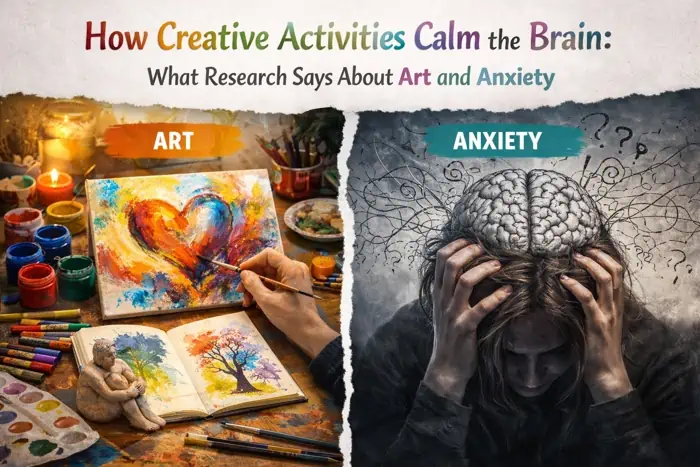
Many people reach for drawing, painting, or adult coloring books when stress rises. This is not just a trend. A growing body of research suggests that short, focused creative sessions can lower state anxiety, improve calm, and sometimes even shift biological stress markers. This expert analysis connects findings across three lines of evidence: structured coloring (including mandalas), brief art-making experiments, and clinical art therapy programs used in hospitals, oncology, and trauma-informed settings. The goal is practical clarity: what research supports, what it does not, and how to apply these tools safely at home.
Important: This article is educational and does not replace diagnosis or treatment. If anxiety is severe, persistent, or connected to safety concerns, seek support from a licensed clinician or local services.
Why art can calm: a brain and body explanation that matches the evidence
Anxiety is not only a feeling. It is a coordinated state involving attention, memory, physiology, and threat evaluation. When the stress response activates, the brain prioritizes scanning for risk, the body prepares for action, and thoughts often narrow into repetitive loops. Many people experience this as racing mind, tight chest, restless energy, or a sense of being “stuck” in worry.
Creative activity can interrupt this state through several overlapping mechanisms. First, it anchors attention to a concrete task. Instead of feeding the brain new reasons to worry, the activity supplies stable sensory information: line, color, shape, pressure. Second, the act of making involves small choices, which restores a sense of agency. In anxiety, perceived control often drops. Even simple decisions like selecting a color or shading an area can shift the internal story from helplessness to capability.
Third, creative tasks can resemble mindfulness in structure. Mindfulness is not emptying the mind; it is returning attention when it drifts. Coloring a pattern or drawing repeating shapes trains the same skill: notice wandering, return to the next segment. This is one reason structured designs often show stronger short-term calming effects than open-ended free drawing in experiments.
Working model: creative tasks support anxiety reduction by attention anchoring, rhythmic motor engagement, emotion labeling through images, and a brief shift toward recovery (reduced arousal and improved calm). Different activities emphasize different levers, which is why structure, environment, and intent matter.
Where the amygdala and stress response fit in
In simplified terms, the amygdala participates in detecting salience and threat. Under stress, the system becomes more reactive, and attention tends to latch onto uncertain signals. Creative tasks can reduce “threat bandwidth” by occupying attentional resources with a predictable goal. This does not erase the source of anxiety, but it can lower the intensity of the body’s alarm state long enough for problem-solving and self-regulation to return.
The most useful question is not: Will art cure anxiety. It is: Can a short creative routine reliably change my state right now, so I can think and act with more control.
Practical interpretation aligned with research on state anxiety and stress markersWhat research says about coloring, mandalas, and brief art-making sessions
The strongest single-session evidence tends to come from structured interventions that are long enough to absorb attention but short enough to be realistic. In multiple studies, adult coloring (especially mandalas and geometric designs) reduces induced anxiety and improves calm-related emotions after about 20 minutes. Separate research on general art-making sessions shows that stress biology can shift too. For example, studies measuring salivary cortisol report decreases after art-making sessions in many participants, suggesting a measurable change in stress arousal.
Pattern matters: structured coloring tends to outperform fully unstructured drawing in short experiments, likely because it provides “gentle focus” with low cognitive load. This is especially relevant when anxiety is high and the mind is already overloaded.
Snapshot table: representative research strands
| Intervention | Where it’s studied | Typical dose | Most common outcome | How to interpret it |
|---|---|---|---|---|
| Art-making session | Adults in structured art-making formats | ~45 minutes | Stress-marker shifts reported (e.g., cortisol decreases) | A single session can measurably lower stress arousal for many people |
| Mandala coloring | Experiments and randomized trials | ~20 minutes | Reduced induced anxiety; improved calm-related emotions | A realistic short reset for state anxiety |
| Mandalas vs free drawing | Student and community samples | ~20 minutes | Mandalas often reduce anxiety more than free drawing | Structure is useful when calming is the goal |
| Art therapy in oncology | Hospital programs and meta-analyses | Multi-session | Average anxiety reduction and quality-of-life gains | Therapy adds reflective support and clinical context |
| Coloring in acute care | High-stress settings (e.g., ED trials) | Short window up to ~2 hours | Lower self-reported anxiety vs control activities | Feasible, low-cost calming tool even in clinics |
Self-guided coloring is typically categorized as self-care. Art therapy is a clinical service delivered by trained professionals. Both can reduce anxiety, but they differ in depth, intent, and safety planning.
Infographic without tiny text: Before vs After a focused 20-minute coloring session
The previous SVG diagram is intentionally removed to avoid unreadable fonts. This infographic uses plain HTML and CSS so the text is always at least 15px. The bars are normalized, illustrative values that reflect typical directions reported in structured-coloring studies: reduced state anxiety, reduced bodily tension, and less mind wandering after a single focused session.
Before vs After: 20 minutes of focused coloring
Illustrative synthesis of research direction (normalized scale, not clinical metrics)
State anxiety
Body tension
Mind wandering
This visualization is a practical model only. Individual response varies, and clinical anxiety may require professional care.
Interactive evidence explorer with visible fallback
Not all creative activities work the same way. Structured coloring prioritizes attention anchoring. Free drawing may support expression, but can be less reliably calming in short, high-anxiety moments. Clinical art therapy combines making with reflective support, which matters in hospitals and oncology settings where uncertainty, pain, and loss of control can intensify anxiety. Use the selector to compare patterns. If scripts are blocked, the fallback remains visible so the block never appears empty.
Fallback summary: For rapid calming, choose structured tasks for 10 to 20 minutes (mandala or geometric pages). For deeper processing in medical or trauma contexts, seek guided support. If anxiety spikes during open-ended work, return to structure or pause and use grounding and breathing.
PTSD and trauma note: open-ended expression can sometimes surface distressing material. If you notice an anxiety spike, return to structured patterns, pause, and use grounding. For trauma-related symptoms, trauma-informed art therapy may be safer than solo deep-expression sessions.
How to try this at home safely (10 to 15 minutes)
If your goal is anxiety reduction, treat the creative session like a short regulation practice rather than a performance. The aim is not to produce a perfect page. It is to change your state by building a stable attentional groove. Research patterns suggest three practical rules: choose mild structure, reduce multitasking, and keep the dose small enough to feel easy to start.
Simple protocol: 10 to 15 minutes • phone away • quiet or low-noise space • slow exhale emphasis • one structured task (mandala, geometric page, repeated shapes, or shading a small area).
Step-by-step routine
- Pick structure: choose a pattern or mandala page if anxiety is high. Save open-ended drawing for calmer states.
- Set a boundary: start a timer for 10 to 15 minutes. Short sessions reduce pressure and perfectionism.
- Start with breath: take 3 slow exhales. If possible, let the exhale be slightly longer than the inhale.
- Single channel: no videos, no scrolling, no messaging. The calming effect depends on reducing competing input.
- Return attention: when the mind drifts, gently return to the next line or shape without self-criticism.
- Close with a check-in: notice body tension, heart rate, and mental noise. Track direction, not perfection.
If you tend to be self-critical, reduce complexity: use two or three colors only, or fill one small section rather than finishing a page. The research-based goal is consistency over intensity. Many people get more benefit from a short daily practice than from rare long sessions.
Where self-care ends and therapy begins
Creative self-care is especially good for state regulation: calming down, shifting mood, lowering the sense of overload, and building a habit of returning attention. Art therapy becomes relevant when the goal is guided change: processing grief, medical distress, trauma, or persistent anxiety, with structured support. In hospitals and oncology settings, art therapy is used because it is adaptable, low risk, and can work even when conversation is exhausting. The therapeutic value often comes from the combination of making, meaning-making, and a safe relationship with a trained provider.
Consider professional support if: anxiety disrupts sleep for weeks, panic attacks occur, avoidance expands, or distress is linked to trauma. In those cases, structured clinical care is not a failure of self-care; it is the safer path.
Why hospitals and oncology programs often use art
Medical environments amplify uncertainty and loss of control, two core drivers of anxiety. Art-based interventions offer a way to externalize feelings, restore agency, and create a calm “micro-environment” even inside a clinic. Reviews and meta-analyses in cancer care often report average reductions in anxiety and improvements in quality of life in structured programs, particularly when sessions include supportive reflection rather than simply providing materials.
Limits of the evidence: what research can and cannot claim
Research in this area is promising but not uniform. Many studies focus on short windows (minutes to hours) and rely on self-reported state anxiety. Some samples are small, and effects can vary with baseline anxiety, personality, perfectionism, and setting. Also, a calming response is not guaranteed. A better way to read the evidence is this: structured creative activity is a low-risk tool that often reduces state anxiety, and clinical art therapy can support broader outcomes in medical or psychological contexts when delivered by trained professionals.
- Dosage matters: habits usually outperform one-off sessions.
- Structure matters: patterns are often better for calming; open-ended work can be better for expression.
- Context matters: trauma, acute distress, or medical stress may benefit from professional support.
Most practical conclusion: treat creative activity as a reliable state tool. Use it to lower arousal, regain attention control, and create a calmer baseline for coping decisions.
Internal links (Mimi Panda reading path)
If you want to go deeper into self-care coloring (without calling it therapy), these two posts fit naturally here:
Sources
Primary and review sources that match the claims summarized above. Links are provided as references.
- Kaimal G, Ray K, Muniz J. Reduction of cortisol levels and participants responses following art making (PMC). PMC
- Koo M et al. Coloring activities for anxiety reduction and mood improvement (randomized trial, PMC). PMC
- Curry NA, Kasser T. Can coloring mandalas reduce anxiety (ERIC PDF). ERIC PDF
- Jiang XH et al. Effects of art therapy in cancer care: systematic review and meta-analysis (PubMed). PubMed
- Adult therapeutic coloring books for anxiety in emergency department patients (clinical trial record / abstract). Wiley

Creative Activities for Anxiety: A Licensed Psychologist’s Comment
Comment by Yevheniya Nedelevych Licensed Psychologist (Ukraine)
Educational use only. This commentary does not create a psychologist–client relationship. This is not a clinical assessment and does not replace individualized mental health care. This is not an endorsement of any product or service.
Why creative activities can reduce anxiety
Creative activities can reduce anxiety because they shift attention away from threat-focused thinking and onto a steady sensory task involving movement, shapes, colours and rhythm. This often lowers physiological arousal and supports “bottom-up” regulation — calming the body first makes anxious thoughts easier to manage. In practice, consistency and gentle structure produce the best results, rather than pushing for a perfect outcome.
How to use this safely at home
When professional help may be needed
You may need professional help if you experience any of the following for more than two weeks:
If you’re unsure, it’s okay to ask for guidance — early support can make coping skills easier to build.