Flow State in Coloring: Why Time Disappears (and When It Doesn’t)
You sit down “for five minutes,” pick a few colors, and suddenly an hour is gone. That time-warp feeling can be a real flow state—deep focus that feels surprisingly smooth. But it doesn’t happen every time. Sometimes coloring feels distracting, frustrating, or oddly flat. This guide explains what flow means in plain English, why structured coloring can support attention restoration, and how to set up a session that’s genuinely flow-ready—without turning a hobby into a performance test.
What “flow” is in plain English
Flow is the mental state where you’re fully absorbed in what you’re doing. Attention narrows to the task, self-monitoring quiets down, and the activity becomes rewarding on its own—so you keep going without forcing it.
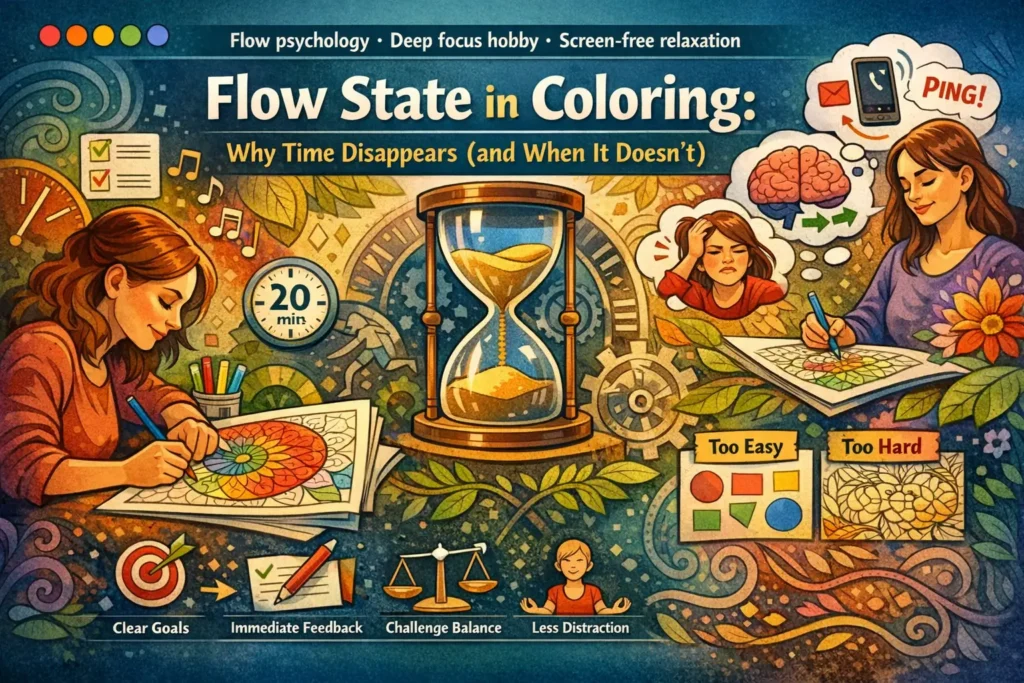
In everyday terms, flow shows up when three conditions line up: you have a clear next step, you receive immediate feedback, and the challenge fits your current capacity—“just right,” not too easy and not too hard. When those pieces click, the brain can settle into a smooth loop: see → choose → act → adjust.
- Balance: challenge matches skills (or stretches them slightly).
- Clarity: goals are obvious and the next move is visible.
- Feedback: you can see the result of your action right away.
- Control: you feel able to steer the task (even in small ways).
- Less self-consciousness: fewer “How do I look?” thoughts.
Flow isn’t the same as relaxation. It can feel calming, but it’s mainly about deep engagement. That’s why many people describe coloring as a screen-free reset: it reduces constant novelty and decision churn while keeping hands and eyes meaningfully busy.
Why structured tasks (like coloring) can trigger flow
Coloring is structured by design. The page provides boundaries, shapes direct attention, and feedback is immediate: the picture changes with each choice.
Structure matters because flow becomes harder when a task is fuzzy (“Where do I start?”) or when you must invent goals on the fly. Many creative activities require a lot of planning energy before you begin. With coloring, you can often skip heavy setup and go straight into doing— which is one reason it can feel like a reliable deep focus hobby.
The next step can be small and obvious: “finish this leaf,” “pick a background tone,” “shade one corner.”
Each stroke changes the image, helping attention stay anchored without constant re-planning.
Outlines guide where to look next. This supports focus without high-stakes performance demands.
One more reason coloring can “invite flow” is flexibility: you can dial it up or down based on energy, stress, sleep, and mood. On low-energy days, simpler shapes and fewer colors can feel restorative. On high-energy days, more detail or shading can provide the level of challenge that keeps the mind engaged.
Choosing the right difficulty (too easy vs too hard)
The fastest way to lose flow is to mismatch difficulty and your current capacity. Flow lives in the middle zone: not boredom, not panic.
If it’s too easy
When the page is overly simple for your skill level (or your mood), the mind often looks for stimulation elsewhere: phone checks, overthinking, switching tasks. The fix is usually not “try harder.” The fix is to increase meaningful challenge in a controlled way.
- Add one constraint: limit yourself to 4 colors and make them harmonize.
- Add one technique: layer, blend, or shade one area instead of flat filling.
- Choose denser designs: patterns with smaller repeating elements can keep attention engaged.
If it’s too hard
When the design is too detailed, the tools aren’t cooperating, or you’re already mentally tired, difficulty becomes friction. Flow can collapse into irritation (“I can’t make this look right”) or avoidance (“I’ll do it later”). Here the fix is to reduce decisions and reduce stakes.
- Shrink the session: do 10–15 minutes with a timer; stop while it still feels doable.
- Choose bigger shapes: larger areas create faster feedback and less fine-motor strain.
- Use a “good enough” rule: one layer is allowed; perfection is optional.
A useful nuance: flow is not “maximum difficulty.” Flow is manageable challenge. If you feel pressure rising, it’s not a failure—just information that today’s match between task and capacity needs an adjustment.
Environment setup (music, lighting, interruptions)
Flow is fragile at the beginning. Small environmental tweaks—especially in the first 3–5 minutes—often decide whether you drop into focus or bounce out.
Make starting effortless
Keep your materials “one reach away.” If you need to hunt for pencils, sharpen, clear space, and choose from 40 tools, you’ve already spent your attention budget before coloring begins. A simple kit (a few reliable pencils or markers, one sharpener, one eraser, a scrap sheet for testing colors) supports a smoother start and fewer decisions.
Choose sensory settings that match your goal
- Lighting: bright enough to avoid strain; a desk lamp can reduce fatigue.
- Sound: steady background audio can help many people; for some, lyrics may pull attention into language.
- Body position: page supported, shoulders relaxed; discomfort becomes a stealth distraction.
- Interruptions: set expectations (“15 minutes, then I’m free”) and use Do Not Disturb when possible.
Flow blockers (notifications, comparisons, rushed goals)
If flow is a smooth loop, blockers are bumps that kick you out of it. Most are not “motivation problems”—they’re setup problems.
Every check forces a context switch. Even a short glance can cost real time and effort to re-enter focus.
Huge palettes and many tools increase decision fatigue. Fewer options often create deeper focus.
Social feeds can turn a restorative hobby into a test. Flow drops when you color to “prove” something.
Flow is process-driven. “Finish fast” creates tension; tension makes attention scatter.
A practical reframe that protects flow
Swap outcome goals for process goals. Outcome: “I must finish this page today.” Process: “I will color for 20 minutes with steady attention.” This keeps the brain oriented toward the loop that produces flow, not the pressure that breaks it.
Another nuance: flow is state-dependent. If you’re sleep-deprived, stressed, hungry, or overstimulated, the same page can feel “too much.” In that case, the most effective move is often to simplify: fewer colors, bigger shapes, shorter session, quieter environment.
Quick checklist: “Flow-ready coloring session” (one page)
Use this as a compact, printable-style checklist. It reduces decisions at the moment you sit down and adds a built-in safety exit so flow doesn’t turn into overload or “stuck” hyperfocus.
| Step | What to do (simple, specific) |
|---|---|
| 1) Pick the page | Match today’s energy: simpler if tired, more detailed if restless. |
| 2) Limit the palette | Select 3–6 colors max. Put the rest away to reduce visual noise. |
| 3) Remove interruptions | Phone out of reach; notifications off; set expectations for your time block. |
| 4) Set a gentle timer | Pick a “doable” window (10–25 min). Stopping on purpose builds trust for next time. |
| 5) Start small | Begin with a corner or a repeated element for quick feedback. |
| 6) Add a stop cue | Halfway: sip water or relax shoulders for 10 seconds. Then continue. |
| 7) Use a re-entry cue | If you pause, circle the next area or place the next pencil on the page. |
| 8) End with one sentence | Write: “Next time I’ll start with ___.” This makes returning easier. |
Flow is a combination of environment, task design, and your current state. If it’s not happening, it doesn’t mean you’re doing coloring “wrong.” It usually means one dial needs adjusting—difficulty, choices, interruptions, or expectations. When you tune those dials, coloring can become a reliable, screen-free practice that supports attention restoration and a calmer, more present mind.
FAQ
What does “flow state” mean in coloring?
In coloring, a flow state is a period of deep, organized focus where the next step feels clear, feedback is immediate (you see the page change), and the challenge matches your current skill and energy. Many people notice reduced self-talk, steadier attention, and a sense that the activity is rewarding in itself.
Why does time feel like it disappears during a good coloring session?
Time distortion is common when attention becomes highly absorbed and distractions drop. In coloring, this often happens because the task is structured (outlines and sections), goals are obvious (finish one area), and feedback is visible right away. When those elements align, the brain spends less effort on deciding what to do next, and time may feel compressed.
Is time loss during coloring always a sign of flow?
Not always. Time can also feel like it disappears during hyperfocus (when it’s hard to stop or switch) or during avoidant zoning-out (escaping stress rather than engaging). A practical check is how you feel afterward: flow often leaves you clearer and more settled, while hyperfocus or overload can leave you tense, depleted, or irritated when you stop.
How do I choose the right difficulty so I don’t get bored or frustrated?
Aim for “manageable challenge.” If it feels too easy, add one constraint (limit colors), one technique (layering or shading), or pick a denser pattern. If it feels too hard, reduce decisions: use fewer colors, choose larger shapes, and shorten the session. The right level should keep you engaged without pushing you into tension.
What are the most common flow blockers during coloring?
The most common blockers are notifications and quick phone checks, too many choices (large palettes and many tools), comparison or performance pressure, and rushed goals like “finish fast.” These factors increase switching and self-monitoring, which makes it harder for attention to stay in a smooth loop.
What environment setup helps flow happen more reliably?
Keep materials within reach, pick 3–6 colors before starting, and choose comfortable lighting that reduces strain. Many people focus better with steady background sound, but lyrics can be distracting for some. The key is reducing interruptions and reducing decisions in the first few minutes so you can enter the task smoothly.
How can I keep flow from turning into exhausting hyperfocus?
Use a gentle timer (10–25 minutes), add a mid-session stop cue (sip water, relax shoulders, quick eye break), and end with a clear re-entry note for next time. Flow should feel organizing and easier to stop; if you notice rising tension or difficulty stopping, simplify the page, reduce detail, and shorten the session.
Primary sources and references
-
Csikszentmihalyi, M. — “Flow: The Psychology of Optimal Experience” (1990).
Foundational work defining flow, its conditions (challenge–skill balance, clear goals, feedback), and core experience markers.
HarperCollins publisher page -
American Psychological Association — “Flow” (APA Dictionary of Psychology).
Authoritative, concise professional definition of flow as an optimal experience state.
APA Dictionary entry -
Mark, G., Gudith, D., & Klocke, U. — “The Cost of Interrupted Work: More Speed and Stress” (CHI, 2008).
Empirical evidence that interruptions change work patterns and are associated with measurable stress effects.
Full-text PDF (UCI) -
Altmann, E. M., & Trafton, J. G. — “Memory for goals: An activation-based model” (Cognitive Science, 2002).
Explains why “re-entry” after interruptions is cognitively costly and how goals are reactivated after a break.
Full-text PDF -
Kaplan, S. — “The restorative benefits of nature: Toward an integrative framework” (Journal of Environmental Psychology, 1995).
Classic primary paper behind Attention Restoration Theory (ART), useful for framing how directed attention recovers.
Journal page (ScienceDirect) -
Curry, N. A., & Kasser, T. — “Can Coloring Mandalas Reduce Anxiety?” (Art Therapy, 2005).
Experimental study comparing structured coloring tasks and anxiety reduction after an anxiety induction.
Full-text PDF (ERIC) -
van der Vennet, R., & Serice, S. — “Can Coloring Mandalas Reduce Anxiety? A Replication Study” (Art Therapy, 2012).
Replication study supporting the anxiety-reduction effect of structured coloring compared to unstructured activity.
Journal page (Taylor & Francis)
In clinical work, the “time disappeared” experience can reflect different attention states. In flow, attention becomes organized around a clear, manageable task: the brain knows what to do next, receives fast feedback, and stays engaged without heavy self-judgment. Coloring can support this because the page provides structure and visual boundaries, while each choice creates an immediate, visible result. For many people, that combination reduces mental “noise” and supports a calmer, more coherent focus—especially when the challenge matches the person’s current energy.
However, time loss is not automatically flow. Some people experience hyperfocus, where engagement becomes sticky and switching is difficult; others may “zone out” to escape stress, which can feel numb rather than restorative. A practical check is how you feel afterward: flow often leaves you clearer, steadier, and able to stop with less friction, while hyperfocus or overload may leave you tense, irritable, or depleted.
- Keep sessions short and predictable: 10–25 minutes with a timer is often more regulating than open-ended sessions.
- Limit choices deliberately: fewer colors and one tool type can reduce cognitive load and decision fatigue.
- Emphasize process, not outcome: focus on starting, staying, and stopping rather than finishing perfectly.
- Add a “stop cue” if you hyperfocus: a brief stretch, sip of water, or eye break can prevent drift into exhaustion.
- Match difficulty to capacity: if you notice tension or perfectionism, simplify the page or reduce detail.
Coloring should not be framed as a treatment or cure. Its value is as a structured, low-stakes activity that can help some people enter a workable focus state and practice regulation—especially during transitions, after overstimulation, or when re-engaging with a task feels hard.