Executive Function Skills Hidden in Coloring: Planning, Patience, and Self-Control
Coloring is often presented as a quiet activity, but its educational value can be more specific than that. A well-chosen page asks a child to hold a plan, follow a sequence, slow down impulsive moves, and recover after a small mistake without abandoning the task. That does not make coloring a miracle tool, and it does not replace broader teaching, play, or support. What it can do, when adults keep the activity structured, short, and finishable, is provide a low-pressure way to rehearse the small mental moves behind school readiness, frustration tolerance, and day-to-day self-management.
Why this matters more than people think
Executive functions are the management skills behind behavior: planning, working memory, inhibitory control, flexible thinking, and the ability to stay goal-directed when the task is not instantly easy. Children use these skills constantly. They use them when they follow a two-step instruction, wait their turn, shift from one classroom demand to another, remember what comes next, or continue after a disappointment instead of melting down. These are not “extra” academic abilities. They are part of the control system underneath learning, routines, and emotional regulation.
Coloring can support these skills because it naturally creates a visible task with a beginning, middle, and end. A child has to decide where to start, remember what they were doing, resist switching tools every few seconds, and accept that the page will be completed one area at a time rather than all at once. Still, a more expert way to describe the benefit is this: the strongest evidence supports structured activities and adult-guided self-regulation practice broadly; coloring fits that model best when it is used as a contained routine, not when it is treated as random free time.
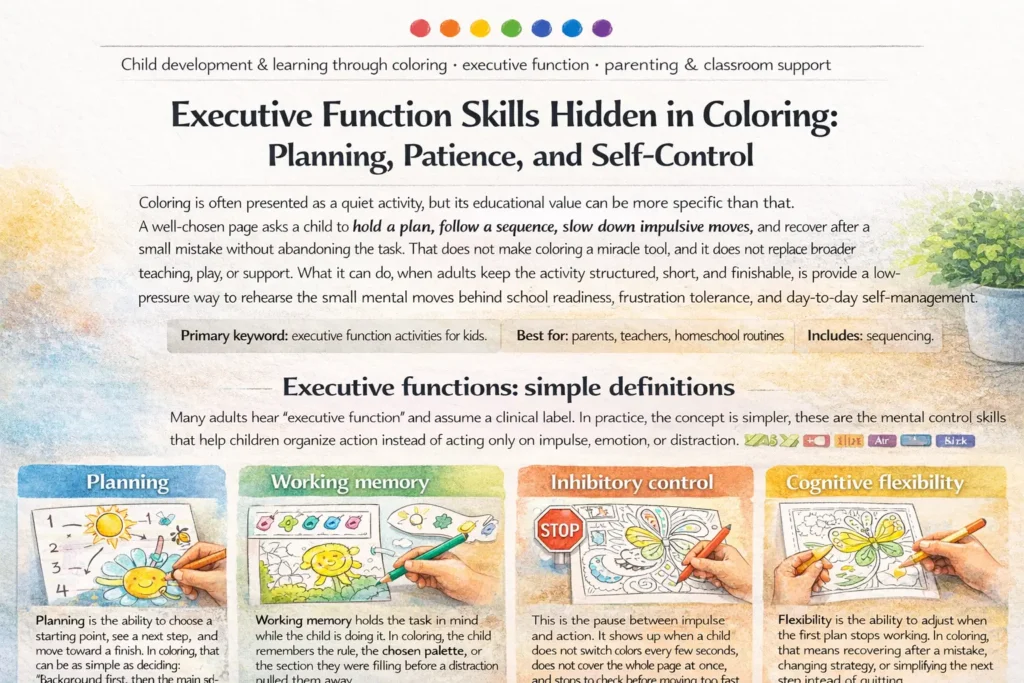
Executive functions: simple definitions
Many adults hear “executive function” and assume a clinical label. In practice, the concept is simpler: these are the mental control skills that help children organize action instead of acting only on impulse, emotion, or distraction.
Planning is the ability to choose a starting point, see a next step, and move toward a finish. In coloring, that can be as simple as deciding: “Background first, then the main object, then the small details.”
Working memory holds the task in mind while the child is doing it. In coloring, the child remembers the rule, the chosen palette, or the section they were filling before a distraction pulled them away.
This is the pause between impulse and action. It shows up when a child does not switch colors every few seconds, does not cover the whole page at once, and stops to check before moving too fast through a small area.
Flexibility is the ability to adjust when the first plan stops working. In coloring, that means recovering after a mistake, changing strategy, or simplifying the next step instead of quitting.
Coloring as sequencing: background → main subject → details
One reason coloring works well for executive-function practice is that it can be broken into a visible sequence. A page becomes less overwhelming when the child is not asked to “do the whole thing,” but to complete one layer at a time. Sequencing reduces cognitive clutter. Instead of facing dozens of tiny decisions at once, the child follows a path.
| Phase | Child task | Executive function practice | Adult support |
|---|---|---|---|
| 1. Start area | Choose one part to begin | Planning + initiation | Offer two start options, not unlimited choice |
| 2. Main sections | Stay with larger areas first | Sustained attention + working memory | Use short reminders: “Keep going with this part” |
| 3. Small details | Slow down for smaller choices | Inhibitory control + precision | Reduce talking and model slower pace |
| 4. Stop point | Decide what counts as “done for today” | Closure + self-monitoring | Name the finish clearly: “That is one completed task” |
This is also why coloring often works better than very open-ended “just be creative” tasks for children who struggle with planning or frustration. The page already supplies part of the structure. The adult’s job is not to add more noise, but to make the structure easier to see.
What the evidence reasonably supports — and what it does not
Short, structured, repeatable coloring routines can rehearse planning, staying with a sequence, tolerating minor mistakes, and completing one contained task. In that sense, coloring can be a practical executive-function-support activity.
It is too strong to suggest that ordinary coloring alone has a large, universal, proven effect on executive function for all children. The activity is best framed as one useful routine within a broader ecosystem of play, movement, language, and adult scaffolding.
This distinction matters because expert writing should not overpromise. Adults do not need exaggerated claims in order to use the activity well. The real value is already strong enough: coloring gives many children a low-stakes place to practice starting, sequencing, persisting, and stopping — especially when adults reduce options, keep the session brief, and support recovery rather than perfection.
Strategy building: palette planning, time boxing, and visible finish lines
Executive-function practice becomes stronger when the child uses a simple strategy rather than relying on mood alone. The goal is not perfection. The goal is to help the child notice that a task becomes more manageable when there is a plan.
Ask the child to pick three colors before starting. That tiny pause strengthens planning and working memory. It also reduces constant switching, which lowers distraction and keeps the task coherent.
A short timer teaches attention with a boundary. Instead of asking for “finish the whole page,” ask for “stay with one part for eight minutes.” Time boxing protects motivation and makes success easier to repeat tomorrow.
When a child colors “wrong,” the meaningful skill is not avoiding all mistakes. It is learning to continue. “We can work around it” supports flexibility far better than correcting every imperfection.
A done tray, folder, or display spot gives the task a real endpoint. Completion matters because executive function is strengthened when children experience a full work cycle, not only repeated starting.
Three levels of difficulty progression
Not every child needs the same demand. A child builds planning and attention best when page difficulty matches current capacity. That is why it helps to choose pages by difficulty rather than only by theme.
| Level | Best page type | Main executive demand | Move up when… |
|---|---|---|---|
| Level 1: Start-and-finish easy | Large shapes, few zones, bold outlines, familiar objects | Task initiation, staying with one section, fast success | The child can start with little resistance and finish most sessions calmly |
| Level 2: Guided challenge | Medium detail, repeated patterns, a few smaller choices | Working memory, slower pacing, attention control | The child can follow a simple plan such as “big parts first, details later” |
| Level 3: Strategy pages | Dense detail, scene-based pages, goal-based printables, classroom themes | Planning ahead, frustration tolerance, flexible problem solving | The child can recover after mistakes and continue without melting down |
Classroom routines + home routines
Coloring becomes much more useful when it belongs to a repeatable slot in the day. In school, it can work as an entry task, calm transition, or independent station. At home, it often works best after school, before homework, or during the late-afternoon friction hour when attention is low and patience is thinner. Keeping a small library of school-themed printable sets makes this easier because the adult is not improvising every day.
- Put out one page choice plus one backup.
- Start with a visible instruction: “Pick a place to begin.”
- Keep teacher talk low once the task starts.
- End with a concrete stop: folder, tray, or clipped stack.
- Use the same table spot when possible.
- Limit tools before the child sits down.
- Let the child own one choice: page, starting corner, or color trio.
- Finish with one calm reflection, not a performance review.
| Minute | Child job | Adult role | What it practices |
|---|---|---|---|
| 0–2 | Choose page and starting area | Reduce options and name the goal | Planning + initiation |
| 2–8 | Stay with the first section | Stay near, do not over-direct | Sustained attention + inhibitory control |
| 8–12 | Slow down for one detail or finishing area | Coach repair, not perfection | Flexibility + frustration tolerance |
| 12–15 | Stop and file the page | Name closure clearly | Task completion + self-monitoring |
Tracking progress without pressure
Progress in executive function rarely looks dramatic from one day to the next. It usually appears in smaller shifts: quicker starts, fewer abandoned pages, less explosive reaction to minor mistakes, better ability to return after distraction, and more realistic stopping. That is why tracking should focus on behavior patterns, not artistic quality.
Start resistance, finish rate, need for reminders, recovery after mistakes, ability to stay with one section, and whether the child can accept a stop without feeling tricked or defeated.
Staying perfectly inside the lines, “pretty” color choices, comparing siblings, or treating speed as the main sign of success. Fast is not the same as organized. Neat is not the same as regulated.
Frequently asked questions
Is coloring enough on its own to build executive function?
No. Coloring is best understood as one practice context. It can rehearse planning, attention, and self-control, but children also build these skills through play, movement, routines, games, language, and daily responsibility.
What age does this work best for?
It can work across ages, but page complexity has to match the child. Younger children usually need larger shapes and shorter sessions. Older children can tolerate more detail, more sequencing, and more independent work.
Should the child finish every page?
No. The goal is not forced completion at any cost. The goal is practicing a clear work cycle. Sometimes “finished for today” is the right win, especially for a child who overloads quickly.
Is staying inside the lines the main goal?
No. Precision may matter sometimes, but executive-function practice is broader: starting, sequencing, persisting, adjusting after mistakes, and stopping in an organized way.
What if a child rushes through the page?
Rushing often means the task is too easy, too long, or not clearly structured. Try a shorter timer, fewer colors, or one clear instruction such as “Finish this one section slowly before switching.”
Can teachers use the same page with mixed-ability groups?
Yes. One child may complete only the main shapes while another adds detail and background. The same page can hold different executive demands when expectations are adjusted clearly.
How often should this routine happen?
Short and regular usually works better than long and occasional. Three to five brief sessions a week often teaches more than one long session that ends in fatigue or conflict.
Structured Expert Commentary: Where Coloring Helps, Where Adults Overstate It, and What Good Support Really Looks Like
1) The main practical value is not “art skill,” but controlled behavior inside a safe task
Adults often underestimate how much invisible regulation is involved in a simple coloring page. From the outside, the child seems to be doing something quiet. From the inside, the child is making repeated decisions: where to begin, how long to stay with one section, whether to switch tools, how to continue after a mistake, and when the page feels complete enough to stop. Those are not trivial moves. They are closely related to the daily self-management demands children face in school, family routines, and peer situations. That is why structured coloring can be useful. It provides a contained setting where organization, attention, and inhibition are easier to observe and support.
2) The strongest benefit appears when adults use coloring as a routine, not as a test
The moment adults turn coloring into evaluation, much of the regulatory value can disappear. If the child feels watched, corrected, compared, or pushed toward a “beautiful result,” the task may stop exercising executive control and start provoking performance anxiety. In practical terms, the more effective stance is structured but calm: limited options, clear beginning, visible finish, low verbal clutter, and acceptance that small errors do not end the task. Children build steadiness better under predictable guidance than under constant commentary.
3) What adults most often get wrong is overpromising what the activity can do
Coloring is not a substitute for broader developmental support. It does not replace movement, conversation, play, sleep, classroom scaffolding, or responsive caregiving. It should also not be marketed as a universal intervention that “develops executive function” in a guaranteed way. A more honest and clinically responsible description is that coloring can rehearse executive-function-related behaviors when the task is well chosen and the adult environment is supportive. This may sound less dramatic, but it is actually more useful. It helps adults use the activity well instead of expecting it to solve problems on its own.
4) What realistic progress looks like
Meaningful improvement usually does not show up first in the finished picture. It shows up in behavior around the task: less resistance at the start, more ability to stay with one area, fewer abrupt abandonments, calmer reaction to imperfection, and a more organized stop. These changes matter because they often generalize beyond the page. A child who can gradually tolerate one contained sequence may also begin to tolerate other structured demands more successfully. That is the right level of expectation. The goal is not perfect coloring. The goal is stronger regulation inside one manageable experience that can be repeated without strain.
“A useful coloring routine does not need to look impressive. It needs to be structured enough for the child to start, stay, repair, and finish with more control than before.”