Digital Coloring vs Traditional Coloring: Focus, Distraction, and Motivation
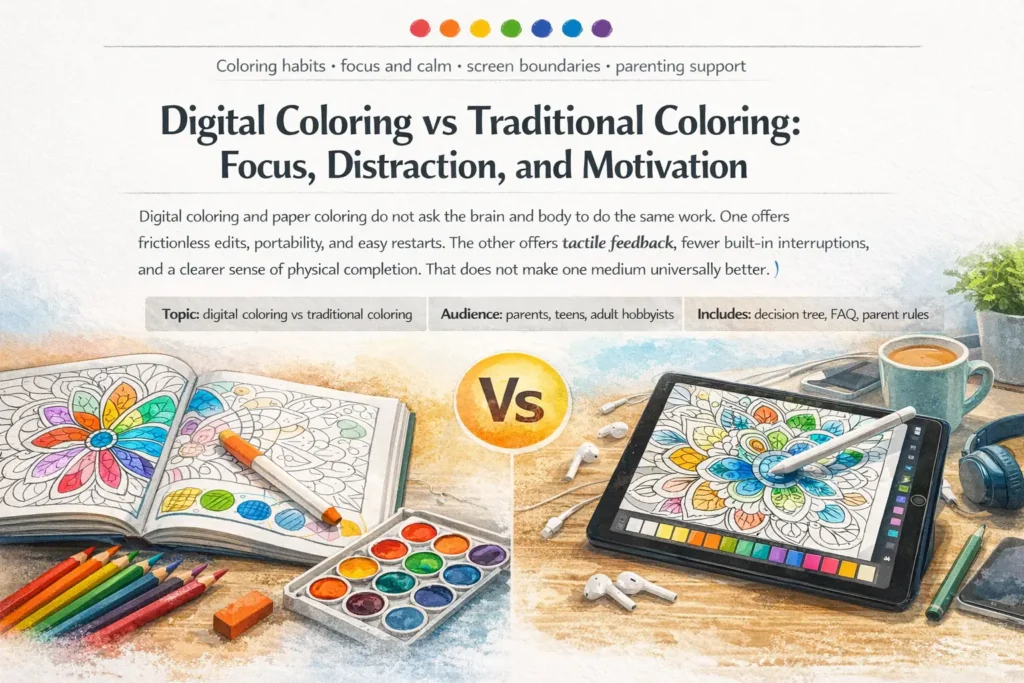
Digital coloring and paper coloring do not ask the brain and body to do the same work. One offers frictionless edits, portability, and easy restarts. The other offers tactile feedback, fewer built-in interruptions, and a clearer sense of physical completion. That does not make one medium universally better. It means each medium changes how attention, frustration, pacing, and motivation are organized. For parents, teens, and adult hobbyists, the most useful question is not “Which format is superior?” but “What does this coloring session need to do today: calm, occupy, encourage, travel well, or support deeper focus?”
A more expert starting point: compare the jobs, not just the formats
Many discussions about screen time become ideological too quickly. Paper is treated as automatically wholesome, and digital tools are treated as automatically distracting. That is too simplistic. A better, more evidence-informed frame is functional: what job is the medium doing in this moment?
If the goal is sensory grounding after an overstimulating day, paper often has an advantage because it narrows the field and adds friction through the hand. If the goal is helping a perfectionistic child begin without fear of “ruining” the page, digital tools may have an advantage because undo lowers the emotional cost of trying. If the goal is a calm bedtime activity, the device itself may become the real variable. If the goal is travel convenience, digital may protect the habit when paper supplies are unrealistic.
That shift in framing matters. Research on device interruptions, touchscreen learning, and digital art use does not support a blanket statement that “screens ruin focus.” What it supports is a more specific point: the ecology around the task matters. The medium is one factor. The setup, age of the user, notification load, perfectionism level, and purpose of the session matter too.
Cognitive differences: tactile feedback vs frictionless undo
Traditional coloring gives the hands more to work with. Paper has drag. Crayons and pencils create resistance. The eyes, wrist, and fingers constantly recalibrate to pressure, line edges, and the texture of the page. That richer sensorimotor feedback does not automatically make paper “smarter,” but it often makes the activity feel more anchored in the body. There is a stronger sense of where the mark begins, how the hand is moving, and when the page is gradually filling.
Digital coloring changes that experience. A tablet surface is smoother. Zoom, fill, erase, and undo reduce the physical and emotional cost of errors. For many users, that is a real benefit. A hesitant child, a teen who dislikes visible mistakes, or an adult hobbyist coloring on the train may stay engaged longer because the threshold to start is lower.
But lower friction changes commitment. When every choice is easy to reverse, the brain may treat each decision as less final. Paper quietly says, choose and continue. Digital often says, try, revise, compare, undo, try again. Neither message is inherently wrong. They simply train different coloring habits.
Slower pacing, stronger physical completion signals, richer tactile feedback, and fewer built-in opportunities to endlessly correct.
Lower fear of mistakes, faster experimentation, portability, and easier re-entry for users who resist messy materials or fear imperfection.
| Question | Paper often fits when… | Digital often fits when… | Main watch-out |
|---|---|---|---|
| How does it feel in the hand? | The user benefits from tactile drag, grip, pressure control, and slower pacing. | The user needs lower physical mess, easy edits, and fast restarts. | Smoothness can become drift if the session loses structure. |
| What happens after mistakes? | You want to build tolerance for imperfection and continue without resetting. | Mistake fear blocks starting or causes early quitting. | Undo can shift from helper to compulsive correction loop. |
| How protected is attention? | The goal is emotional downshift, after-school decompression, or bedtime calm. | The device is contained: one app, no alerts, no multitasking. | A multitasking device can pull attention away even when the app is simple. |
| How realistic is the setup? | There is time, table space, and a calm environment. | Travel, waiting rooms, commuting, or crowded family logistics make portability decisive. | Convenience should not turn a creative task into general device time. |
Age matters more than people admit
Expert comparison becomes stronger when age is separated clearly. Preschoolers, school-age children, teens, and adults do not use coloring for the same reasons, and they do not carry the same distraction risks.
Paper often has the edge because tactile learning, hand control, and body-based pacing matter more. Touchscreens can still work, but benefit depends heavily on task design and adult scaffolding.
Both media can work. The bigger issue is whether digital coloring stays one contained task or becomes an opening into tabs, videos, or repeated switching.
Digital often wins on realism and motivation. It may support creative consistency, especially for perfectionistic or travel-heavy routines. Boundaries matter more than ideology.
The choice is usually goal-dependent: paper for embodied calm and visual rest, digital for convenience, experimentation, or keeping the habit alive during busy life periods.
Motivation: why undo can help or hurt
Undo is one of the strongest motivational advantages of digital coloring. It lowers the threat level. A child who freezes after one imperfect mark may finally continue because the mistake is reversible. A teen who likes clean results may stay engaged longer because the app feels less punishing. An adult hobbyist may experiment more freely with color combinations because there is less fear of “wasting” the page.
But the same feature can quietly undermine progress. Some users fall into micro-correction loops: color, zoom, undo, compare, re-do, undo again. The activity begins to serve control rather than rest, expression, or completion. The person looks active but is not moving forward through the page. In practical terms, that is a motivation problem disguised as precision.
When the main barrier is mistake fear, low confidence, reluctance to begin, or frustration with messy materials, undo protects momentum.
When the session becomes endless correction, repeated zooming, visible tension around “perfect enough,” or repeated color swapping without finishing anything.
The expert question is not “Does the user like undo?” It is “Does undo help this person move through the activity, or trap them inside one corner of it?” Healthy motivation shows up as forward motion, decision-making, and eventual completion.
Distraction risk: notifications, multitasking, and task-switching
The strongest argument against digital coloring is not that all screens are bad for attention. It is that digital coloring usually lives on a device designed for interruption. Notifications, banners, tabs, music controls, quick messages, recommended content, and habitual app switching all compete with the coloring task. Research on interruptions and smartphone notifications consistently points in the same direction: even brief alerts can pull cognitive resources away from the active task and increase switching costs.
Paper does not eliminate every distraction, but it is usually a lower-interruption environment by default. A page cannot ping. A marker box does not surface a message preview. This is why traditional coloring often works better when the goal is regulation first: after-school landing, bedtime wind-down, recovery after social overload, or quiet focus when the nervous system is already carrying too much input.
Digital coloring can still be calming, but only when the device ecology is cleaned up first. A tablet on airplane mode with one offline coloring app open is functionally different from a tablet carrying messages, autoplay, split-screen content, and browser tabs waiting in the background.
Hybrid approach: paper for calm, digital for travel
In real life, the best answer is often not either-or. It is role separation. Paper can be the home-base medium for slower, fuller, sensory-rich sessions. Digital can be the portability medium for commuting, waiting rooms, travel days, sibling logistics, or short creative windows that would otherwise disappear.
This hybrid model does two important things. First, it reduces ideology. Second, it protects fit. The child who comes home dysregulated may need paper because it contains the field. The teen who wants ten minutes of low-pressure creative time on the bus may need digital because realism matters more than theory. The adult who wants calm before sleep may do better with paper, while the same adult may prefer digital during airport delays or lunch breaks.
- If the goal is calm after overload → start with paper, a short session, and limited tools.
- If the goal is portability or waiting-room use → digital can fit better, but use one offline app only.
- If the person quits after mistakes → digital may help them begin and stay with the page.
- If the person gets trapped in endless corrections → switch to paper or use a simple “no undo for 3 minutes” rule.
- If tactile input seems regulating → choose crayons, pencils, or markers on paper.
- If messy materials create resistance → digital may lower the barrier and preserve the habit.
- If bedtime is the use case → paper usually wins because the device itself stays out of the routine.
- If travel is frequent → make digital the travel tool and paper the home tool.
Parent rules: how to keep “screen coloring” actually calming
Parents do not need to ban digital coloring to keep it healthy. They need to keep it from turning into general device use. Younger children usually do best when “screen coloring” behaves like one contained ritual, not like open tablet access with a coloring app somewhere inside it.
- One purpose, one app. Coloring time is not coloring plus chat plus videos plus browsing.
- Turn off notifications first. If the device can interrupt, eventually it will.
- Use a visible beginning and end. Ten to twenty minutes works better than vague, endless access.
- Keep the body with the task. Stylus, finger, and page movement are fine; app-hopping is not.
- No autoplay, no split-screen, no open tabs. Protect attention on purpose.
- End with one short reflection. “Did this feel calming, energizing, frustrating, or just okay today?”
The same principle works for adults: decide whether the session is for calm, experimentation, or simple occupancy, then shape the device to match that goal. A calming session should not compete with inboxes, social feeds, or message badges.
How to judge whether the format is working
Expert evaluation is not about asking which medium sounded better in theory. It is about observing the pattern that follows. After paper coloring, does the child seem more settled, more organized, or more able to transition? After digital coloring, does the person actually complete something, or do they leave the session more irritable and scattered?
The person starts more easily, stays with the page, makes decisions, finishes or saves a stopping point, and looks more organized afterward.
The session becomes avoidance, perfection loops, rapid switching, emotional escalation, or general device drift without real creative engagement.
That is why the better routine is rarely loyalty to one format. It is the skill of choosing intentionally, then watching honestly.
FAQ
Is digital coloring worse for attention than paper coloring?
Not automatically. The bigger issue is interruption load. Paper usually protects attention better because it is single-purpose. Digital can still work well when one app is open, notifications are off, and the session has a clear boundary.
Can iPad coloring apps still be calming?
Yes. They can be calming when they are used as one contained creative task rather than general device time. Environment matters: airplane mode, no tabs, no autoplay, no message banners.
Does undo hurt frustration tolerance?
It can help or hurt. It helps when fear of mistakes blocks participation. It hurts when it becomes endless correction and keeps the person from moving through the page or tolerating ordinary imperfection.
Is paper always better for tactile learning?
Paper usually provides richer tactile and motor feedback, which can be useful for younger children and for users who benefit from sensory anchoring. But that does not mean digital has no learning value. Context, age, and task design still matter.
What works best as a screen time alternative?
Traditional coloring is usually the cleaner screen time alternative because it removes device-level interruptions altogether. Digital coloring is more useful when portability is the deciding factor and the session can still stay contained.
How long should screen coloring last for kids?
There is no single magic number for every child. A more useful rule is short, bounded sessions with a clear beginning and end, then observe the after-effect: calmer, more focused, neutral, or more dysregulated.
Is a hybrid routine better than choosing one format only?
Often yes. Many families do best with paper for calm at home and digital for travel or practical constraints. The hybrid model gives each format a job instead of forcing one tool to solve every situation.
Expert Conclusion: Match the Medium to the Nervous System Task
1. The real comparison is not analog vs digital — it is containment vs drift
Families often compare paper and digital coloring as if they are moral categories. In practice, the clinically more useful distinction is whether the activity creates containment or encourages drift. Paper usually contains more effectively because the environment is narrower: one page, one tool set, one visible task. Digital tools can also contain, but only when the device is stripped down enough that the coloring session is not competing with the rest of the platform. That is why digital coloring can feel calm in one house and scattered in another even when the same app is used.
2. Paper often helps when the body needs more sensory anchoring
When a child is overstimulated, dysregulated after school, or struggling to land in the body, paper often offers a better regulatory surface. The page pushes back. The pencil leaves physical evidence. The hand has to tolerate the mark that was made and continue. For many children, that sensorimotor resistance is quietly organizing. It slows the pace and increases the sense that the task has an edge, a middle, and an end. That does not make paper universally superior, but it explains why paper often works better for recovery, bedtime wind-down, and calmer forms of focus.
3. Digital helps most when shame, perfectionism, or logistics are the true barrier
Digital coloring deserves a fairer evaluation than it often receives. For some users, especially perfectionistic children, teens, and adults, the biggest threat is not overstimulation but visible error. Undo reduces shame. Restart reduces avoidance. Portability protects consistency during busy or crowded life phases. In those cases, digital is not the weaker medium. It is the more accessible one. The problem begins only when convenience turns into compulsive correction, comparison, or open-ended tablet use that no longer resembles a creative task.
4. The healthiest family rule is simple: give each medium a job
A strong household structure is often this: paper for calm-at-home sessions, digital for travel or mistake-sensitive use. That division reduces confusion and arguments. The child learns that different tools are for different nervous-system needs. The parent stops asking, “Which format should we believe in?” and starts asking, “What will help most right now?” That shift is both more practical and more developmentally sound.
5. Bottom line
If a coloring session ends with more steadiness, more genuine engagement, and a clearer sense of completion, the medium is probably serving the person well. If it ends with more switching, more tension, or more unfinished control loops, the format or setup needs to change. The goal is not loyalty to paper or loyalty to digital. The goal is a medium that supports attention, emotion, and forward motion instead of competing with them.