Coloring Through Big Life Changes: Moving, Divorce, a New School, or a New Sibling
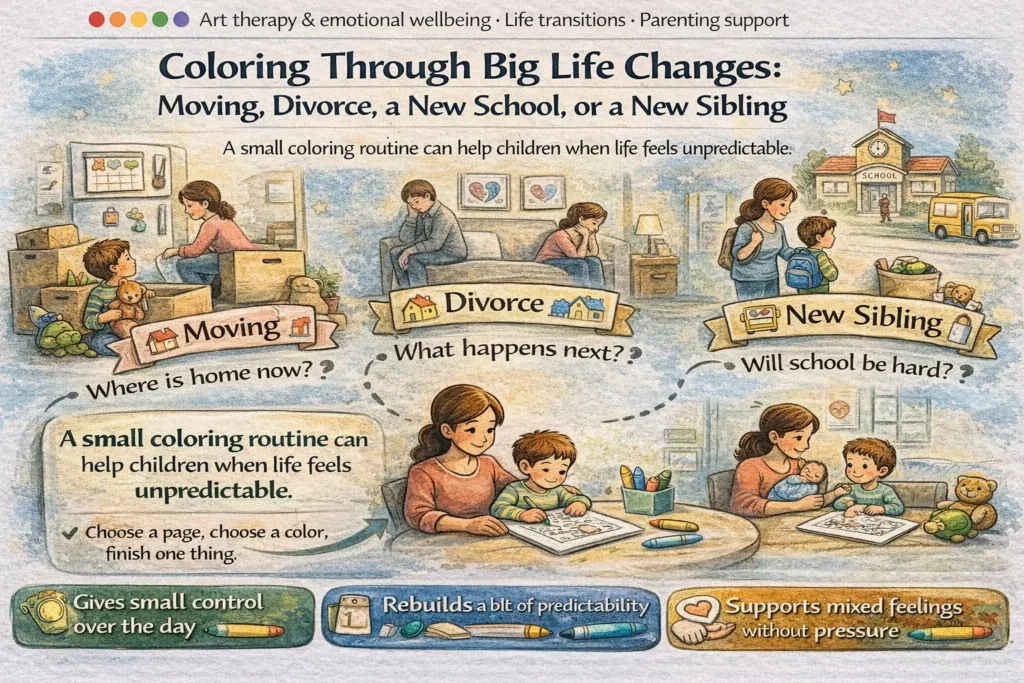
Big life changes rarely feel “small” to a child. A move can make the world feel unfamiliar. A divorce can split routines, spaces, and expectations. A new school can make every morning feel uncertain. A new baby can suddenly change attention, noise, and family rhythm. That is where coloring can help— not as a cure, and not as a way to avoid the real conversation, but as a quiet place to land when life feels unpredictable. In a gentle art-based coping frame, a printable page can become a small zone of control: choose a page, choose a color, finish one shape, complete one thing.
Why transitions hit children so strongly
Adults often focus on the event itself: the house, the school, the custody schedule, the baby, the paperwork. Children focus on what the event does to their sense of safety, predictability, and belonging. They notice who is where, who is available, what happens next, whether bedtime feels the same, and whether they still know the rules of their world.
Research and pediatric guidance tend to point in the same direction: children usually cope better with big changes when adults restore routine, use simple honest language, and create small predictable moments inside the day. That is why life transitions often show up in ways that look “smaller” than the feeling underneath. A child may suddenly resist bedtime, become clingier, ask the same question again and again, reject clothes that were fine last week, or melt down over tiny changes.
These reactions are not always signs that something is going badly. Often, they are signs that the child is trying to rebuild orientation in a world that feels less certain. In that context, coloring helps not because it “fixes” the transition, but because it offers one manageable task inside a bigger situation the child did not choose.
- More questions, repeated questions, or “What happens next?” loops.
- Shorter patience for frustration around dressing, meals, homework, or bedtime.
- Clinginess or separation difficulty even if the child was previously more independent.
- Regression such as sleep disruption, baby-talk, accidents, or wanting more help than usual.
- Quiet withdrawal—less play, less interest, less spontaneous talking, or “I don’t care” behavior.
It gives the child a contained activity with a beginning, middle, and end. That structure helps when daily life feels open-ended, emotionally noisy, or hard to predict.
It should not replace honest explanations, stable routines, or needed support. The page is a bridge to regulation and conversation— not a substitute for care, and not a test of how the child “should” feel.
How different life changes show up—and how printables can fit
Not every transition feels the same. The child who is moving homes may need familiarity. The child adjusting to divorce may need language for “two homes, two feelings.” The child starting a new school may need predictability before performance. The child with a new sibling may need protected one-on-one moments more than “be a great big brother/sister” pressure.
Helpful pages: houses, rooms, neighborhood scenes, “my safe places,” familiar animals, calming repeated patterns. The goal is often continuity: “Some things are changing, and some things still belong to you.”
Helpful pages: feelings faces, weather pages, heart/house pages, “two homes” visual routines, open-ended scenes with lots of blank space. The goal is not to force optimism or disclosure. It is to make mixed feelings easier to hold without pressure.
Helpful pages: backpacks, classroom objects, buses, friendship themes, simple mazes, “first-day” visual sequences. The goal is rehearsal without performance pressure: letting the child get used to the idea of the day before they have to function inside it.
Helpful pages: family scenes, helper pages, baby-animal pages, choice-based coloring, “special time with me” pages. The goal is protection from replacement fears: “There is still room for you here.”
The “15-minute transition reset”
When life feels unstable, long creative projects can be too much. A short, repeatable coloring routine works better. The purpose is not artistic output. The purpose is to create one dependable pocket of the day.
- Minute 0–1: Clear one small surface. Put out only what you want to manage.
- Minute 1–2: Offer two pages, not ten. Too much choice increases stress.
- Minute 2–10: Color quietly nearby. You do not need to entertain. Calm presence matters.
- Minute 10–12: Ask one question: “What part feels easiest today?”
- Minute 12–15: Put the page in a “DONE” tray or folder. Visible closure is regulating.
| Minute | Child task | Adult role | What it builds |
|---|---|---|---|
| 0–2 | Choose one page and one tool set | Reduce options, keep your tone calm | Predictability + control |
| 2–10 | Color or trace quietly | Stay near, do not overtalk | Containment + attention |
| 10–12 | Point to one favorite part | Reflect, do not correct | Emotion language without pressure |
| 12–15 | File the page away | Name the closure: “That’s one finished thing” | Completion + steadiness |
Language parents can borrow when change feels hard
Children often do not need a perfect explanation first. They need words that make uncertainty feel survivable. Good transition language is honest, brief, warm, and concrete. It does not promise that everything feels good. It tells the child what is true, what stays the same, and what they can do right now.
“A lot looks different right now. That can feel strange. We are still your people, and we are still building our routine.”
“Some family things are changing. Your feelings can be big, mixed, or different from day to day. You do not have to choose one feeling.”
“The first part may feel new and awkward. New does not mean wrong. We can practice one piece at a time.”
“The baby needs a lot, and you still matter a lot. We will keep having special time that belongs just to you.”
Age tweaks that keep coloring helpful
- Ages 3–5: Choose bold, simple pages with large shapes, familiar objects, and low-detail scenes. Keep sessions short. Let the child point, name, and circle if full coloring feels like too much.
- Ages 6–8: Add pages with light structure: mazes, “choose the feeling color,” classroom scenes, room-design pages, friendship themes, simple prompts like “Color the calmest part first.”
For older kids: “Which part feels most like today?”
How to choose pages by need, not just by theme
Parents often search by topic—school, family, baby, moving. That is useful, but it is only half of the fit. The better question is: What does the child need from the page today?
| What the child needs | Pages that often fit | Adult prompt | Avoid |
|---|---|---|---|
| More control | Simple pages, repeated shapes, clear outlines | “You get to choose where to start.” | Overly complex scenes or too many tool choices |
| More emotional room | Open-ended pages, weather pages, hearts, homes, mixed-feeling pages | “More than one feeling can fit here.” | Forcing a “happy” interpretation |
| Rehearsal for change | School objects, routines, backpacks, buses, family scene pages | “Let’s color one part of tomorrow.” | Long explanations before the child is regulated |
| Connection | Co-coloring pages, family animals, shared picture pages | “Let’s do one small part together.” | Using the page only as babysitting when the child needs closeness |
When coloring is helpful—and when a child may need more support
Transition reactions are common. So are temporary regressions. A child may need more holding, more routine, more repetition, and more reassurance for a while. That alone is not a sign of pathology. What matters is whether the child is gradually reconnecting to daily life or staying stuck in distress.
More clinginess, rougher bedtimes, repeated questions, some regression, or extra reassurance needs that slowly soften as routine returns.
Distress that stays intense, spreads across daily life, or keeps reducing the child’s ability to sleep, separate, play, learn, or participate.
- Prolonged withdrawal—the child stays flat, disengaged, or uninterested for weeks rather than days.
- Regression that does not ease—sleep, toileting, language, or separation problems stay intense or worsen.
- Persistent school refusal, panic, or strong avoidance around daily functioning.
- Ongoing aggression, hopeless talk, or intense self-blame after the transition.
A good rule: coloring can support coping, but it should not have to carry the whole emotional load. If the child is not recovering over time, or daily function is clearly shrinking, it is wise to check in with a pediatrician or child mental health professional.
FAQ
1) Why does coloring help with moving, divorce, or other family changes?
Because transitions often reduce a child’s sense of predictability. Coloring gives back a small structure: one page, one choice, one task, one ending. That can make the nervous system feel less overwhelmed.
2) Should I ask my child to talk while they color?
Lightly, not constantly. Many children regulate better first and talk second. A short question such as “Which part feels easiest today?” usually works better than a big emotional interview.
3) What if my child only uses dark colors during a hard transition?
Do not over-interpret one color choice. Dark colors can mean comfort, seriousness, preference, contrast, or strong feeling. Stay curious instead of decoding: “Tell me about this part.”
4) Are regressions normal during big life changes?
Temporary regressions can happen during stressful changes, especially around sleep, toileting, clinginess, and separation. What matters is whether the child gradually returns to steadier functioning.
5) Which pages work best for a new school transition?
Choose clear, low-pressure pages: school objects, classroom scenes, buses, backpacks, simple mazes, and routine pages. The child usually needs familiarity first, not performance pressure.
6) How long should the routine be?
Ten to fifteen minutes is enough for most children. During transition periods, a short repeatable ritual usually works better than a long creative session.
7) When should parents seek additional help?
Seek more support if withdrawal, regression, sleep disruption, anxiety, aggression, or school refusal stay strong over time, clearly interfere with daily functioning, or seem to intensify rather than soften.
Sources (primary references)
Useful for the article’s emphasis on restoring routines and rebuilding a sense of home after change.
Supports the calm-first, connect-first approach used here: regulation before long explanation.
Relevant because it explicitly notes that major family changes such as divorce, a move, or a new sibling can trigger regression.
Useful for the new-school part of the article and for recognizing when transition anxiety begins to interfere with attendance.
Peer-reviewed research overview on how family transitions can affect child development, especially socioemotional adjustment.
Supports the point that a new sibling is a real developmental transition, not a “small” change from a child’s point of view.
Review of art-therapy interventions for children and adolescents with psychosocial difficulties.
Helpful for the “small zone of control” framing: art-making can support autonomy when much feels uncertain.
Expert Assessment: When Change Feels Like Loss of Control
What uncertainty often feels like from the child’s side
Adults usually organize transition around logistics. Children organize it around felt certainty. They ask, often without words: Who will be there? What happens next? Is my place still safe? Do the rules still work? When those answers feel unstable, the child may try to recover control through small behaviors—repetition, rigidity, clinginess, refusal, or shutting down.
This is why coloring can be clinically useful during transitions. It offers a small, manageable sequence inside a bigger situation the child did not choose. The page does not solve the divorce, unpack the boxes, guarantee friendship at the new school, or remove jealousy about the baby. What it can do is reduce helplessness for a few minutes and create a safer path back into relationship and language.
Language that helps more than reassurance alone
When uncertainty is high, children often respond better to naming + containing than to fast reassurance. Instead of “It’s fine,” try language like: “A lot feels different right now,” “You don’t know exactly how this will go yet,” “We can do one small part first,” or “Two feelings can be true at the same time.” This reduces shame and gives the child a way to experience distress without feeling overwhelmed by it.
When parents should watch more carefully
Temporary clinginess, sleep changes, or regression can be normal during big transitions. What deserves closer attention is prolonged withdrawal or persistent regression: the child stays flat, avoids play, stops engaging, loses previously stable skills for an extended period, or becomes increasingly trapped in fear and avoidance.
A useful distinction is this: temporary adjustment stress still leaves room for recovery, small moments of play, and gradual return to baseline. Persistent impairment keeps narrowing daily function over time. In those cases, supportive routines are still helpful, but they may no longer be enough on their own.
- Watch duration: a rough week is different from a pattern that keeps deepening.
- Watch functioning: sleep, eating, toileting, play, school participation, and ability to separate matter more than one difficult afternoon.
- Watch recovery: the key question is not “Does my child ever get upset?” but “Can my child return to baseline with support?”