Color, Emotions, and Meaning: How Professionals Use Color Choices in Art Therapy
Color can feel loud, quiet, comforting, or simply “the marker that was closest.” In professional art therapy, color is treated as one piece of information—never a secret code. The most reliable insights come from combining color with context, culture, the full image, and the client’s own words. That’s why responsible guides focus on meaning-making instead of “color fortune-telling.”
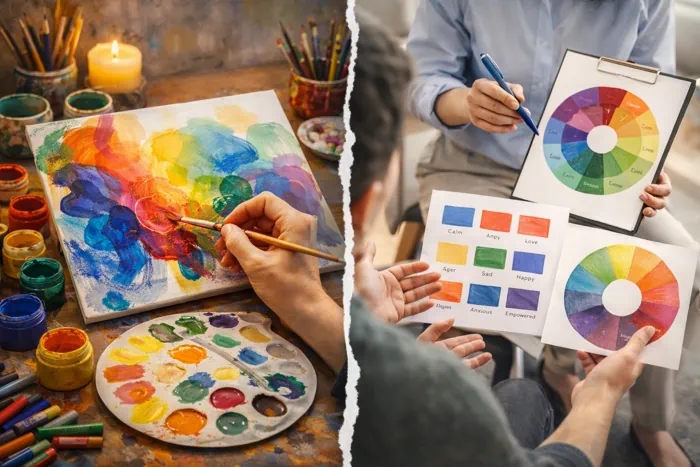
A professional starting point: color is a clue, not a verdict
People love simple answers: “Red means anger.” “Blue means sadness.” “Black means depression.” These statements are tempting because they’re quick, shareable, and feel certain. But in real clinical practice, certainty is exactly what therapists avoid—because a single visual cue rarely carries one stable meaning across people, situations, and cultures.
Art therapists treat artwork as part of a living conversation. Color sits beside other information: subject matter, composition, symbols, pacing, repetition, pressure, line quality, omissions, and—most importantly—how the person explains what they made. The guiding question is not “What does this color mean for everyone?” but: “What does this color do here, in this picture, for this person, today?”
This is why professionals avoid one-size-fits-all “dictionaries.” A bright yellow background might be joy for one person, overstimulation for another, and simply “the light in the room” for a third. A deep blue can be sadness, safety, spirituality, or spaciousness. And a strong red may communicate anger, vitality, urgency, love, or a preference for bold contrast. Meaning emerges from the whole—not one swatch.
If you’re a parent, teacher, or caregiver, the most supportive move is to stay curious. Instead of interpreting, ask: “Tell me about the colors you chose.” When people feel safe explaining their choices, color becomes a bridge to language—not a test they can fail.
What research says about color–emotion associations (and what it does not say)
Research in psychology and perception suggests that many people share broad color–emotion associations. Brighter or lighter colors are often linked with more pleasant feelings, and darker colors with less pleasant feelings. Reds are frequently associated with higher arousal, while blues and greens are often associated with calmer states. These patterns appear across different kinds of studies—surveys, matching tasks, and experiments examining how color cues can influence attention and motivation.
But there’s a crucial limitation: most studies describe group-level tendencies, not individual truth. In plain terms, research can tell us what “many people often report,” but it cannot reliably tell you what a specific child (or adult) meant by a color in a specific drawing on a specific day. Professionals use research as a map of possibilities, then return to the person’s story to find the route that actually fits.
People often share broad correspondences (bright/light ↔ pleasant; dark ↔ unpleasant; red ↔ higher arousal; blue/green ↔ calmer). These are useful as conversation starters and hypotheses.
A universal decoder where one color always equals one emotion. Meaning shifts with context, culture, memory, and the role a color plays in the image.
They translate “meaning claims” into questions, check for alternatives (materials, habits, culture), and prioritize the creator’s explanation.
Warm vs cool colors: a practical lens, not a label
“Warm vs cool” is a grounded way to talk about color without forcing a single emotion. Warm hues (reds, oranges, many yellows) often feel more active or intense. Cool hues (blues, many greens, violets) often feel calmer, more distant, or more spacious. In therapy and self-reflection, this lens is useful because it describes energy and arousal rather than pretending to name a diagnosis.
How professionals explore color meaning without “fortune-telling”
In art therapy sessions, color is explored through gentle inquiry—not pronouncements. Below are common professional habits that keep color work ethical, accurate, and helpful for emotion regulation.
- Start with the person’s words. “What made you choose this color?” beats guessing every time.
- Look at relationships, not single tones. A small patch of black in a bright scene differs from a page flooded with it.
- Notice intensity variables. Hue matters, but so do saturation, pressure, layering, repetition, and speed.
- Check material reality. Limited crayons, dried markers, classroom rules, or “favorite pen” habits can drive choices.
- Hold symbolism lightly. White can be mourning in some cultures and purity in others; red can be luck, love, warning, or power.
- Connect color to coping. “Which colors help you settle?” “Which colors help you speak up?” turns art into a skill.
This approach is especially important with children. Kids often choose color for fun, contrast, imitation (cartoons/games), or availability. Over-interpretation (“You used black, so you must be sad”) can make art feel unsafe. A better stance is permission and curiosity: “There are many reasons to choose black—tell me what it is for you.” The result is a calmer, more honest conversation.
Common associations and safer interpretations
The table below summarizes common emotional associations people often report. The professional move is the last column: turning an assumption into a client-centered prompt that respects context.
| Color family | Often associated with | Warm/cool | What to check before assuming | Client-centered prompt |
|---|---|---|---|---|
| Red | Energy, urgency, passion, anger, vitality | Warm | Focal vs background? Bright vs dark? Warning, love, power, contrast? Cultural meanings? | “What does red do here—protect, shout, celebrate, warn?” |
| Orange | Play, warmth, stimulation, sociability | Warm | Playful vs overwhelming? Paired with dark tones (tension) or light tones (optimism)? | “Does orange feel friendly, loud, brave, or ‘too much’?” |
| Yellow | Joy, hope, alertness, attention (sometimes anxiety) | Warm | Bright yellow can energize or stress; pale yellow can soothe. Check intensity + context. | “Is yellow sunshine—or ‘too much light’ today?” |
| Green | Balance, safety, growth, nature (sometimes envy) | Cool | Shade matters (lime vs forest). Nature meaning? “Fresh start”? Personal memories? | “Does green feel like rest, renewal, or something else?” |
| Blue | Calm, depth, trust, distance (sometimes sadness) | Cool | Soothing vs numbing? Check layering, pressure, and how the person describes it. | “Does blue bring steadiness, space, or heaviness?” |
| Purple/Violet | Imagination, introspection, dignity, mystery | Cool | Creativity vs solitude? Aesthetic preference? Cultural symbolism? | “If purple is a place, what kind of place is it for you?” |
| Black | Grief, fear, protection, power, boundaries | Neutral | Outline, shadow, armor, style, emphasis, or mourning? What function does it serve? | “Is black hiding, protecting, defining, or decorating?” |
| White / Blank space | Openness, relief, purity, avoidance, “not ready” | Neutral | Intentional breathing room? Fear of “ruining it”? Time limits? Minimalist style? | “Does empty space feel like breathing room—or unfinished?” |
| Gray / Brown | Stability, neutrality, fatigue, earthiness | Neutral | Grounding realism vs dulling/flattening. How does it change energy in the picture? | “Do these tones feel steady and safe—or drained and heavy?” |
Practical takeaway: treat associations as hypotheses—then confirm meaning with the person who made the art.
Myths to avoid (so color stays helpful)
Color can support insight, but myths can turn it into pressure. Here are common misunderstandings professionals actively avoid:
- Myth: “One color = one emotion.” Reality: The same color can express different feelings depending on context, culture, and personal history.
- Myth: “Dark colors are always bad.” Reality: Dark tones can be comfort, protection, style, strength, boundaries, and contrast.
- Myth: “Bright colors mean everything is fine.” Reality: Bright palettes can also be masking, overstimulation, or simply a preferred style.
- Myth: “You can diagnose from a drawing.” Reality: Art can raise questions, but diagnosis requires careful assessment and broader information.
- Myth: “Therapists read hidden messages.” Reality: Ethical practice centers the client’s meaning and avoids “mind-reading.”
A safer, more empowering frame is: “Color is a language we can learn.” Like any language, it has patterns, but each person also has a dialect. The goal is not to translate your art into a label, but to use it to notice what you feel, what you need, and what helps you regulate.
Interactive Color & Emotion Explorer
Pick an emotion focus and see a common “pattern” of color associations. Use it as a starting point: Does this match you, or not? Either answer is useful—and helps you build a personal “color vocabulary.”
These are broad tendencies. Use them as prompts for reflection, not proof about a person.
| Emotion focus | Often higher-association colors | Often lower-association colors |
|---|---|---|
| Calm / Relief | Blue, Green | Black, Red |
| Joy / Play | Yellow, Orange | Black, Gray |
| Anger / High energy | Red, Orange | Blue |
Notice how your own experience compares. If you feel calm in red, that’s not “wrong”—it’s personal meaning. The skill is to name what’s true for you and to recognize when a color choice is about mood, memory, culture, style, or the story you’re telling in the image.
Emotion regulation through color: practical strategies that work in real life
In therapy, color can become a practical tool for emotion regulation. The aim is not to prove that a color “causes” a feeling universally. The aim is to build a usable skill: choosing color intentionally to shift arousal, create boundaries, and express what words cannot yet hold. Below are strategies that are simple enough for home use while still matching how many professionals think.
1) Match first, then shift (a gentle staircase)
Many people try to jump straight from distress to positivity. A more reliable approach is a staircase: match first (validation), then shift one step. If you’re in a hot state (anger, agitation, urgency), you might begin with a warm color to acknowledge it, then introduce a cooler tone at the edges to soften intensity. If you’re in a cool state (numbness, low energy), you might begin with calmer blues or grays, then add a small warm accent that signals a next step toward movement.
2) Build a container (boundaries before details)
When emotions feel “too big,” the page can become a container. Many people naturally outline or frame a space and then fill it. This is not inherently “negative”—it can be organizing and protective. A darker outline can function like a fence, not a prison. Inside the boundary, you can choose a support color—something that feels steady, safe, or clarifying.
3) Limit the palette (less choice, more clarity)
Too many options can increase overwhelm. Limiting yourself to 2–4 colors often reduces mental load and can sharpen insight: “These are the main feelings today.” You can even label them as roles rather than emotions: one for “energy,” one for “protection,” one for “hope,” one for “rest.” This keeps meaning flexible and self-directed.
Downloadable feelings palette worksheet (kids & adults): how to use it
This worksheet is designed for self-reflection and emotion vocabulary. It does not diagnose or score anything. It helps a person (child or adult) notice what colors feel supportive, intense, calming, or “in-between,” and to practice one small experiment.
- Step 1 — Pick a moment. Use it after coloring, after a stressful moment, or before bedtime to “unpack” the day.
- Step 2 — Choose 2–5 colors. For each color, write one line: “When I use this color, I feel…” (short and honest is best).
- Step 3 — Try one experiment. Change one thing: warmer/cooler, lighter/darker, or brighter/more muted—and notice what changes.
- Step 4 — Name the function. Ask: “Did this color help me calm, focus, speak up, feel safe, or express something?”
- When I use red, I feel…
- Red helps me…
- Red means… (to me)
- Orange shows…
- Orange protects…
- Orange changes the story by…
- Yellow feels like…
- Yellow gives me…
- If yellow had a voice, it would say…
- Green is my… (safe place / growth / something else)
- Green helps me slow down / restart by…
- I avoid green when…
- Blue holds…
- Blue makes space for…
- Blue reminds me of…
- Purple feels like…
- Purple is where I…
- Purple means…
- Black draws boundaries around…
- Black protects…
- Black is style / shadow / something else: …
- Gray feels steady / tired / neutral when…
- Gray helps me…
- Gray is “in-between” for…
- Blank space gives me…
- Blank space means…
- I want more / less space because…
If you’re using this with a child, consider one gentle add-on: after they write one line for a color, ask them to choose an action word—“protects,” “opens,” “hides,” “warms,” “separates,” “connects,” “calms.” Verbs keep the conversation in experience rather than labels, and they make it easier to talk about needs (rest, safety, connection, clarity) without turning art into a diagnosis.
Internal links (Mimi Panda reading path)
If you want to go deeper into self-care coloring (without calling it therapy), these two posts fit naturally here:

Where Self-Care Ends and Therapy Begins: A Licensed Psychologist’s Comment
Comment by Yevheniya Nedelevych Licensed Psychologist (Ukraine)
Educational use only. This commentary does not create a psychologist–client relationship. This is not a clinical assessment and does not replace individualized mental health care. This is not an endorsement of any product or service.
How color choices can support emotional wellbeing
Color choices in drawings can support emotional literacy because they help children externalize feelings and talk about them safely. In professional practice, color is never “proof” of a specific emotion—its meaning depends on the child’s context, culture, and the story they attach to the image. Used gently, color-focused prompts can improve self-awareness and self-regulation without turning art into a test.
How to use this safely at home
When professional help may be needed