Choice Overload and Coloring: Why Too Many Pages or Colors Can Backfire
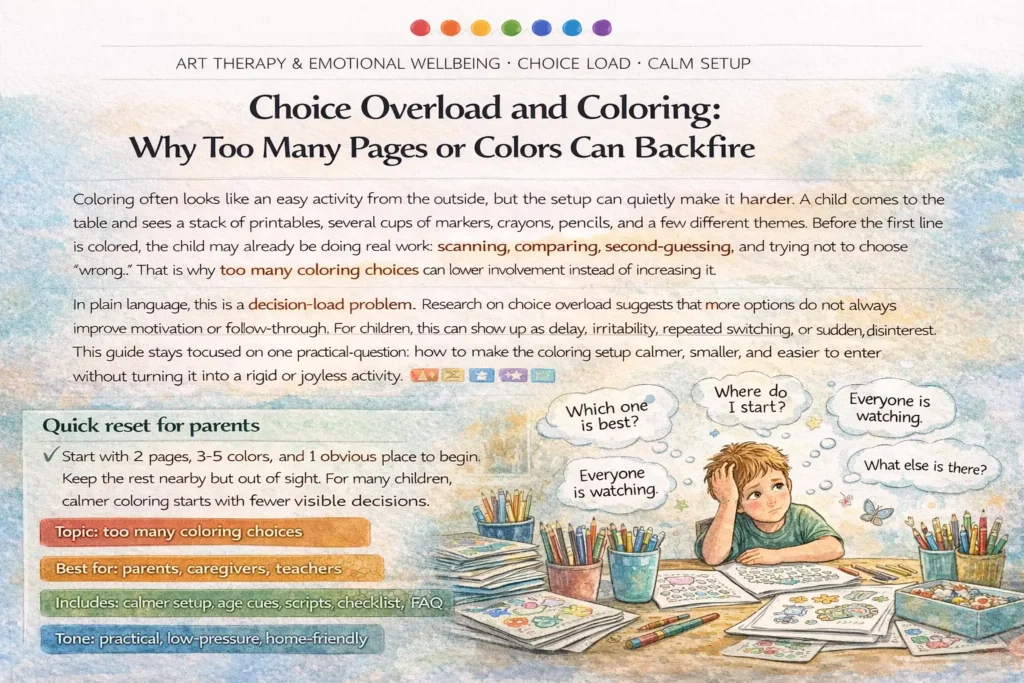
Coloring often looks like an easy activity from the outside, but the setup can quietly make it harder. A child comes to the table and sees a stack of printables, several cups of markers, crayons, pencils, and a few different themes. Before the first line is colored, the child may already be doing real work: scanning, comparing, second-guessing, and trying not to choose “wrong.” That is why too many coloring choices can lower involvement instead of increasing it.
In plain language, this is a decision-load problem. Research on choice overload suggests that more options do not always improve motivation or follow-through. For children, this can show up as delay, irritability, repeated switching, or sudden disinterest. This guide stays focused on one practical question: how to make the coloring setup calmer, smaller, and easier to enter without turning it into a rigid or joyless activity.
Why “more options” can make coloring feel worse
Adults often mean well when they create a big, generous-looking coloring station. More pages can look more exciting. More tools can look more creative. More themes can look more personalized. The problem is that an adult sees abundance, while a child may experience choice pressure. Instead of thinking, “Great, I have everything,” the child may start wondering, “Which one am I supposed to pick? What if another page is better? What if I use the wrong colors first?”
This matters because coloring is usually chosen as a settling activity, not as a decision marathon. If the entry point is crowded, the calming part gets delayed. Research on choice overload has repeatedly shown that once the menu becomes too large or too hard to compare, motivation can drop rather than rise. In a coloring context, that does not usually look dramatic. It looks like touching five pages and choosing none, asking for help and rejecting every suggestion, or seeming interested until the moment it is time to begin.
Another issue is performance pressure. A large display of tools can accidentally make the activity feel more evaluative. A child may start to think that a “good” coloring session should involve the best page, the smartest color choice, or the prettiest result. The supplies themselves are not the problem. The problem is when the setup turns a low-demand activity into a visible sequence of decisions that feel important.
A smaller starting menu helps for a simple reason: it reduces comparison. When there is less to scan, there is less to second-guess. When the first choice feels manageable, the child is more likely to cross the starting line. After that, extra colors or extra pages can be added without the same level of friction.
What overload usually looks like at the table
Choice overload rarely sounds like “I have too many options.” More often, it appears in behavior.
One page already visible, a short row of familiar colors, simple outlines, and permission to start anywhere. The activity feels finite, readable, and low-risk.
A thick pile of printables, a crowded marker basket, several themes offered at once, comments like “Pick your favorite,” or pressure to decide quickly. Once starting becomes a test of choosing well, stress rises.
Simplifying the table is not shutting down creativity. It is not treating the child as incapable. It is a way to lower unnecessary decision load so the child can begin first and personalize later.
A useful parent rule is this: when a child is not starting, reduce visible choice before increasing encouragement. A crowded decision field is usually not fixed by saying “Come on, just pick one.”
How this can look at different ages
The same overloaded table can affect children differently depending on age. The pattern is similar, but the bottleneck is not always the same.
| Age range | What often gets hard | How it may look | What usually helps |
|---|---|---|---|
| 3–5 years | Too much scanning and too many concrete choices at once. | Wandering, touching everything, asking the adult to choose, quick frustration. | One visible page, very small color set, short and concrete choices. |
| 6–8 years | Comparing options and worrying about picking the “best” one. | Switching pages, rejecting suggestions, saying “I don’t know.” | Two or three clearly different pages and easy-to-reverse choices. |
| 9–12 years | Self-consciousness, perfectionism, or wanting the result to look right. | Long delay before starting, overplanning, frequent color changes, quitting early. | Limited starter palette, low-pressure language, permission to begin imperfectly. |
This age lens matters because it keeps adults from using the same explanation for every child. One child is overwhelmed by too much visual input. Another is stuck in comparison. Another is worried about the quality of the outcome. The setup should respond to the real bottleneck, not just to the behavior on the surface.
Why the first choice matters so much
The first minute often decides whether the session gets going at all. If the opening feels simple, children usually settle faster and handle later choices better. If the opening feels crowded, they may spend their energy on deciding rather than coloring. This is why one of the most useful setup questions is not “How many options do I own?” but “How many options does the child have to process right now?”
Starting is easier when the child does not have to compare too much at once. Comparison sounds small, but it adds mental load. It invites second-guessing and keeps attention on what has not been chosen yet. A page that feels inviting in a stack of two can feel impossible in a stack of twenty because the child is no longer asking, “Do I like this?” but “Is this the best possible choice?”
That is why a staged approach works so well. Offer the page first. Then let the child begin. After that, add one more option only if the child wants it. A calm coloring setup does not remove choice. It sequences choice.
How to structure a calmer coloring setup
Parents do not need to hide every supply or make the table feel strict. The goal is simply to reduce the number of active decisions at the start. The easiest way to do that is to prepare a narrow starting menu and keep the rest as backup, not as part of the main visual field.
| Choice point | What to do | What to avoid | Why it matters |
|---|---|---|---|
| Pages | Offer 2–3 pages with clearly different styles or themes. | A full binder, loose stack, or “pick anything from here.” | A short menu lowers scanning and reduces fear of missing a better option. |
| Colors | Start with 3–5 familiar colors already placed near the page. | Large mixed cups of markers, pens, crayons, and pencils all at once. | A small visible palette lowers comparison and speeds the first mark. |
| Themes | Choose one theme for the session, or two at most. | Animals, holidays, fantasy, vehicles, and characters all shown together. | Too many themes turn preference into pressure. |
| Timing | Make the session feel bounded and manageable. | Open-ended setups with no clear sense of beginning or end. | A finite task is easier to start than a vague one. |
| Help language | Use narrow questions like “This page or this one?” | Wide prompts like “What do you want to do?” when the child is already stalled. | Small questions reduce load and make action more likely. |
| Extras | Keep special tools off the table until the child is engaged. | Showing stickers, gel pens, glitter, stamps, and all accessories immediately. | Novelty feels fun later, but can feel chaotic at the start. |
The key idea is not “less forever.” It is less at the beginning. Once the child is already coloring, most additional choices become easier to manage because the hardest step — getting started — has already happened.
Three practical ways to simplify choice without making the activity feel rigid
Use a starter tray
Instead of placing everything on the table, create a small starter set: one page, one backup page, and a short line of colors. This communicates, “This is enough to begin.” It lowers the feeling that the child needs to sort through the entire collection before they can color.
Use layered choice
The first decision can be the page. A few minutes later, the next decision can be whether to add one or two more colors. Later still, the child can decide whether to switch tools or try another page. This preserves autonomy while preventing all decisions from arriving at once.
Use closed extras
Keep extra pages and tools in a nearby box instead of in plain sight. The child can still access them, but they do not become part of the first visual problem. This helps because hidden options rarely create the same comparison pressure as options spread across the whole table.
The child begins faster, switches options less, and needs fewer reassurance questions before the first few colored spaces appear.
What to say when a child gets stuck choosing
Adults often make the stall longer by widening the question. A child who already feels overloaded usually does worse with “Anything is fine” or “Just choose what you like best.” That sounds flexible, but it also hands the whole decision burden back to the child. Narrower language is usually kinder and more effective.
“I put out two good choices. You can point if you don’t want to answer.”
“Let’s try one first. The other one can stay here for later.”
“We can start with these four. If you want more after that, we can add them.”
“This doesn’t have to be the best one. It just has to be easy enough to start.”
“There are too many choices on the table right now. I’m going to make it smaller.”
These scripts help because they lower pressure without taking over the activity. The adult becomes a calm organizer, not a judge and not a salesperson for the activity.
Signs the setup is still too big
If coloring keeps collapsing before it really starts, the issue may still be the menu rather than motivation.
- The child circles the table but does not sit down. The entry point may still be too visually crowded.
- They ask for help, then reject each option. The remaining options may still be too many or too similar.
- They keep replacing one tool with another. The visible palette is probably too large.
- They say “I don’t know” again and again. The question may still be too open-ended.
- They get irritable before coloring anything. Decision pressure may be arriving before any success happens.
- They settle only after you remove items. That is useful feedback that the smaller setup is genuinely helping.
A calmer way to think about creativity
Some adults worry that simplifying the table makes coloring less expressive. In practice, the opposite is often true. A child who begins with a manageable setup is more likely to add ideas, preferences, and variation than a child who spends ten minutes comparing options and then gives up. Creativity does not require maximum visible supply. It requires enough mental space to begin.
A helpful distinction is this: children often need less visible choice and more usable choice. Usable choice means the available options are clear, limited, and easy to act on. It gives the child a real sense of agency without burying that agency under unnecessary comparison.
So if coloring has become a cycle of hesitation, bargaining, or fast frustration, do not rush to fix the child first. Fix the menu first. Fewer pages. Fewer colors. Fewer active decisions. For many families, that alone is enough to turn coloring from a stressful setup into a workable, pleasant part of the day.
FAQ
Why do too many coloring choices make some kids shut down?
Because the child may have to compare, decide, and avoid mistakes before the enjoyable part begins. When the menu is too large, the activity can feel mentally heavier than adults expect.
How many pages should I offer at once?
For many children, 2–3 pages is a strong starting range. That usually gives enough choice without creating a long comparison process.
How many colors should be visible at the beginning?
A starter palette of about 3–5 familiar colors works well in many home and classroom setups. More can be added later if the child is already settled into the page.
Is simplifying the setup too controlling?
Not when the goal is to reduce pressure rather than control the result. You are simplifying the entry point, not dictating how the child must color.
Should I keep extra supplies out of sight?
Often yes, at least at the start. Hidden extras can still be available without becoming part of the first visual decision field.
What if my child keeps asking for the “best” page or color?
Narrow the choice and make it easy to reverse. Phrases like “Let’s try this one first” or “We can add more later” reduce the feeling that the first choice must be perfect.
What is the best immediate fix if coloring time keeps turning stressful?
Reduce the visible menu. Put out fewer pages, fewer colors, and one obvious starting spot. In many cases, the simplest change is also the most effective.
Sources (primary references)
Expert Commentary: The Problem Is Often Not “Too Many Supplies” but Too Many Decisions at Once
Why adults often misread hesitation
One of the most common adult mistakes is to interpret slow starting as low interest. In real life, many children do want to color. What they do not want is to manage a crowded entry point. Adults look at the table and see opportunity. The child may see a chain of exposed choices: which page to take, whether a better page is hidden underneath, which tool is the right one, whether other people will notice the choice, and whether taking too long already counts as doing it badly. That is why a child can look both interested and avoidant at the same time. The activity itself is attractive, but the first step into it is too demanding.
What becomes easier when the menu gets smaller
A smaller menu reduces more than visual clutter. It reduces comparison, self-monitoring, and the fear of irreversible mistakes. That matters because children rarely need perfect certainty to begin; they need a start that feels survivable. When only a few pages and a few colors are visible, the decision becomes concrete enough to act on. Once action starts, flexibility often increases. A child who could not choose from twelve markers may use six colors happily after beginning with three. This is an important practical lesson for adults: calm participation often grows out of a smaller beginning, not out of maximum freedom at the start.
What parents should watch in real time
The best clues are behavioral and immediate. How long does the child take to begin? Do they calm down when the table becomes smaller? Do they keep comparing, or do they settle once the first mark is made? These details tell you whether the bottleneck is really motivation or whether it is decision load. Parents do not need a complicated intervention here. Usually the most effective move is environmental: narrow the choices, make the first decision easy to reverse, and allow the child to build momentum before adding variety. That protects confidence without lowering respect for the child’s abilities. In practice, many children are not asking for fewer possibilities forever. They are asking for a setup that lets them reach the enjoyable part before the pressure takes over.