Before the Appointment: Using Coloring to Support Kids with Pre-Visit Stress
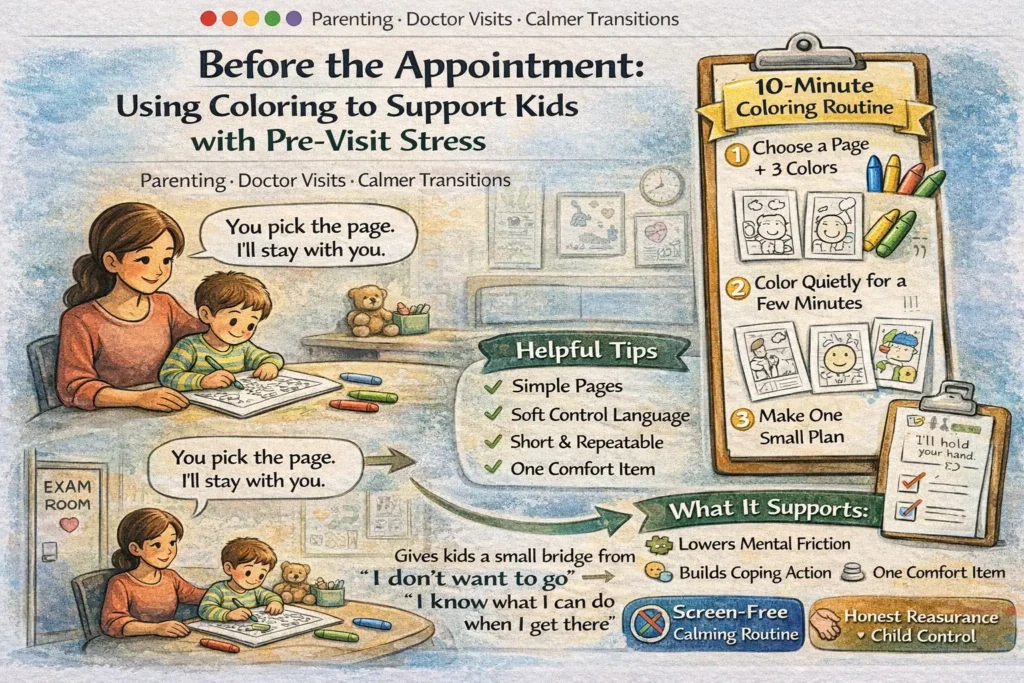
For many children, stress starts before the doctor, dentist, vaccine, or blood draw visit begins. The body hears the word “appointment” and fills in the rest: waiting room, bright lights, unfamiliar tools, maybe a pinch, maybe a cleaning, maybe something new and uncertain. That is why a short coloring routine can be useful as part of pre-visit preparation. Not because it erases fear, and not because it guarantees a smooth visit, but because it gives the child a small, predictable place to put their hands, eyes, and thoughts. In practical family life, a printable page can become a calm bridge between “I don’t want to go” and “I know what I can do when I get there.”
Why the stress often starts long before the visit
A child does not need to be inside the clinic to feel medical stress. Anticipation alone can activate it. The mind starts guessing. The body tightens first and asks questions second. That is why pre-visit tension often shows up as “random” whining, clinginess, extra silliness, refusal to get dressed, or sudden arguments over tiny things. The child is not necessarily being difficult. Often, they are trying to manage uncertainty with the tools they have.
Good preparation is not about flooding the child with information. It is about making the experience more predictable. Child-life and pediatric guidance generally emphasize developmentally appropriate explanation, coping strategies, emotional expression, and trust. In other words: tell the truth simply, give the child something active to do, and do not leave them alone with a giant blank space in their imagination.
This is exactly where coloring can fit well. A page has a boundary, a beginning, and a finish line. It is easier than a full craft, quieter than a game, and more emotionally flexible than “just calm down.” A child can put fear into colors, symbols, or tiny choices without needing adult-level language. That makes coloring a practical support tool before an appointment, when the goal is not deep processing but a more settled nervous system and a more usable plan.
Why coloring can help better than “just relax”
Relaxation instructions often fail with children because they arrive too high-level and too abstract. “Don’t worry.” “It’s fine.” “Be brave.” These phrases ask the child to leap from alarm to composure without any bridge in between. A short coloring routine can create that bridge. It turns pre-visit stress into a simple sequence: choose a page, choose a color, fill one area, finish one step. That sequence matters.
In practical terms, coloring can lower mental friction for some children. It gives the hands something to do, narrows attention, and adds a small sense of control. It also supports expression without pressure. A child may not be able to say, “I am afraid of the unknown part,” but they may circle the dentist chair in dark blue, or color the needle tiny and the bandage bright green. Those choices do not need heavy interpretation to be useful. They simply give the adult a place to join gently.
Think of coloring here as supportive preparation, not entertainment and not analysis. The goal is not “make the child forget.” The goal is “help the child approach the visit with more predictability, more control, and less internal chaos.”
This can also help parents. When adults feel rushed, they often default to either too much reassurance or too much distraction. A short coloring routine slows the moment down. It gives the parent a script, a role, and a container too.
The most helpful way to use coloring before a visit
The page matters less than the structure around it. Before a medical or dental appointment, the best pages are usually simple, choice-based, and easy to finish. This is not the ideal moment for a hyper-detailed page that invites perfection, or a huge scene that cannot be completed before leaving the house.
The child should be allowed to choose symbols, colors, and one small goal. That matters more than adult ideas about what the page “should” look like. Choice is part of regulation. When a child gets to decide, “This green is my stay-close color” or “This yellow is the bandage color,” they are not avoiding the appointment. They are rehearsing coping in a form their nervous system can use.
A good parent line sounds like this: “You can show the visit on the page any way you want.” That sentence removes performance pressure and invites honest expression. It is also far better than trying to steer the child toward “happy colors.”
A 10-minute coloring routine before the appointment
This routine is short on purpose. You are not building a therapy session. You are giving the child a repeatable transition that supports regulation, language, and cooperation.
| Minute | Child task | Parent line | What it may support |
|---|---|---|---|
| 0–2 | Choose one page and three colors | “You pick the page. I’ll stay with you.” | Starts with control and lowers decision overload |
| 2–5 | Color one easy section first | “Let’s start with the easiest part.” | Builds momentum instead of avoidance |
| 5–7 | Add one “worry color” and one “helper color” | “Which color shows the hard part? Which color helps?” | Makes feelings visible without overtalking them |
| 7–9 | Point to one detail and name one plan | “What will your hands do when we get there?” | Turns vague fear into a coping action |
| 9–10 | Put page in folder or bring it along | “This page can come with us or wait for us at home.” | Creates closure and continuity |
The parent does not need to analyze the page. The parent’s job is to keep the routine predictable, warm, and short. A child usually benefits more from one honest question and one steady presence than from ten attempts to talk them out of fear.
What to say instead of false reassurance
Before medical visits, adults often say too much or promise too much. The problem is not comfort itself. The problem is comfort that breaks trust. If the child hears “It won’t hurt at all” and then it pinches, the next visit can become harder because the fear now includes disappointment.
- Instead of: “It won’t hurt.” Try: “It may pinch or feel strange, and I’ll stay with you.”
- Instead of: “Don’t be scared.” Try: “You can be scared and still have a plan.”
- Instead of: “Be brave.” Try: “Let’s decide what your hands, breath, and eyes will do.”
- Instead of: “Stop crying.” Try: “Your body is working hard. Let’s help it.”
- Instead of: “It’s no big deal.” Try: “It feels big right now, and we can go one step at a time.”
Coloring makes these better lines easier to use. The page gives you something concrete to point to: “Show me the hard part.” “Which color is the waiting room?” “Where would the brave helper go?” That kind of question validates fear without feeding panic.
Age tweaks that keep the routine calm
Ages 3–5
Keep the page bold and simple. Big shapes, clear scenes, one character, one office, one bandage, one chair. Offer fewer words and fewer choices. Younger children often do better when the preparation is close enough to feel relevant, but not so early that they carry the worry all day. Focus on one physical plan: hold a grown-up hand, blow out slowly, or look at the page.
Ages 6–8
School-age children often want a little more detail and a little more control. They can handle a “worry color / helper color” frame, a short checklist, or a tiny script written on the page: look, breathe, squeeze, finish. They may also want to ask practical questions. Answer briefly and truthfully.
A waiting-room plan that does not depend on a screen
Screens are not automatically “bad,” but many parents already know the hidden cost of using them for every hard transition: the child may calm fast, then struggle more when the screen ends. Pediatric media guidance also tends to encourage families not to rely on a device every time a child is upset or bored, and to build calmer offline routines where possible.
For many children, a small coloring folder can be an easier waiting-room tool than fast-paced screen content because it begins and ends more cleanly. It is quieter, easier to pause, and easier to carry into the next step. It also helps keep the emotional tone of the visit more regulated: the child does not have to jump from rapid digital stimulation to a medical exam.
- 2–3 printed pages only
- 3 crayons or washable markers
- One mini clipboard or stiff folder
- One comfort item from home
- One “job” line: “When we finish this section, we’ll check in at the desk.”
If the appointment is long, rotate between tiny tasks instead of one big demand: color one corner, count five blue things, circle the helper object, trace one slow line with your finger, then return to the page. The point is not to keep the child occupied at any cost. The point is to keep the nervous system from tipping into overload before the visit even starts.
What else can support a child before a medical visit
Coloring works best as one part of a broader coping routine, not as the only strategy. Depending on the situation, it can help to pair the page with a favorite toy, a short breathing cue, a comfort position, a simple explanation of what will happen, or one predictable job for the child such as holding still hands, choosing a bandage, or deciding whether to look or look away.
For vaccine visits or other brief procedures, many pediatric resources also point to practical support tools such as comfort positioning, distraction, favorite objects, calm parent coaching, and discussing pain-management options with the clinic when relevant. That means the real goal is not to find one perfect trick. It is to create a small, honest plan the child can actually use.
When it helps to tell the clinic ahead of time
Sometimes coloring and routine are enough. Sometimes the child needs the environment adjusted too. Tell the clinic in advance if your child has a strong history of panic around shots, sensory overload, fainting, extreme avoidance, past traumatic medical experiences, or needs very concrete preparation.
Ask simple, practical questions: can we use a comfort hold, can we wait in a quieter space, can we prepare with pictures, can we bring the page into the room, and are there pain-management options we should discuss with the care team? Preparation works best when home and clinic are not working against each other.
The goal is not no fear. The goal is fear that feels held, named, and manageable enough to move through.
When this may not be enough
A short coloring ritual is usually most useful for mild to moderate anticipatory stress. It may be less helpful on its own when a child has repeated panic reactions, extreme distress before every visit, severe sensory overload, fainting, strong avoidance that disrupts family routines, or anxiety that stays active for days or weeks around medical care.
In those cases, it is worth speaking with the pediatrician or clinic team ahead of time. Some children do better when the plan includes extra preparation, visual supports, procedural coaching, child-life support, or a more individualized coping strategy.
FAQ
1) Can coloring really reduce pre-visit stress in kids?
It can help because it adds predictability, choice, and a concrete coping task. It will not remove all fear, but for many children it can lower mental friction and make the child easier to guide through the next step.
2) What kind of coloring page works best before a doctor or dentist visit?
Use simple, finishable pages: one scene, one character, one office, a body outline, a brave-character page, or a “find and color” page. Avoid highly detailed pages right before leaving if your child tends toward frustration or perfectionism.
3) Should I tell my child the appointment may hurt?
Use honest, simple language. Saying that something may pinch, sting, or feel strange is usually better than promising it will not hurt at all. Trust matters, especially for future visits.
4) What if my child refuses to color?
Do not force the page. Offer a very small version of the same function: circle one picture, choose one helper color, trace one line, or point to the “hard part.” The regulating part is the structure and the choice, not the amount of coloring completed.
5) Is it better than using a phone in the waiting room?
For many children, an offline activity can create a gentler transition because it is easier to pause and easier to carry into the exam room. A phone may calm quickly, but the next transition can feel sharper when the device stops.
6) Can this routine help before vaccines or blood draws too?
Yes. It can be especially useful when paired with an honest script, a comfort item, distraction, and a clear plan for breath, body position, and what the child’s hands will do during the procedure.
7) When is pre-visit anxiety big enough to talk to the clinic ahead of time?
Reach out early if your child has intense panic, strong sensory overload, previous traumatic procedures, fainting, or escalating avoidance. Small environmental changes can make a big difference when planned ahead.
Sources (primary references)
Psychologist Note: Fear Works Better When It Is Named, Not Argued With
Why validation matters clinically
Children do not calm down because an adult says, “There is nothing to worry about.” They calm down when their internal experience becomes more understandable and more manageable. Before appointments, fear is often not only about pain. It may be about loss of control, the unknown sequence, body exposure, sensory intensity, embarrassment, or the memory of a previous difficult visit. When adults rush to erase fear, the child may feel even more alone inside it.
How coloring helps without becoming avoidance
Coloring is most useful when it stays connected to the real event. That means the page should not be used to pretend the appointment does not exist. It works best when it becomes a gentle rehearsal space: the child chooses symbols, colors, and one coping action. In this form, coloring can support regulation and agency rather than denial.
This approach tends to work best for mild to moderate anticipatory stress. If a child repeatedly moves into panic, severe shutdown, or strong medical avoidance, the family may need more than a home routine. In those cases, additional support from the pediatric team or a mental health professional may be more appropriate.
- Validate first: “It makes sense that your body feels worried.”
- Let the child choose: one symbol, one “hard” color, one “helper” color.
- Avoid false reassurance: do not promise zero pain or a perfectly easy visit.
- Praise coping, not performance: notice planning, finishing, breathing, asking for help, or returning after discomfort.
- Close the loop afterward: let the child color one small “done” mark, sticker, or final shape after the visit.
The most supportive message is often very simple: “You do not have to feel calm first. We can help your body get through this step by step.” That is the real value of a pre-visit coloring ritual. It does not demand bravery as a personality trait. It teaches bravery as a sequence of doable actions.