Bedtime Coloring Routines: A Screen-Free Way to Wind Down Before Sleep
Bedtime routines work best when they reduce stimulation instead of adding one more thing to complete. That is exactly why coloring can be such a useful evening ritual. It is tactile, quiet, finite, and easy to repeat without the endless pull of a screen. Used well, bedtime coloring is not about neatness, productivity, or finishing the page. It is a calming transition that helps the body slow down, helps the room feel softer, and makes the last part of the day more predictable. With warm light, simple pages, a small set of tools, and no pressure to “do it right,” coloring can become a reliable bridge between daytime energy and nighttime rest.
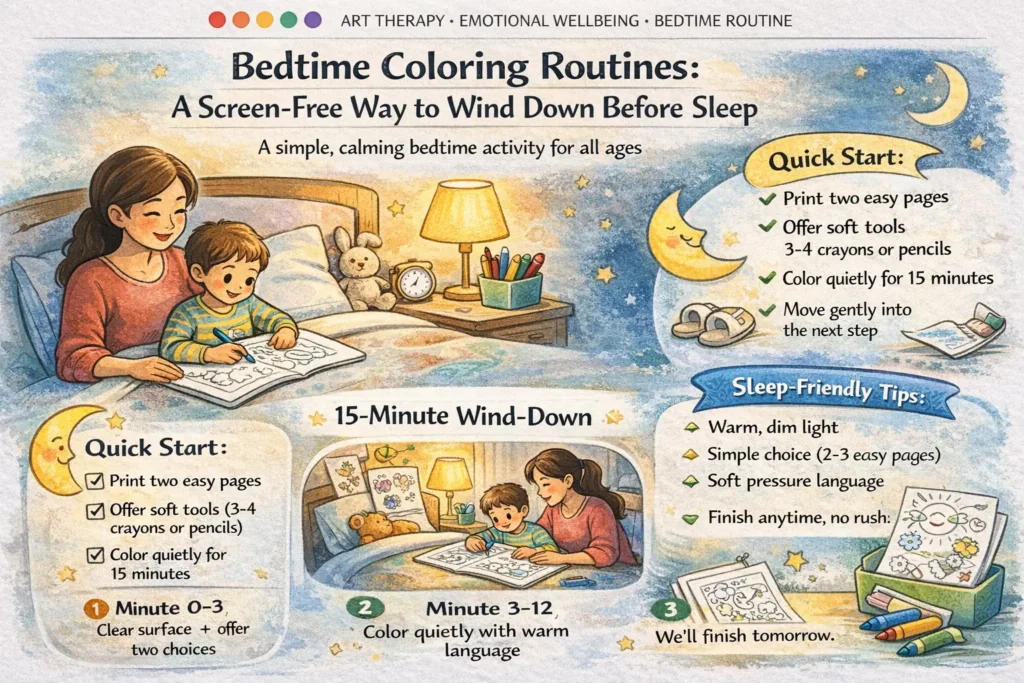
Put screens away, dim the room slightly, offer one or two easy pages, set out two to four soft crayons or pencils, and use one simple line: “We’re coloring for a few quiet minutes, not trying to finish.” Then move straight into the next bedtime cue.
Good bedtime routines are predictable, low-demand, and easy to repeat. Coloring fits because it narrows attention gently, gives the hands something steady to do, and has a visible stopping point.
Why bedtime coloring works as a transition, not a task
A lot of evening activities look relaxing in theory but still keep the household switched on. Fast videos, bright phones, noisy games, unfinished homework checks, or overcomplicated crafts can all send the message that the day is still active and unfinished. Bedtime coloring works differently when it is framed correctly. It asks for light focus, repeated hand movement, and a small, contained area of attention. That combination often helps the mind narrow without turning the activity into a new performance demand.
The value here is not abstract “mindfulness.” It is the structure. The same seat. The same general time. The same few pencils. The same soft expectation. That repetition matters because predictable evening cues lower negotiation and reduce decision fatigue. Families are often not looking for one more clever idea at night. They are looking for something calm enough to repeat on ordinary weekdays.
Coloring is also useful because it is visibly finite. A printable page has edges. The activity begins, continues for a short time, and pauses without the endless loop of streaming, scrolling, or fast app-based stimulation. For children, that visible boundary can make bedtime feel less open-ended and less emotionally messy. For adults, it reduces the burden of inventing one more activity from scratch.
- Harder transitions when a device is turned off.
- Restless mood after fast content: tired, but not settled.
- Lower tolerance for slow tasks like books, puzzles, or quiet play.
- More bargaining around “just one more minute.”
- Bedtime drift because nothing clearly signals closure.
A single page removes part of the adult planning load. You are not inventing a whole craft, gathering many materials, or explaining new rules late in the day.
Most families can realistically manage a page and a few crayons on a normal weeknight. That matters because routines only help when they are actually repeatable.
Bedtime coloring does not replace daytime play, movement, art, or imagination. It serves a narrower role: it helps the household move from stimulation toward settling.
The “15-minute wind-down” routine
The goal is not perfect coloring. The goal is a short and predictable sequence that helps the evening downshift.
- Minute 0–2: Clear one small surface. Put out only the tools you are willing to manage.
- Minute 2–3: Offer two page choices, not a full stack. Too many options keep the brain alert.
- Minute 3–12: Color quietly. Keep the mood warm and low-pressure. No correcting and no “stay inside the lines.”
- Minute 12–14: Ask one soft question: “Which part feels nicest?” or “Which color felt calm tonight?”
- Minute 14–15: Stop while it still feels easy. Put the page away and move directly to the next bedtime step.
| Minute | Child task | Adult role | What it supports |
|---|---|---|---|
| 0–3 | Choose one page and a few tools | Offer two options and set the calm frame | Predictability + low decision load |
| 3–12 | Color quietly | Stay nearby and keep the room steady | Attention + slower pacing |
| 12–14 | Share one favorite detail | Ask one warm question, no fixing | Connection without evaluation |
| 14–15 | Put the page away | Guide the transition forward | Closure + bedtime momentum |
What makes this routine effective is rhythm, not exact timing. When the sequence repeats over days and weeks, the page becomes one cue in a chain: calmer light, quiet surface, short coloring time, page away, next bedtime step. That chain reduces friction because bedtime no longer has to be invented from zero every night.
Sleep-friendly setup: what helps and what to skip
The same coloring activity can be soothing in one setup and activating in another. Bright overhead light, ten markers, a highly detailed page, and pressure to finish create a very different experience from a warm lamp, three crayons, an easier page, and permission to stop whenever the body is ready.
- Warm, soft, sufficient light that feels evening-like without causing eye strain.
- Two to five soft tools instead of a giant marker set.
- Simple pages with larger shapes and open space.
- Process language: “We color for a few quiet minutes.”
- Harsh light or lighting so dim it becomes irritating.
- Highly stimulating materials that invite speed and excitement.
- Tiny detailed pages that pull the child into precision mode.
- Outcome pressure: “finish it,” “make it neat,” “stay in the lines.”
Bedtime coloring should feel like a soft landing, not late-night art class.
This matters especially for children who already struggle with bedtime transitions. If the evening has become the part of the day where pressure, rushing, and bargaining pile up, even a good activity can stop helping when too much performance meaning is attached to it. A calmer setup protects the function of the routine.
Why “finish the page” pressure often ruins the calming effect
Many bedtime struggles are not caused by the page itself. They are caused by the meaning attached to it. The moment coloring becomes another thing to do correctly, the activity can shift from settling to guarding. A child may erase, restart, freeze, or become upset by tiny slips. An adult may keep going long after feeling tired because the page feels unfinished. That is not wind-down behavior. That is bedtime activation dressed up as diligence.
Sleep-friendly routines lower stakes. The page can be half-colored. A section can remain blank. The colors do not need to match. The strongest bedtime message is: nothing bad happens if we stop here. That message is especially important for children who are sensitive to mistakes or who turn quiet activities into self-tests.
- “You can stop at any point.”
- “The page will still be here tomorrow.”
- “We are coloring to get cozy, not to complete it.”
- “There is no wrong way to pause for tonight.”
Lowering bedtime pressure does not mean lowering all standards forever. It simply means bedtime is the wrong place to turn a page into a performance test. Skill-building can happen at another time of day. The late evening needs a different job from the activity.
Age tweaks that keep the routine calm
One of the easiest mistakes is treating every age the same. Bedtime coloring works best when the page, timing, and expectations match the child’s developmental level.
Use big shapes, bold outlines, short coloring time, and very few tools. This age group usually regulates better with less complexity, not more.
Add a little more choice, but keep it contained. Two pages are often enough. Slight challenge is fine, but the child still should not need adult rescue to continue.
More detailed pages can be enjoyable, but bedtime is still not the ideal moment for perfection-heavy designs that tighten the jaw, speed up the pace, or trigger frustration.
Two easy modes that keep the page gentle
Script: “Pick one shape and color it very slowly.” This works well when the child is restless and needs a very small starting point.
Script: “Choose two parts to color first.” This helps scattered attention without turning the page into a lesson or a test.
These prompts work because they are concrete. At bedtime, many children do better when adults say less, simplify more, and keep the activity emotionally light.
When bedtime coloring is not the right tool
Bedtime coloring can help many families, but it is not universal. A routine is only useful if it actually lowers arousal for that specific child. Some children find fine-motor tasks frustrating, some are highly sensitive to tactile input, and some interpret every quiet activity as something that must be done “right.” In those cases, coloring may not calm the system at all.
Coloring may be less helpful for children who become rigid about mistakes, children who dislike the sensory feel of the tools or paper, or children who escalate when asked to do seated fine-motor work late in the day. Another repetitive low-demand routine may fit better: listening to a story, cuddle-and-read time, simple building, or another quiet transition activity.
- Difficulty falling asleep on multiple nights per week for several weeks.
- Nightmares that regularly increase bedtime fear or avoidance.
- Panic-like distress at bedtime that does not improve with simpler structure.
- Daytime exhaustion that suggests sleep disruption is affecting functioning.
- Escalating perfection distress where the page repeatedly triggers shutdown, anger, or refusal.
In those situations, bedtime coloring can still remain a gentle support, but it should not be expected to solve the whole problem. It is better understood as one part of a broader sleep, regulation, or mental health conversation.
FAQ
1) How long should a bedtime coloring session last?
Usually 8 to 15 minutes is enough. The goal is transition, not a long art block. Stop while the activity still feels easy and before the child shifts into fixing mistakes.
2) Is coloring before bed only for children?
No. Teens and adults can use it too. The same rule applies across ages: bedtime coloring should stay simple, low-pressure, and calming.
3) Are markers a bad choice for bedtime?
Not always, but softer tools are often better at night. Some marker sets feel visually loud or increase sensory intensity before sleep.
4) What if the child insists on finishing the whole page?
Normalize stopping: “We can leave it for tomorrow.” If this keeps happening, choose easier pages and shorten the session so it ends before frustration builds.
5) What are good signs the routine is actually helping?
Look for observable changes: less bargaining, softer voice, fewer restarts, easier movement into the next bedtime step, and calmer lights-out.
6) Can bedtime coloring replace other sleep habits?
No. It works best inside a broader sleep-friendly routine with steady timing, reduced stimulation, calmer lighting, and predictable transitions.
7) What if coloring makes my child more upset?
That is useful information. It may mean the page is too detailed, the session is too long, the lighting is irritating, or coloring is simply not the best bedtime tool for that child.
Sources (primary references)
What bedtime coloring distress often means in practice
When a child becomes upset over small coloring slips in the evening, the page is rarely the whole problem. More often, bedtime has already become a high-pressure transition, and coloring becomes the place where that pressure shows up visibly. Signs can include a tight grip, repeated checking, restarting, shallow breathing, irritability over tiny lines, or urgent requests to erase and redo.
How adults can help without feeding the perfection loop
The most useful adult stance is warm, steady, and low-stakes. Instead of praising neatness or rescuing the page too quickly, reduce the pressure: “That part feels annoying. We can pause here.” A better sign of progress is not prettier coloring. It is faster recovery: fewer restarts, less checking, and more willingness to stop without distress.
- Keep sessions predictable: short, repeatable routines usually regulate better than long and ambitious ones.
- Use observable markers: softer voice, easier transition, less bargaining, smoother lights-out.
- Watch the threshold: if bedtime problems happen on multiple nights per week for several weeks, the issue may be larger than routine design.
Red flags worth taking seriously
Bedtime coloring is a support tool, not a treatment for persistent sleep problems. A broader conversation is worth considering when there is ongoing difficulty falling asleep, repeated nightmares that increase bedtime avoidance, or panic-like bedtime distress that does not improve after routine simplification.