Art Therapy vs Coloring Books: Where Self-Care Ends and Therapy Begins
People often ask: art therapy vs coloring—are they the same thing? And is coloring art therapy if it makes you calmer? This guide separates marketing language from clinical reality, so you can enjoy therapeutic coloring for wellbeing without confusing it with therapy.
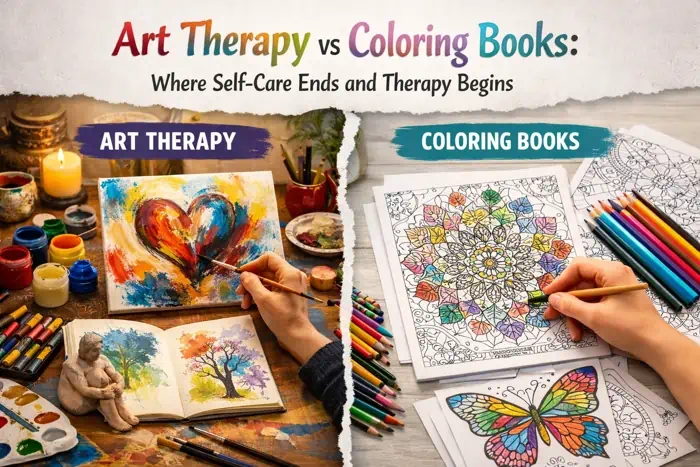
Clear disclaimer: Mimi Panda is a creativity and coloring resource—not a therapy service. Coloring tools can support relaxation and self-care, but they do not diagnose, treat, or replace mental health care. If you feel unsafe, overwhelmed, or unable to function, seek professional help or contact your local emergency number.
One sentence that solves the confusion: Coloring can be therapeutic (it may help you feel better), while art therapy is a structured mental health service delivered by a trained professional.
The quick definitions (no jargon)
What art therapy actually is
Art therapy is a mental health profession. It happens inside a professional relationship, with a therapist trained in psychology + art-based methods, and it targets clinical goals (for example: trauma processing, emotion regulation, coping skills, communication).
- Who leads it: a credentialed / licensed art therapist.
- What makes it “therapy”: assessment, goals, ethics, documentation, and therapeutic relationship.
- What you do: you create (draw, paint, collage, clay, mixed media) and reflect with guidance.
What therapeutic coloring is
Therapeutic coloring (including adult coloring books, mandalas, pattern pages, or printables) is typically a self-guided wellbeing practice. It can support relaxation, attention, and mood—especially as a short reset in a stressful day.
- Who leads it: you (or a group leader, teacher, nurse, etc.—not necessarily a therapist).
- What it targets: self-care, calm, focus, “flow,” gentle structure.
- Where it shines: as a low-barrier creative habit that’s easy to repeat.
A simple “continuum” to locate yourself
Instead of a yes/no argument, it helps to see coloring and art therapy on a continuum—from everyday self-care to professional treatment. The key shift is not the paper or pencils; it’s the presence of clinical intent and a therapeutic relationship.
Where therapy begins: when a trained clinician uses art-making in a psychotherapeutic relationship toward clinical goals.
Why people confuse “adult coloring” with art therapy
1) The word “therapy” is used casually
In everyday speech, “that was therapeutic” can simply mean “that helped me feel calmer.” In clinical care, therapy is a structured service with professional responsibility and ethical standards.
2) Products are sometimes marketed as “art therapy”
Some adult coloring books, apps, and workshops use “art therapy” as a label. That can blur a line that matters—especially for people seeking help for trauma, severe anxiety, depression, or grief.
3) Both can feel calming—and that’s real
Coloring can reduce stress for many people. That does not make it “fake” or “pointless.” It simply means it fits best under mental health self care, not clinical treatment.
4) Art therapists may use coloring—carefully
In some contexts, an art therapist might include structured coloring as a warm-up or regulation tool. The difference is the clinical container: therapist oversight, goals, and how the activity is processed.
Key idea: Feeling better is a valid outcome. But therapy is defined by relationship, training, and clinical intent—not by a product name.
Keep reading: the “how to tell the difference” checklist + comparison table appears below.What art therapy is (in the real world)
Art therapy is not “doing art because it’s relaxing.” It is a mental health profession where a client and a licensed / credentialed art therapist work together using art materials and reflection to pursue specific therapeutic goals. In other words, art-making becomes a language—and the therapist helps you use that language safely and effectively.
The three elements that make it therapy
- 1) A therapeutic relationship: trust, confidentiality, boundaries, and a clinician who can hold difficult material.
- 2) Clinical intent: the session is guided by goals (coping skills, insight, trauma processing, social functioning, etc.).
- 3) Professional responsibility: ethics, scope of practice, documentation, and referral when needed.
“Coloring activities must be distinguished from art therapy services provided by a credentialed art therapist.”
— Professional guidance summarized from the American Art Therapy Association’s public education materialsWhat happens in a typical session
Sessions vary by setting (private practice, school, hospital, rehab, community clinic), but the structure is often similar:
- Check-in: what’s happening today, what you want help with, what feels safe to explore.
- Art-making: the therapist chooses or co-creates an approach (open-ended, directive, trauma-informed, sensory-based, etc.).
- Reflection: you explore meaning, emotions, body signals, memories, and patterns—without forcing interpretation.
- Integration: coping steps, grounding strategies, or “between-session” supports.
Importantly, art therapy is not about producing “good art.” It is about using the creative process to access and transform inner experience.
Who provides art therapy (credentials that matter)
Terms vary by country and state, but in the U.S. you will commonly see professional credentials such as ATR and ATR-BC (and/or state licensure where applicable). A trained provider has graduate-level preparation plus supervised clinical hours.
- Look for: “art therapist,” “licensed art therapist,” “registered art therapist,” or board certification indicators.
- Ask directly: “What is your training? Are you credentialed? What populations do you specialize in?”
- Red flag: “Art therapy” offered with no clinical training, no ethics framework, and no referral pathways.
If you’re unsure, use a professional directory (for example, the American Art Therapy Association’s locator) and verify credentials with recognized boards.
Why “adult coloring art therapy” is a risky label
Calling a product “therapy” can create false expectations—especially when someone is struggling with serious symptoms. It can also unintentionally discourage people from getting appropriate help, because they assume a book is an equivalent substitute for care.
Where the risk shows up: if coloring becomes avoidance (“I can’t face my panic/trauma/grief, so I only numb out”), or if it triggers distress (intrusive memories, shame spirals, self-criticism, dissociation), that’s a signal to seek professional support.
Two truths can coexist
- Truth #1: Coloring can be calming, stabilizing, and genuinely supportive for daily stress.
- Truth #2: Art therapy is a clinical service that involves assessment, goals, and a therapeutic relationship.
“We all have our own ways of zoning out… And that’s fine. But art therapy is so much more.”
— Donna Betts (art therapy educator; quoted in a university feature about the difference)Therapeutic coloring: what evidence suggests (and what it doesn’t)
If you’re searching is coloring art therapy, it helps to reframe the question: Can coloring support wellbeing? For many people, yes—especially as a short, repeatable way to downshift stress. But the evidence generally supports it as adjunct self-care, not a replacement for psychotherapy.
Evidence snapshot (plain-English): Controlled studies in clinical and community settings often find short-term reductions in self-reported anxiety after structured coloring (frequently mandala/pattern tasks). Results vary by population, context, and how outcomes are measured.
Why coloring can feel regulating
- Attention anchoring: focusing on lines + color choices can reduce rumination.
- Predictable structure: “within-the-lines” tasks lower decision fatigue when you’re stressed.
- Flow moments: steady progress can create a sense of control and calm.
- Body cues: slower breathing and steadier hand movements can support down-regulation.
A tiny chart: short-term anxiety change (example from a randomized trial)
In one randomized placebo-controlled emergency department study, the coloring group reported a larger short-term decrease in anxiety scores than placebo. The chart below illustrates the reported change at two hours (lower is better).
Comparison table: Art therapy vs therapeutic coloring
| Category | Art therapy | Therapeutic coloring (self-care) |
|---|---|---|
| Primary goal | Clinical change: coping skills, insight, trauma processing, functioning, symptom reduction—guided by a treatment plan. | Regulation and wellbeing: calm, focus, routine, enjoyment, mindful breaks. |
| Setting | Clinical or therapeutic setting (private practice, hospital, school services, rehab, community clinic). | Anywhere: home, workplace break, travel, group hobby sessions, wellness spaces. |
| Who provides it | Licensed / credentialed art therapist (training + ethics + supervision + scope of practice). | You (or a non-clinical facilitator). No clinical responsibility is assumed. |
| Process | Art-making + reflection with therapeutic guidance; interventions matched to your needs and readiness. | Pre-drawn designs; low-pressure repetition; self-paced; optional journaling/reflection. |
| Risks | Managed clinically (safety planning, pacing, containment, referrals). Therapist monitors distress and progress. | Usually low risk, but can become avoidance or trigger distress; no built-in clinical support. |
| Best for | Persistent symptoms; trauma; grief; major life transitions; communication difficulties; when you want structured help. | Daily stress; mild anxiety; focus breaks; building a gentle creative habit; supporting other care. |
Where self-care ends and therapy begins: a practical checklist
Use coloring for self-care—but treat these signs as a cue to involve a professional (not as something to “push through alone”).
Consider a licensed professional (and specifically a licensed art therapist if you want art-based care) if:
- Symptoms persist for weeks and interfere with sleep, work, relationships, appetite, or basic routines.
- You experience panic, intrusive memories, dissociation, self-harm urges, or escalating substance use.
- Coloring becomes the only coping method and you can’t function without it.
- You feel worse after creative activities (shame spirals, self-criticism, overwhelm, emotional flooding).
- You want to work on trauma, grief, addiction, or longstanding patterns—beyond stress relief.
How to use coloring responsibly as self-care
- Make it small: 10–20 minutes is enough to reset; stop before fatigue.
- Choose the right difficulty: too intricate can become frustrating when you’re already stressed.
- Use a “gentle prompt”: “What color feels safe right now?” or “What would calm look like?”
- End with grounding: name 3 things you see, 2 things you feel, 1 thing you hear.
- Track impact: “Before: 7/10 stress → After: 5/10.” If it’s not helping, switch tools.
If you’re already in therapy, ask your therapist how coloring could fit into your plan—especially for regulation between sessions.
Internal links (Mimi Panda reading path)
If you want to go deeper into self-care coloring (without calling it therapy), these two posts fit naturally here:
Primary sources (official, world-class)
Links below are included for transparency and fact-checking. These are not endorsements of any single intervention for any individual case.
- American Art Therapy Association (AATA): About Art Therapy
- American Art Therapy Association (AATA): What is Art Therapy?
- Art Therapy Credentials Board (ATCB): Credentials overview
- NIH / PubMed: Randomized trial (adult coloring in emergency department)
- NIH / PubMed Central: Review on art therapy for anxiety in adults


Where Self-Care Ends and Therapy Begins: A Licensed Psychologist’s Comment
Comment by Yevheniya Nedelevych Licensed Psychologist (Ukraine)
Educational use only. This commentary does not create a psychologist–client relationship. This is not a clinical assessment and does not replace individualized mental health care. This is not an endorsement of any product or service.
How color choices can support emotional wellbeing
Color choices in drawings can support emotional literacy because they help children externalize feelings and talk about them safely. In professional practice, color is never “proof” of a specific emotion—its meaning depends on the child’s context, culture, and the story they attach to the image. Used gently, color-focused prompts can improve self-awareness and self-regulation without turning art into a test.
How to use this safely at home
When professional help may be needed
Consider speaking with a licensed professional if you notice any of the following patterns:
If you’re unsure, it’s okay to ask for guidance—early support can make coping skills easier to build.